
TOMI Environmental: Specialized Disinfection Technology Meets Persistent Financial Pressure
TOMI Environmental Solutions, Inc. operates at the intersection of environmental safety and biotechnology, leveraging proprietary disinfection platforms like SteraMist for niche applications such as honeybee virus control. Despite industry recognition and incremental revenue growth, the company remains challenged by recurring net losses and reported liquidity position, raising essential questions about its path to sustainable scale.
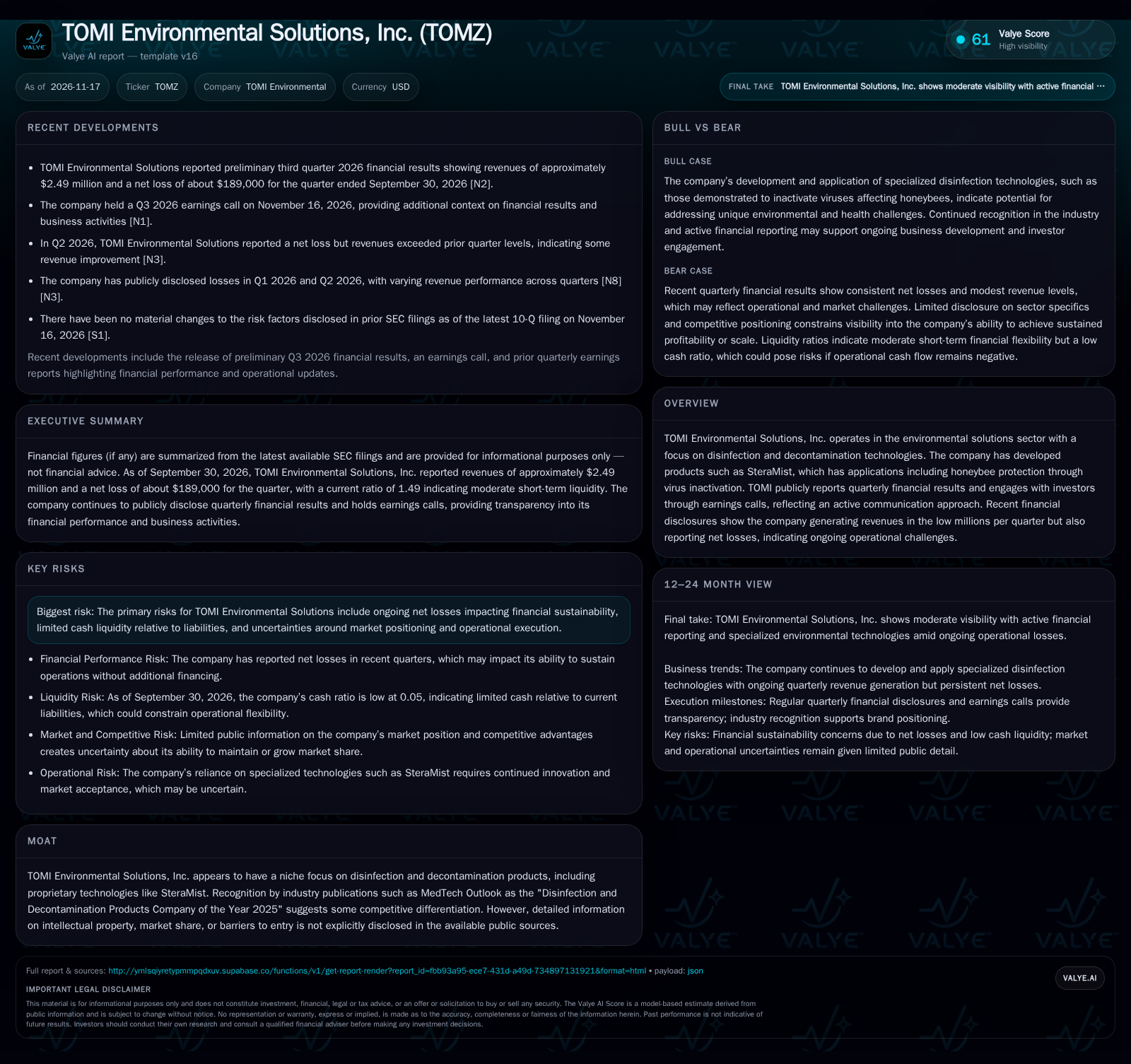
TOMI Environmental Solutions is recognized for its proprietary disinfection technologies, including SteraMist, with applications from healthcare to agriculture.Recent quarters show incremental revenue improvement but ongoing net losses and a reported cash ratio, placing financial sustainability in question. [S1] [N2] [N3]
TOMI Environmental Solutions, Inc. stands out for its focus on advanced disinfection and decontamination technologies, notably the proprietary SteraMist platform, which targets unique challenges such as honeybee virus inactivation. Despite earning industry awards and showing some revenue improvement in 2026, TOMI continues to report net losses and operates with minimal cash reserves. This combination of technical promise and financial vulnerability sets the stage for a business that must rapidly translate innovation into sustainable commercial outcomes—or face escalating operational risk.
Where TOMI Stands: Recent Results and Financial Position
As of September 30, 2026, TOMI Environmental reported quarterly revenue of approximately $2.49 million and a net loss of about $189,000, continuing a multi-quarter trend of operating losses. TOMI’s recognition as "Disinfection and Decontamination Products Company of the Year 2025" signals industry validation, but there have been no material changes to previously disclosed risk factors, leaving the company’s financial and operational uncertainties unresolved. [S1] [N2] [N3]
How TOMI’s Business Model Could Scale—And What Might Hold It Back
TOMI’s business model centers on the commercialization of proprietary disinfection technologies—specifically, the SteraMist platform. Revenue streams plausibly include direct product sales, consumables, and potentially recurring service or maintenance contracts, especially if SteraMist devices require ongoing support or proprietary refills. However, the company has not disclosed contract structures or the proportion of recurring versus one-time sales, making revenue visibility uncertain.
The economics of such a model typically depend on a mix of upfront hardware sales, recurring consumables or service revenue, and the ability to leverage fixed R&D and regulatory costs over a growing installed base. High gross margins are plausible for consumables and service contracts, but hardware sales may be more competitive and lower-margin. Working capital requirements could also become acute if sales cycles are long or if customers delay payments.
Thus, the company’s path to operating leverage likely requires a shift toward higher-margin, recurring revenue streams and a larger installed base—both of which may require upfront investments or partnerships that its current cash position makes difficult.
A critical factor influencing TOMI’s scalability is the capital intensity associated with both product development and regulatory compliance. Proprietary disinfection technologies often require ongoing investment in R&D to maintain efficacy against evolving pathogens and to meet increasingly stringent safety standards. This dynamic creates a double-edged sword: while continuous innovation can sustain competitive advantage, it also demands consistent funding, which may be challenging given TOMI’s current financial constraints. Strategic partnerships or licensing agreements could mitigate some of these burdens by sharing costs or accelerating market access, but these arrangements typically require upfront negotiation and alignment of incentives.
Differentiation in a Crowded Disinfection Market: Strengths and Threats
TOMI’s strength lies in its niche technology focus and the ability to address specialized problems—such as virus inactivation in honeybee populations—where off-the-shelf solutions may be lacking. Recognition by MedTech Outlook suggests a degree of technical credibility and industry awareness. However, the broader disinfection and decontamination market is fiercely competitive, with established players offering a range of chemical, UV, and advanced oxidative technologies.
Without disclosed details on intellectual property protections, installed base, or customer retention, it remains unclear whether TOMI’s differentiation translates into sustainable barriers to entry. Competitors may be able to replicate or substitute similar outcomes, especially if price or regulatory approval becomes a deciding factor for institutional buyers. Additionally, if customers perceive switching costs as low, TOMI’s ability to build recurring revenue could be limited by price competition or new entrants targeting its niches.
Ultimately, the company’s competitive position hinges on its ability to demonstrate superior efficacy, regulatory compliance, and ease of integration—none of which are fully detailed in the available disclosures.
Unlocking SteraMist’s Full Potential: What a Breakout Would Look Like
A favorable scenario for TOMI would see its proprietary SteraMist technology adopted as a standard in targeted high-need applications—such as apiaries, healthcare settings, or biocontainment facilities—resulting in a growing installed base and the emergence of predictable, recurring consumables or service revenue. This would drive higher gross margins, better working capital dynamics, and the ability to leverage fixed costs across a larger revenue base.
Evidence that would confirm this bullish trajectory includes public disclosure of multi-year customer contracts, recurring revenue percentages, large-scale deployment partnerships, or regulatory wins that position TOMI as a preferred solution provider. Sequential improvements in both revenue and gross margin, alongside narrowing net losses and rising deferred revenue or backlog, would further corroborate a breakout scenario.
Conversely, failure to secure such commercial anchors or to expand the installed base would falsify the upside case and indicate that the technology, while innovative, is not gaining sufficient market traction.
In scenarios where TOMI successfully leverages its technical differentiation, economies of scale could emerge through expanded manufacturing capabilities and streamlined distribution channels. As the installed base grows, the fixed costs associated with production and regulatory compliance would be spread over higher volumes, improving gross margins and cash flow. Additionally, establishing a robust recurring revenue model—such as subscription-based consumables or maintenance services—would enhance predictability and reduce reliance on cyclical hardware sales. This transformation would also increase customer lifetime value and create barriers to entry for competitors, reinforcing TOMI’s market position.
Incremental Progress Amid Financial Constraints: The Most Likely Course
The most plausible path for TOMI over the next 12–24 months is one of modest revenue growth from niche applications and continued industry engagement, but persistent operating losses due to insufficient scale and constrained resources. The company may secure periodic sales wins—potentially aided by its technical differentiation and industry accolades—but is likely to face headwinds converting these into sustainable, recurring revenue streams without additional external funding or a major commercial breakthrough.
Confirming evidence for this middle path would be continued quarterly revenue in the low millions, ongoing net losses, and steady but unspectacular customer acquisition or partnership announcements. The absence of significant capital raises, major contract wins, or recurring revenue disclosures would reinforce the view that TOMI is making incremental, but not transformative, progress.
Financial Strain Escalates: When Innovation Isn’t Enough
If working capital needs outpace available liquidity, TOMI could be forced to scale back operations, lose key talent, or miss critical delivery deadlines—undermining customer trust and eroding any competitive differentiation.
This scenario would be confirmed by sharp declines in revenue, widening losses, or disclosures around going-concern risk or emergency financing. Missed product shipment deadlines, layoffs, or customer defections would also signal that the company’s operational and financial challenges are becoming existential rather than merely transitional.
What Will Prove TOMI’s Ability to Turn Technical Strength into Durable Value?
Quarterly gross margin trends—particularly any improvement attributable to a higher mix of consumables or recurring service revenue—would help test the company’s ability to scale profitably.
Disclosure of multi-year customer contracts or recurring revenue percentages, if provided, would clarify revenue visibility and operating leverage.
Evidence of new capital raised, credit facilities secured, or strategic partnerships formed would indicate whether TOMI can address its liquidity constraints and fund growth.
Updates on regulatory approvals, new market entries, or large-scale deployments of SteraMist technology would suggest progress in market penetration.
Product development milestones—such as new applications for SteraMist or expanded IP protection—would shed light on TOMI’s capacity for innovation and sustained differentiation.
Customer retention or churn rates, if disclosed, would help assess switching frictions and the stickiness of TOMI’s installed base.
Any signals of cost-cutting, layoffs, or changes to supplier relationships would be early warnings of escalating financial stress.
Disclaimer: This is research-only, informational analysis and not investment advice. It may include AI-generated interpretation and general industry context. Always verify important details using primary sources.

Comments