
Expion360: Battery Ambition, Customer Concentration, and the Uncertain Foray into Oil & Gas
Expion360’s core lithium-ion battery business faces tight customer concentration and supply chain dependencies just as it expands into the high-risk, single-well oil and gas sector.
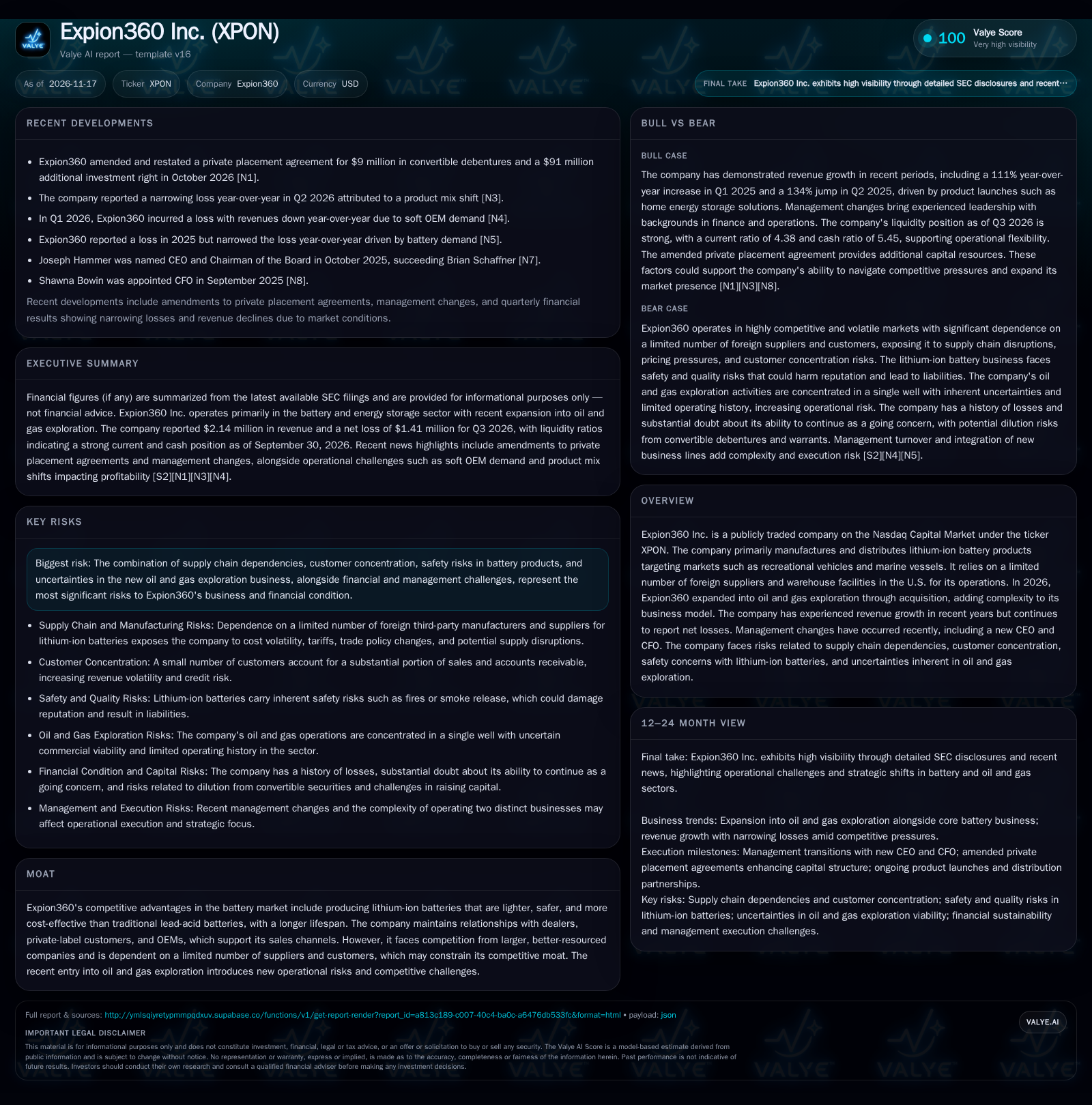
Expion360 remains fundamentally a lithium-ion battery company targeting RV and marine markets, but its recent move into oil and gas exploration adds operational complexity and risk. The business is exposed to customer and supplier concentration, safety issues, and ongoing losses despite a strong Q3 2026 liquidity snapshot. The company’s future hinges on its ability to diversify its customer base, manage supply chain volatility, and extract value from its oil and gas venture—all under new executive leadership. [S2]
Expion360 stands at a strategic crossroads, balancing its ambitions as a lithium-ion battery supplier to RV and marine markets with a bold, high-stakes entry into oil and gas exploration. The company’s Q3 2026 results reflect ongoing losses and a highly concentrated customer base, even as it reports reported liquidity position. With new executive leadership and a business model now straddling two volatile industries, Expion360 faces both the challenge and opportunity of redefining its growth narrative—if it can navigate execution pitfalls and deliver on diversification.
Concentration, Expansion, and Recent Losses Define the 2026 Backdrop
Expion360’s Q3 2026 financials reveal a net loss of $1.41 million on $2.14 million in revenue, reflecting ongoing challenges in achieving profitability despite some year-over-year improvement. Four customers represented approximately 60% of gross sales and 69% of accounts receivable at year-end 2025, leaving the business acutely exposed to the buying patterns and credit health of a handful of counterparties. [S2]
The company’s supply chain is similarly concentrated: 55% of 2025 inventory purchases came from foreign suppliers in Asia, tying operational continuity to a limited set of partners and exposing the business to tariff, geopolitical, and cost risks. [S2]
In August 2026, Expion360 acquired a single oil and gas prospect, marking its first foray outside batteries. The commercial viability of this well remains highly uncertain, and the company lacks a track record in the sector. [S2]
Leadership has also shifted, with a new CEO and CFO appointed in the past year—Joseph Hammer and Shawna Bowin, respectively—potentially altering strategic direction and operational discipline. [S1] [S2] [N7] [N8]
How Expion360’s Revenue Model and Cost Structure Could Evolve
Expion360’s core revenue comes from manufacturing and distributing lithium-ion batteries, primarily for RV and marine markets. The business is characterized by a high degree of fixed costs (assembly, warehousing, R&D) and variable costs tied to component procurement, with the latter heavily influenced by supplier pricing and logistics volatility. Gross margins in battery manufacturing are typically sensitive to input costs, volume leverage, and product mix—premium, higher-capacity batteries may command better margins but require greater sales effort and working capital.
The reliance on a few large customers means pricing power is limited; any shift in their demand or negotiating stance can sharply impact realized ASPs and margin mix. Expion360’s concentration on a handful of Asian suppliers further constrains its ability to manage COGS, as alternative sourcing may be difficult or costly if disruptions occur.
The new oil and gas segment introduces fundamentally different economics: high upfront capital for exploration, long payback periods, and binary outcomes (commercial success or dry well). With only a single well and no established production, near-term cash flows from this segment are highly speculative. The company reported cash and liquidity metrics for the period; these figures do not by themselves establish operating runway, investment capacity, financial flexibility, or financing capacity. [S2]
Assessing Expion360’s Strategic Position in Batteries and Oil & Gas
In the lithium-ion battery space, Expion360 competes against larger, better-capitalized players with broader product portfolios and deeper distribution networks. Its differentiation rests on offering lighter, safer, and longer-lasting batteries compared to traditional lead-acid products—a value proposition that appeals to RV and marine markets. However, these advantages are not unique, as many battery manufacturers are pursuing similar innovations and targeting the same segments.
The company’s limited customer and supplier base leaves it vulnerable to both upstream and downstream bargaining power. Larger competitors may be able to absorb supply chain shocks, offer more favorable terms, or outspend Expion360 on R&D and marketing. The fragmented nature of the RV/marine OEM and aftermarket channels also means that gaining and retaining share often comes down to pricing and service, not just technical merit.
In oil and gas, Expion360 lacks scale, operational experience, and diversification. Its single-well focus means it cannot spread risk or optimize production costs across a portfolio, putting it at a disadvantage relative to established E&P firms. The oil and gas sector also demands compliance expertise, capital discipline, and risk management capabilities that may stretch Expion360’s resources.
Diversification Pays Off: What Would Drive a Positive Inflection?
A bullish outcome for Expion360 would require the company to successfully diversify both its customer base and revenue streams. In batteries, this could take the form of winning additional OEM contracts, expanding into adjacent markets (such as commercial vehicles or stationary storage), and reducing dependency on top customers. Improved supply chain management—such as securing multi-source agreements or domestic suppliers—could also help stabilize costs and margins.
On the oil and gas front, unexpected commercial success at the acquired well could provide a new profit stream and validate strategic diversification, especially if the company can replicate this model with additional prospects or partnerships. Such a result would require timely operational execution, favorable commodity prices, and minimal regulatory or technical setbacks.
Evidence that would confirm this scenario includes: a rising number of active OEM relationships, declining revenue concentration, margin expansion in battery sales, successful initial production and sales from the oil and gas asset, and positive cash flow trends.
Navigating Volatility: Probable Outcomes Absent Major Shifts
Absent a step-change in customer or supply chain dynamics, Expion360 will likely continue to experience lumpy growth, with profitability constrained by concentrated risk and ongoing cost pressures. The battery business should remain the primary revenue engine, but its fortunes will hinge on the health of a few large buyers and the stability of its Asian supplier relationships.
The oil and gas segment is unlikely to be a material contributor in the near term, given the single-asset exposure and lack of sector experience. Instead, it could drain management attention and capital if commercial results disappoint or regulatory hurdles arise.
Confirmation of this scenario would be continued customer concentration, persistent gross margin volatility, limited revenue contributions from oil and gas, and sustained (if narrowing) net losses. Falsification would require a breakthrough in customer diversification, margin stability, or a commercially successful well.
Failure to Manage Concentration and Execution Risks Could Amplify Losses
If Expion360 loses one or more of its top customers, or if a major supply chain disruption occurs, the company could see a sharp contraction in revenue and face inventory or working capital challenges. The inability to quickly replace lost business or secure alternative suppliers would likely result in further margin compression and potentially force restructuring or asset sales.
Safety incidents involving lithium-ion batteries—such as fires or product recalls—could damage the brand, trigger liabilities, and impair channel relationships. In oil and gas, unsuccessful drilling or regulatory setbacks could lead to write-downs and drain liquidity.
Evidence confirming this scenario would include sudden revenue declines, increasing bad debt provisions, negative gross margins, major safety incidents, or the need to raise emergency capital on unfavorable terms. Falsification would require demonstrated resilience to customer turnover or supply shocks, or rapid resolution of operational crises.
Factors That Will Define Expion360’s Strategic Trajectory
Customer concentration trends: A useful metric would be the percentage of revenue and receivables from top customers each quarter, indicating diversification progress or increased risk if concentration remains high.
Gross margin evolution: Track reported gross margins in the battery segment to assess the impact of input cost volatility, product mix changes, and pricing power.
Supply chain resilience: Disclosure of additional or alternative suppliers, or updates on sourcing strategies, would help gauge vulnerability to disruptions.
Safety and quality incidents: Monitoring any reported fires, recalls, or reputational events tied to battery performance will be critical, given the inherent risks.
Oil and gas well results: Production volumes, commercial sales, and reserve estimates—if disclosed—would indicate whether this diversification is yielding tangible returns.
OEM and channel expansion: Announcements of new OEM contracts or entry into adjacent markets would test the thesis that Expion360 can broaden its revenue base.
Management commentary on execution: Statements regarding integration of oil and gas operations, supply chain strategies, or customer pipeline would illuminate execution risk and strategic clarity.
Disclaimer: This is research-only, informational analysis and not investment advice. It may include AI-generated interpretation and general industry context. Always verify important details using primary sources.

Comments