
GHST World Inc.: Capital Constraints, Strategic Ambition, and the All-or-Nothing Nature of a Development-Stage Pivot
GHST World Inc. is at an inflection point defined by a lack of cash, a high accumulated deficit, and the urgent need to secure both capital and a viable operating partner.
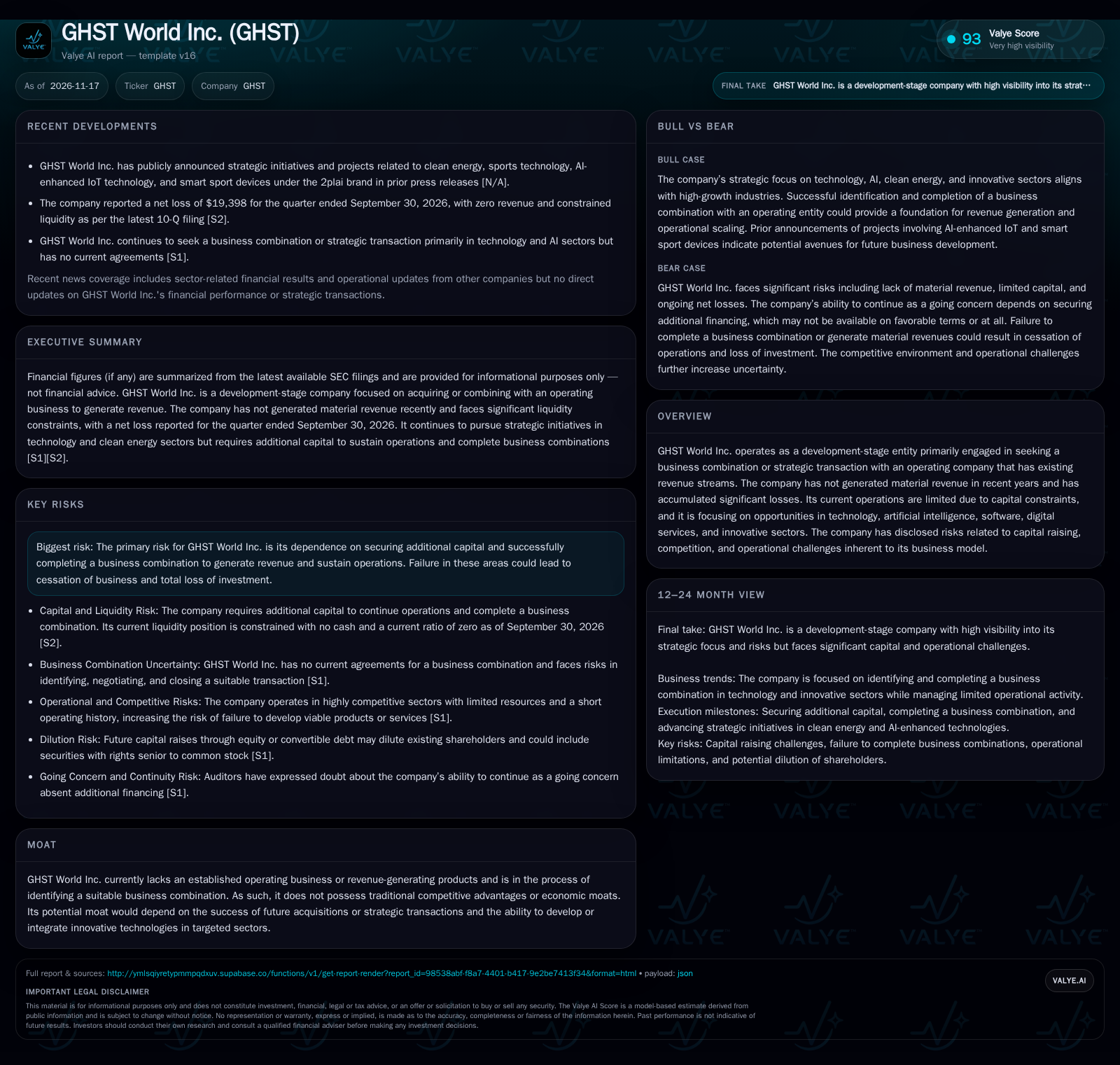
GHST World Inc. is a development-stage company with no material revenue, a significant accumulated deficit, and a current ratio of zero as of September 30, 2026 [S2]. Its ongoing viability depends on raising capital and completing a business combination in technology or digital services—without which continued operations and investor capital are at risk [S1] [S2].
GHST World Inc. stands as a textbook case of the risks and occasional rewards inherent to development-stage public vehicles. With no revenue, no cash, and a current ratio of zero, the company is functionally dormant—its only path forward is to secure capital and consummate a business combination in a high-growth sector like technology or artificial intelligence. The current predicament is stark: operations are suspended, the deficit is large, and there are no active agreements for a merger or acquisition. This binary outlook means that GHST’s investment case hinges entirely on its ability to raise funds and close a transformative deal before its limited resources run out.
Liquidity Crisis and Strategic Uncertainty Define the Present
As of September 30, 2026, GHST World Inc. reported zero revenue, $766 in current assets, and $597,204 in current liabilities, yielding a current and cash ratio of zero [S2]. The company reported cash and liquidity metrics for the period; these figures do not by themselves establish operating runway, investment capacity, financial flexibility, or financing capacity. The company has accumulated losses of $14,150,715 since inception and reported a net loss of $19,398 for the quarter ended September 30, 2026 [S1] [S2]. GHST World Inc. has suspended or severely limited its activities due to these financial constraints, and its own disclosures highlight that its ability to continue as a going concern is contingent on raising new capital and completing a business combination [S1]. There is currently no arrangement or agreement with any operating business, making the company’s future highly uncertain and dependent on external developments [S1].
How Value Could Be Created: The Economics of a Development-Stage Shell
GHST World Inc. currently has no operating business, revenue, or product line. Its business model is predicated on identifying, negotiating, and closing a business combination with an entity that already generates revenue—typically in a high-growth sector like technology, AI, or digital services. Until such a transaction occurs, the company’s economics are defined by fixed public-company costs (compliance, minimal staff, legal expenses) and variable costs tied to deal sourcing and diligence.
The economics of such a shell are highly binary. If a business combination is consummated, future earnings and value creation will depend on the acquired company’s growth profile, margins, and integration success. Prior to a deal, all capital raised is consumed by holding costs and transaction expenses, with no offsetting income. The company’s need for additional capital is acute: it must raise funds simply to remain solvent and maintain its public listing, let alone to finance a transaction. If successful, the capital structure may be heavily diluted due to the issuance of new shares or convertible instruments to both investors and the merger target. The resulting post-transaction entity could benefit from public market access and growth optionality, but only if the integration yields a sustainable and competitive operating business.
Competition for Deals and the Race Against Time
In its current form, GHST World Inc. does not compete for customers or market share, but rather for attractive business combination targets. The company faces indirect competition from other public shells, special purpose acquisition companies (SPACs), private equity vehicles, and strategic buyers—all of whom are similarly seeking to acquire or merge with high-growth operating entities. The competitive landscape is crowded, especially in the technology and AI sectors where acquisition candidates may command premium terms or favor partners with more robust capital and certainty of closing.
GHST’s lack of cash and absence of a pre-arranged transaction put it at a disadvantage compared to better-capitalized vehicles. The company may need to offer more favorable terms to attract a target, resulting in greater dilution for existing shareholders. Additionally, the broader market has seen a tightening of capital for speculative vehicles, as well as increased scrutiny from both investors and regulators on the quality and sustainability of post-merger companies. Without a distinctive sourcing advantage or a unique strategic angle, GHST’s ability to outcompete other suitors is highly uncertain.
If a Transformative Acquisition Materializes: The Path to Value Creation
The most favorable scenario for GHST World Inc. is the successful identification and closing of a business combination with an established, revenue-generating company in a high-growth sector such as AI, software, or digital services. This would require raising sufficient capital to consummate the deal and provide the new entity with growth runway.
Confirmation of this scenario would come from disclosures of a signed letter of intent, definitive agreement, or announced financing commitments. If the target business brings strong fundamentals—recurring revenue, growth momentum, defensible technology, or established customer relationships—the combined entity could attract renewed investor interest and potentially command a premium valuation. Falsification would be evident if GHST fails to announce a transaction or continues to report suspended operations and capital shortfalls over the next several quarters.
Stasis and Dilution: The Most Likely Near-Term Outcome
Given the company’s current lack of liquidity, suspended operations, and no active business combination agreement, the most plausible near-term outcome is continued stasis. GHST World Inc. may secure small bridge financings to maintain its listing and minimal operations while continuing to search for a merger partner. Any funds raised in this environment are likely to be expensive and highly dilutive, further eroding value for existing shareholders.
This scenario would be confirmed by continued quarterly reports showing minimal or no revenue, persistent net losses, and working capital deficits, alongside periodic announcements of new but non-binding strategic initiatives or target sectors. Falsification would require evidence of a material capital raise, a signed acquisition agreement, or the actual closing of a business combination.
If Capital Runs Out: The Risk of Liquidation or Delisting
The most adverse scenario is one in which GHST World Inc. is unable to raise additional capital and fails to secure a business combination. In this case, the company may be forced to liquidate or face involuntary delisting due to non-compliance with public company requirements and insolvency. Creditors could pursue remaining assets, and common shareholders would likely be left with little or no recovery.
Warning signs for this scenario include continued zero cash balances, rising current liabilities, auditor going-concern warnings, and the absence of any credible financing or deal activity. Confirmation would come in the form of bankruptcy filings, delisting notices, or formal announcements of liquidation proceedings. Any material capital raise or credible transaction announcement would partially falsify the risk, but only if sufficient to restore operational viability.
Milestones and Metrics That Will Determine GHST World Inc.’s Trajectory
Disclosure of a signed letter of intent, definitive agreement, or term sheet with a revenue-generating operating company.
Announcement and closing of any material capital raising event—debt, equity, or convertible securities—sufficient to restore positive working capital.
Quarterly updates on current assets, cash balance, and current liabilities to track liquidity restoration or further deterioration.
SEC filings or press releases indicating the resumption of normal operations or the hiring of transaction-focused executives.
Evidence of exclusive or advanced-stage negotiations with a target company in the technology, AI, or digital services sector.
Filing of auditor reports with continued or escalated going-concern language.
Any signals of regulatory or exchange scrutiny regarding listing compliance or potential delisting actions.
If disclosed, details on the terms of any proposed business combination, including valuation, dilution, and integration plans.
Disclaimer: This is research-only, informational analysis and not investment advice. It may include AI-generated interpretation and general industry context. Always verify important details using primary sources.

Comments