
Aldabra 4 Liquidity Opportunity Vehicle: Capitalized for a Business Combination, But Execution Risk Defines the Thesis
Aldabra 4 Liquidity Opportunity Vehicle, Inc. (ALOV) stands as a newly capitalized SPAC with a $300 million trust account and broad acquisition mandate, but its future value hinges entirely on the identification and execution of a successful business combination within a limited window.
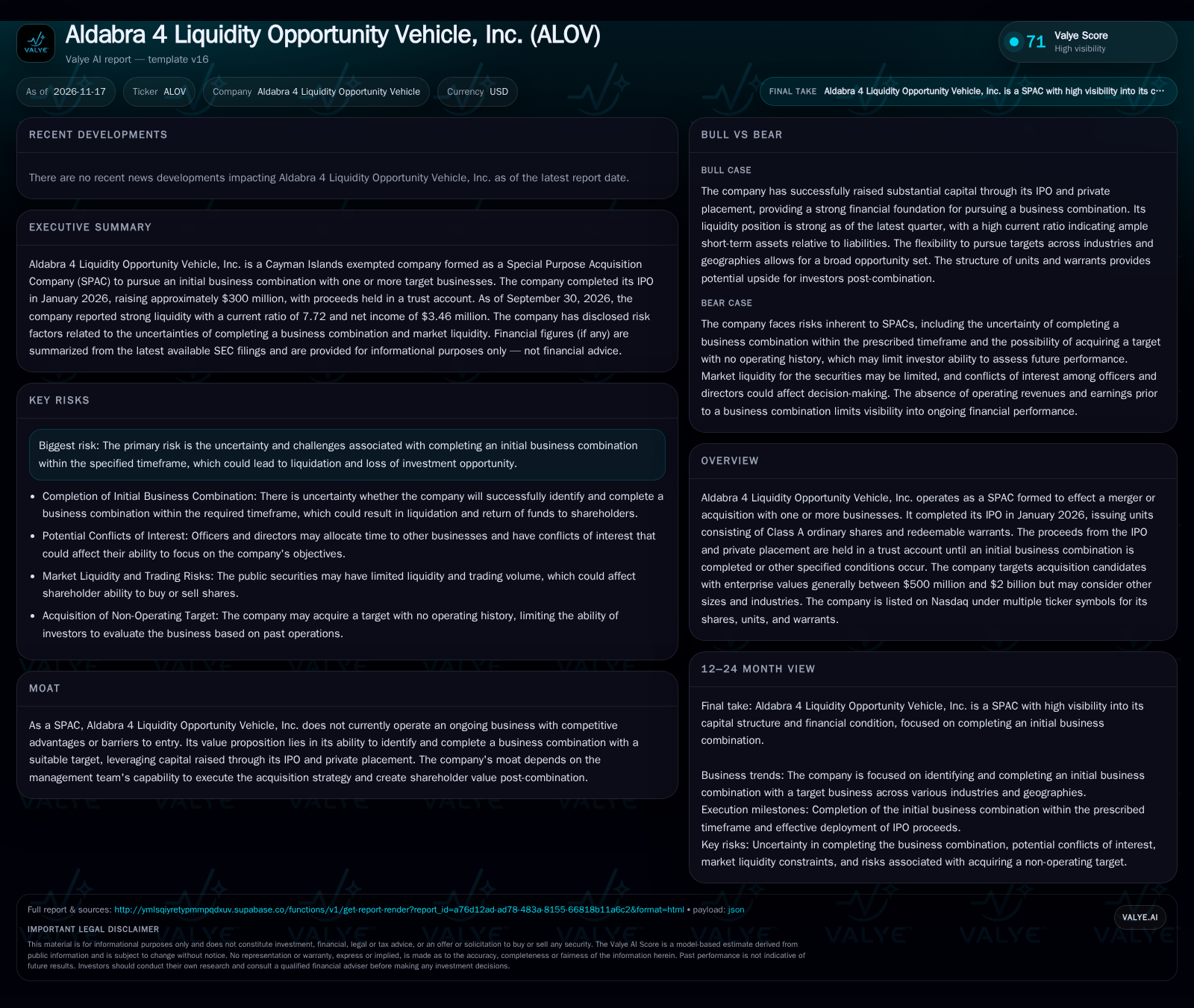
Aldabra 4 Liquidity Opportunity Vehicle, Inc. is a Cayman Islands SPAC with $300 million in IPO proceeds and additional private placement capital, all held in trust pending a merger or acquisition. With no revenue or operations, its value is purely optionality on management’s ability to find and close a compelling deal—ideally one valued between $500 million and $2 billion. The main risks: failure to complete a transaction within the required timeframe, potential conflicts of interest, and the uncertainty of post-merger performance. Until a deal is announced, the thesis is binary and execution-dependent. [S1] [S2]
Aldabra 4 Liquidity Opportunity Vehicle, Inc. (ALOV) exemplifies the high-visibility, high-uncertainty nature of the SPAC model. With its $300 million trust account and a broad mandate to pursue an acquisition or merger—ideally with a target valued between $500 million and $2 billion—its entire investment case is predicated on the successful identification and consummation of a business combination. Until that event, ALOV is essentially a call option on management’s deal-making ability, with downside protection only to the extent of trust capital return in the event of liquidation. The company’s reported liquidity position reflects a reported current ratio, but the absence of any operating business means all future value is contingent and binary. [S1] [S2]
ALOV’s Current State: Cash-Rich, Deal-Dependent, and Pre-Operating
Aldabra 4 Liquidity Opportunity Vehicle, Inc. completed its IPO in January 2026, raising approximately $300.15 million through the sale of 30,015,000 units at $10 each. Each unit consists of one Class A ordinary share and one-third of a redeemable warrant exercisable at $11.50 per share. An additional $7.3 million was raised via a private placement of warrants. All IPO and private placement proceeds are held in a trust account, awaiting deployment into a business combination. As of September 30, 2026, ALOV reported current assets of $850,304 and current liabilities of $110,076, resulting in a current ratio of 7.72. However, the company has no operating business, no revenue, and its only reported income is trust account interest. The SPAC is listed on Nasdaq under ALOV, ALOVU, and ALOWV tickers. [S1] [S2]
The most material facts are the size and integrity of the trust account, the absence of a selected target, and the lack of any operating activity. These define the binary nature of the investment: success is determined solely by the management team’s ability to select and consummate a value-creating transaction before the SPAC’s deadline.
SPAC Economics: Optionality, Incentives, and the Importance of Deal Quality
A SPAC like ALOV does not generate operating revenues prior to a business combination. Instead, its economics are driven by the terms of the eventual merger, the structure of the trust account, and the incentive alignment between sponsors and public shareholders. The $300 million held in trust serves as both the acquisition currency and downside protection for investors: if no deal is completed within the allowed timeframe, shareholders are entitled to redeem their shares for a pro-rata share of the trust.
The embedded warrants create a secondary layer of optionality, offering investors upside if the post-merger entity performs well. Sponsor economics are typically structured such that management receives a 'promote'—often 20% of post-merger equity—contingent on closing a deal. This can create pressure to complete a transaction, even if the target’s quality is marginal.
The SPAC incurs operating expenses related to legal, accounting, and due diligence, but these are minor relative to trust assets. The capital structure is highly fixed-cost until a merger closes, at which point the economics shift entirely to the acquired business and any new capital needs.
Competing for Targets in a Crowded SPAC Market
ALOV operates in a competitive environment for acquisition targets, with many SPACs vying for a finite pool of attractive businesses. The company’s lack of sector or geographic restriction broadens its opportunity set, but also means it lacks a built-in sourcing advantage. Success will depend on the management team’s network, reputation, and ability to structure compelling deals.
The main counterforces include competition from other SPACs, private equity funds, and strategic acquirers—many of whom may offer faster execution, more flexible deal terms, or greater certainty. The post-2021 SPAC market has seen increased scrutiny of target quality, tighter regulatory oversight, and greater redemption risk, all of which raise the bar for a successful transaction.
Without a proprietary sourcing edge or a differentiated value proposition, ALOV’s competitive position is neutral until its management team demonstrates the ability to source and close a high-quality deal.
A High-Quality Acquisition Unlocks Value and Investor Upside
The optimal scenario for ALOV is the identification and consummation of a business combination with a high-growth, well-performing private company valued between $500 million and $2 billion. If the target has a compelling growth story, robust financials, and a credible management team, the merged entity could attract strong investor demand, drive warrant conversion, and create price appreciation for shareholders.
Evidence that would support this scenario includes: a deal announcement with clear strategic rationale; positive market reaction; low shareholder redemptions; and subsequent evidence of operational execution by the post-merger company. Confirmation would come from above-average trading volumes, successful capital raises, and positive analyst coverage post-merger.
Falsification would occur if the announced target is of questionable quality, if redemptions are high, or if the deal fails to close due to shareholder or regulatory opposition.
Most Likely Outcome: Deal Closure with Moderate Redemptions and Uncertain Post-Merger Performance
The most plausible scenario is that ALOV will announce and close a business combination within the required timeframe, but with a target that is neither a clear winner nor a clear loser. Moderate shareholder redemptions may occur, diluting the trust capital available to the merged company. Post-merger share price performance will depend on the quality of the target and the market environment at the time of de-SPACing.
This outcome is supported if the management team announces a deal with a credible, but not top-tier, private company; if the redemption rate is in line with recent SPAC averages; and if the merged entity achieves basic operational milestones in its first year. Signs of this scenario include tepid but not catastrophic market reaction, and the need for additional post-merger capital raises.
Falsification would be a failure to announce a deal, a wave of redemptions that leaves little capital for the target, or immediate post-merger trading below trust value.
Failure to Close a Transaction Triggers Liquidation and Lost Opportunity
If ALOV fails to identify and close a business combination within the SPAC’s statutory window (typically 18-24 months post-IPO), the company will be forced to liquidate, returning trust account proceeds to shareholders. In this scenario, investors recoup their pro-rata share of the trust, but lose the time value of money and any upside optionality.
Downside is also realized if the management team rushes into a subpar deal, resulting in heavy redemptions, poor post-merger stock performance, or regulatory rejection. High sponsor promote dilution can exacerbate value destruction.
This scenario is confirmed by a lack of deal announcements as the deadline approaches, or by negative shareholder votes and high redemption rates in response to a weak target.
Milestones That Will Make or Break the Aldabra 4 SPAC Thesis
Announcement of a definitive agreement for a business combination, including target identity, industry, and enterprise value.
Level of shareholder redemptions at the time of deal approval—a key indicator of investor confidence in the chosen target.
Quality and track record of the target company’s management team and financials, if disclosed.
Market reaction (share price, warrant price, trading volume) following deal announcement and upon de-SPACing.
Evidence of post-merger operational execution, revenue growth, and ability to raise additional capital, if disclosed.
Any regulatory or shareholder opposition to the proposed transaction.
Material changes to the trust account balance, including interest income, expenses, or withdrawals related to deal costs.
Sponsor activity, including additional capital commitments, backstop agreements, or changes to promote structure, if disclosed.
Disclaimer: This is research-only, informational analysis and not investment advice. It may include AI-generated interpretation and general industry context. Always verify important details using primary sources.

Comments