
Healthy Choice Wellness: Liquidity Strains and the Economics of Scaling a Multi-Banner Organic Grocery Portfolio
Healthy Choice Wellness Corp. operates a network of natural and organic grocery stores across six states, focusing on rigorous product standards and localized customer engagement.
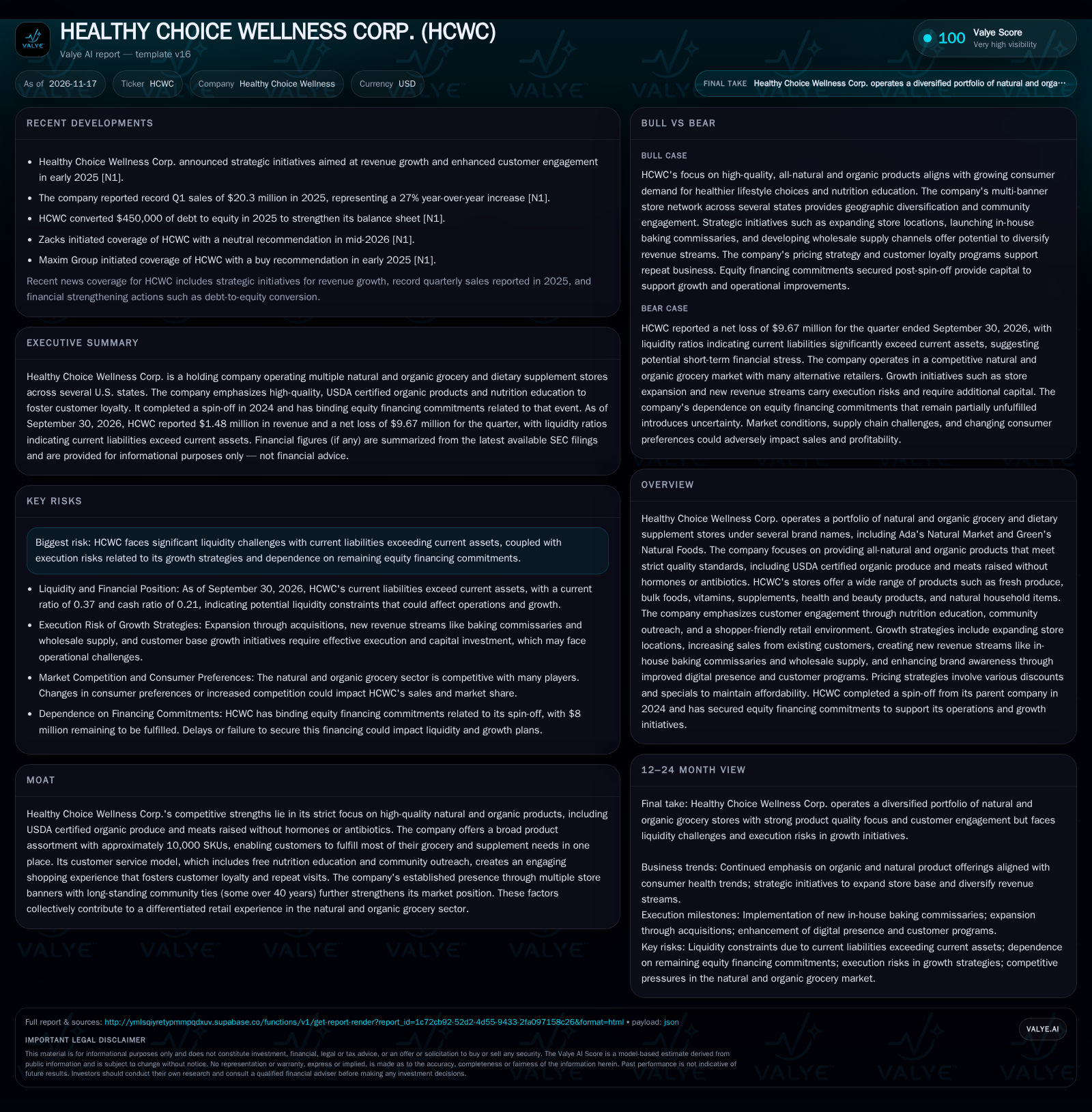
Healthy Choice Wellness Corp. (HCWC) runs 19 natural and organic grocery and supplement stores under multiple banners, emphasizing high product quality and community engagement. The company reported a quarterly net loss of $9.67 million and has a current ratio of just 0.37, with $8 million of equity financing commitments still outstanding. [S1] [S2]
Healthy Choice Wellness Corp. (HCWC) is attempting to carve out a durable position in the fragmented natural and organic grocery market by operating a portfolio of branded stores across multiple states, each with a strong local identity, rigorous product standards, and a focus on customer education. As HCWC pursues further expansion and operational enhancements, its ability to manage margin compression, secure remaining equity financing, and execute on its growth strategies will determine whether it can transition from a differentiated niche player to a sustainably profitable operator.
Liquidity Stress and Net Losses Define the Immediate Reality
As of September 30, 2026, Healthy Choice Wellness Corp. reported $1.48 million in revenue and a net loss of $9.67 million for the quarter. The company’s balance sheet highlights acute liquidity pressures: current assets of $21.1 million against current liabilities of $57.3 million yield a current ratio of 0.37, while cash and equivalents stand at $12.2 million and the cash ratio is just 0.21. This imbalance signals a significant risk of cash shortfalls unless additional financing is secured. Moreover, $8 million of the company’s binding equity financing commitments remain outstanding, with extensions under discussion, adding uncertainty to the company’s funding outlook. These factors collectively raise concerns about HCWC’s ability to support ongoing operations, fund growth initiatives, and weather adverse industry dynamics in the near term. [S1] [S2]
Unit Economics Under Pressure: Pricing, Volume, and Fixed Cost Dynamics
HCWC’s business model relies on multi-banner retailing, offering approximately 10,000 SKUs—primarily all-natural and organic products—across 19 stores. Margins in the natural and organic grocery sector are typically thin, given high product costs and the need to remain price-competitive against both conventional grocers and specialty chains. HCWC’s use of frequent discounts, in-store specials, and seasonal promotions is designed to drive traffic and maintain affordability, but this approach can erode gross margins unless offset by high volume or operational efficiencies.
Fixed costs—such as labor, occupancy, and distribution—are substantial for grocery operators, limiting the degree of operating leverage unless same-store sales growth is robust. Recent declines in same-store sales due to macro pressure and consumer trade-down behavior further strain margin expansion opportunities. The company’s plans to introduce in-house baking commissaries and wholesale supply lines could diversify revenue streams and improve gross margins if executed at scale, but these initiatives require upfront investment and carry execution risk. Given the company’s current loss profile and liquidity constraints, the path to self-sustaining positive cash flow is uncertain without either a step-change in sales productivity or a reduction in fixed cost intensity. [S1] [S2]
Differentiation Versus Scale: Navigating a Crowded Organic Grocery Landscape
Healthy Choice Wellness positions itself as a differentiated player through a strict focus on USDA-certified organic products, hormone- and antibiotic-free meats, and an extensive SKU assortment. Its banners emphasize local community ties, nutrition education, and customer engagement—attributes that foster loyalty and repeat visits among health-conscious shoppers. However, the competitive landscape is formidable: large-scale national grocers (including conventional and specialty chains), regional health-focused retailers, and e-commerce platforms all target the same customer segments.
Scale players often enjoy superior purchasing power, supply chain efficiency, and digital reach, enabling them to offer similar products at lower prices or with greater convenience. Meanwhile, the proliferation of private-label organic offerings in mainstream supermarkets is eroding the differentiation of specialty stores. HCWC’s multi-banner, localized approach may create pockets of defensibility, but the company must continually invest in customer experience and assortment to avoid commoditization. The question is whether these efforts can drive enough volume and margin to outpace structural cost disadvantages and mounting competitive pressures. [S1]
Pathways to Margin Recovery: Strategic Growth and Operational Efficiency
A favorable scenario for HCWC hinges on two reinforcing developments: successful execution of its growth strategies and a stabilization or rebound in consumer spending on health-focused grocery categories. If the company can convert its pending $8 million in equity commitments into cash, it would have the runway to invest in new store openings, in-house production capabilities, and digital customer programs. Effective differentiation—such as exclusive product lines, popular in-house baked goods, or strengthened community engagement—could drive higher customer loyalty and basket sizes.
Operationally, improvements in inventory management, shrink reduction, and labor productivity could incrementally lift gross and operating margins. Evidence for this scenario would include a return to positive same-store sales growth, rising gross margins despite promotional activity, and narrowing operating losses. Confirmation would also come from successful launches of new revenue streams (e.g., commissary or wholesale) and timely receipt of remaining financing. Falsification would be persistent negative same-store sales, further margin compression, or failure to secure committed capital. [S1] [S2]
Sustained Strain: Incremental Progress Amid Structural Headwinds
The most plausible near-term trajectory for HCWC is one of ongoing financial strain, with incremental operational improvements offset by persistent macro and industry headwinds. Modest gains in store productivity or cost control may partially reduce losses, but ongoing promotional pricing and heightened competition will likely keep margins compressed. The company may receive some or all of the remaining $8 million in equity financing, enabling continued operations but not transformative investment.
Continued liquidity constraints could force HCWC to further prioritize short-term cash generation over long-term strategic initiatives, delaying or scaling back planned expansion. Evidence supporting this scenario would include stabilizing but still negative net income, partial fulfillment of equity commitments, and a slow pace of new store openings or ancillary revenue launches. Falsification would come from a dramatic shift in either direction—either a rapid move to profitability or a liquidity crisis resulting in asset sales or restructuring. [S1] [S2]
Liquidity Crisis and Forced Retrenchment: When Funding and Margins Fall Short
In an adverse scenario, HCWC’s liquidity situation deteriorates further—either because the remaining $8 million in equity financing does not materialize in time, or because operating losses accelerate due to continued same-store sales declines and margin compression. Without access to additional external capital or a rapid improvement in cash flow, the company could face pressure to close underperforming stores, sell assets, or seek restructuring protection.
This scenario could be triggered by a combination of worsening macroeconomic conditions, intensifying competition from larger chains, or supply chain disruptions that further inflate input costs. Confirmation would come from missed payments, delayed supplier deliveries, store closures, or explicit going-concern warnings in future filings. Falsification would be a sudden improvement in liquidity—whether via new financing, asset sales, or unexpectedly strong operating results. [S2]
Milestones That Will Determine HCWC’s Viability and Competitive Standing
Progress and timing of the remaining $8 million in equity financing commitments—actual cash receipt and any changes to terms or extensions. [S1]
Quarterly same-store sales growth rates, if disclosed, to gauge underlying store productivity and consumer demand trends.
Gross margin trends in the face of ongoing promotional activity and inflationary pressures, as an indicator of pricing power and cost control.
Net cash used in operating activities and quarterly change in cash and equivalents, to assess burn rate and solvency risk. [S2]
Implementation milestones for new revenue streams such as in-house baking commissaries and wholesale supply—announced launches or material contributions to revenue.
Store portfolio changes: new store openings, store closures, or material changes in store count, as signals of expansion or retrenchment.
Any updates on supplier relationships or product sourcing, especially in response to inflation or supply chain disruptions.
Disclosures about restructuring efforts, going-concern warnings, or other signals of acute financial distress in future filings.
Disclaimer: This is research-only, informational analysis and not investment advice. It may include AI-generated interpretation and general industry context. Always verify important details using primary sources.

Comments