
Picard Medical: Artificial Heart Innovation Confronts Listing Pressures and Tight Liquidity
The company’s operational progress is real, but future viability will depend on clinical validation, regulatory wins, and the ability to secure new capital.
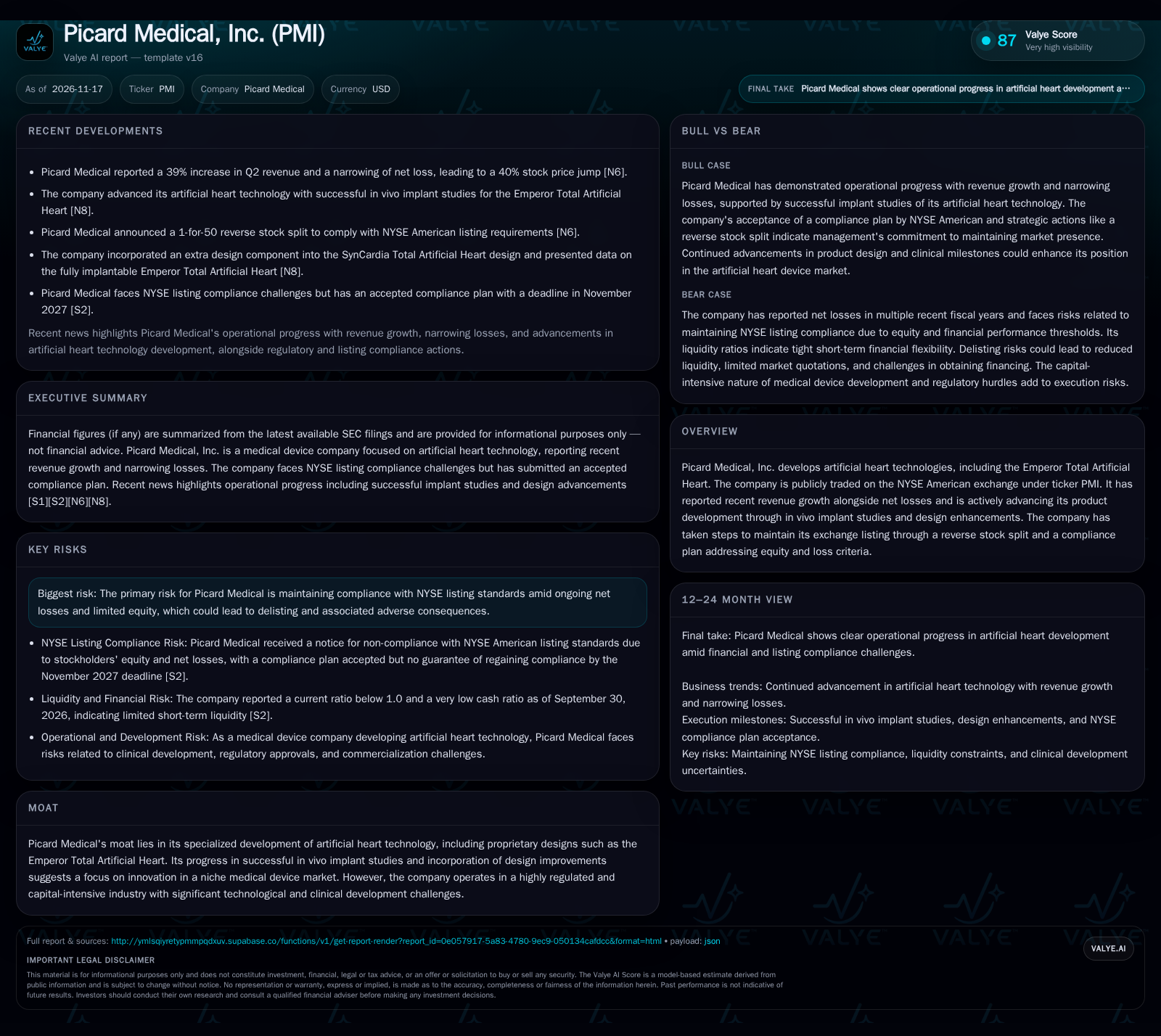
Picard Medical is making technical strides in artificial heart development, as evidenced by successful in vivo studies and design upgrades. However, persistent net losses, thin liquidity, and a recent NYSE compliance warning highlight the company’s precarious financial footing. The trajectory from innovation to commercial sustainability will hinge on clinical/regulatory progress and the ability to attract funding before cash constraints force strategic retrenchment or delisting.
Picard Medical sits at a critical inflection point. On one hand, it is advancing artificial heart technology, evidenced by successful in vivo studies and design improvements that could position it as a future contender in a high-stakes, niche device market. The next 12-24 months will be defined by whether Picard Medical can translate technical milestones into regulatory progress and secure the funding required to survive—and eventually scale—in a capital-intensive, highly regulated industry.
Recent Financial and Regulatory Events Reshape the Investment Picture
Picard Medical reported a 39% increase in Q2 2026 revenue and a narrowing net loss, which was followed by a 40% jump in its stock price, suggesting that investors are responsive to operational progress [N6]. However, as of September 30, 2026, the company’s cash and cash equivalents had dwindled to just $67,000, with current assets of $7.6 million and current liabilities of $7.7 million—resulting in a current ratio of 0.99 and a cash ratio of 0.01 [S2]. This precarious liquidity position is compounded by the company’s history of net losses in three of its last four fiscal years [S2].
Complicating matters, Picard Medical received a notice from the NYSE American in May 2026 for non-compliance with listing standards related to stockholders’ equity and net losses. The company responded with a compliance plan that was accepted in July 2026, and it executed a 1-for-50 reverse stock split in an effort to maintain its listing [S2] [N6]. The compliance plan sets a deadline of November 2027 to regain full compliance, effectively putting the company on a regulatory clock.
On the technology front, Picard Medical is advancing its Emperor Total Artificial Heart, with successful in vivo implant studies and new design enhancements reported in 2026 [N8]. These technical milestones are essential for establishing credibility in the artificial heart space and are a necessary (but not sufficient) precondition for future commercial traction.
How the Business Could Scale: Revenue, Cost Dynamics, and Funding Needs
Picard Medical’s path to profitability is shaped by the economics typical of medical device innovators: high upfront R&D and regulatory costs, significant clinical trial investment, and a long runway before meaningful commercial revenue. The company posted $2.1 million in revenue for Q2 2025, but ongoing net losses and a reported cash balance underscore the capital intensity of its business model [S2].
In the artificial heart market, revenue is eventually driven by a combination of device sales, consumable/ancillary products, and potentially service contracts for ongoing patient management. Pricing for total artificial hearts can be substantial—often in the high six-figure range per implant—but adoption is gated by regulatory approvals, reimbursement, and surgeon familiarity. Margins can be attractive at scale due to the high price point and recurring service/consumables revenue, but fixed costs are daunting until the business achieves broader adoption.
Operating leverage could, in theory, be significant if Picard Medical can move from prototype to commercial sales. However, the company’s current financials suggest it is still in the pre-commercial or very early commercial stage. Without substantial new capital, the risk is that cash constraints will force downscaling or delay, especially given the need for ongoing R&D, clinical trials, and regulatory submissions. External funding—via equity, partnerships, or strategic investment—will be critical for bridging the gap to commercialization.
Innovation Edge Meets Entrenched Players and High Barriers
Picard Medical’s competitive angle lies in its proprietary artificial heart designs and recent successful in vivo studies, positioning it as an innovator in a niche but high-impact segment of the medical device market [N8]. The Emperor Total Artificial Heart, if it achieves regulatory approval, could address a segment of patients with end-stage heart failure who are not candidates for transplantation.
However, the artificial heart landscape is characterized by a small number of highly specialized, well-capitalized competitors—often subsidiaries of large medtech conglomerates or long-established device firms. These incumbents benefit from established clinical relationships, regulatory expertise, and distribution infrastructure. Moreover, any new entrant must not only demonstrate technical superiority but also navigate lengthy clinical trials, regulatory hurdles, and reimbursement negotiations.
Switching costs for hospitals and surgeons are high given the clinical risk, training requirements, and the stakes involved with life-sustaining implants. As a result, Picard Medical’s ability to win share will depend on demonstrating clear clinical advantages, securing regulatory approvals, and building commercial partnerships. The company's current financial position may limit its ability to compete aggressively on all these fronts unless it can secure new funding.
Clinical and Regulatory Breakthroughs Unlock Commercial and Funding Momentum
The favorable scenario for Picard Medical hinges on converting its technical progress into regulatory and commercial milestones. If ongoing in vivo studies translate into successful human trials and subsequent regulatory approvals (e.g., FDA or CE Mark), the company could emerge as a credible alternative or complement to existing artificial heart solutions.
Such clinical milestones would likely attract strategic interest—either from larger medtech players seeking to bolster their heart failure portfolios or from institutional investors willing to fund the final push to market. This could enable Picard Medical to raise new capital on more favorable terms, address its liquidity constraints, and invest in scaling manufacturing and commercial operations.
Evidence that would confirm this scenario includes announcements of successful human trials, regulatory submissions or approvals, new strategic funding, and early commercial contracts or partnerships. Sustained revenue growth and narrowing losses, if rooted in commercial expansion rather than one-time events, would also support the bull case.
Incremental Progress with Persistent Financial Strain
The most plausible near-term outcome is one of incremental clinical and technical progress, but with continued financial and regulatory strain. Picard Medical may achieve additional preclinical or early clinical milestones, further validating its technology.
In this scenario, the company could seek small equity raises, grants, or research partnerships to extend its runway, but these may be dilutive or insufficient for full-scale commercialization efforts. Ongoing net losses and compliance-plan deadlines will keep pressure on management to demonstrate tangible progress to both investors and regulators.
Evidence supporting this scenario would include continued technical updates, modest revenue growth, and additional bridge financing announcements—without the step-change associated with regulatory approval or major commercial partnerships. Signs of cost containment, but not outright profitability, would also fit this pattern.
Liquidity Crunch or Delisting Forces Strategic Retreat
The adverse scenario involves a failure to secure additional funding before cash resources are exhausted, leading to either a forced strategic retrenchment, asset sale, or delisting from the NYSE American. Delisting, in turn, could sharply curtail liquidity, access to new capital, and the ability to attract commercial or strategic partners.
In this environment, Picard Medical could be forced to slow or halt R&D, lay off staff, or seek a distressed sale of its core technology to a better-capitalized competitor. The capital intensity and regulatory risk inherent in artificial heart development mean that few buyers may emerge, and any transaction could be at a steep discount.
Any announcement of delisting or inability to meet payroll or vendor obligations would be clear red flags.
What Will Determine Whether Picard Medical Survives and Scales?
Progress on clinical milestones for the Emperor Total Artificial Heart, including initiation and results of human trials, if disclosed.
Regulatory submissions or approvals (e.g., FDA IDE, PMA, or CE Mark) that would validate the technology and unlock commercial potential.
Announcements of new capital raises, strategic partnerships, or non-dilutive funding that extend operating runway.
Revenue growth attributable to recurring commercial sales rather than one-off events, if disclosed.
Updates on NYSE American listing compliance status, including any changes to compliance plan deadlines or requirements.
Cost containment or restructuring actions that may signal either prudent management or distress, depending on context.
Competitive responses from incumbent artificial heart/device companies, such as new product launches or pricing changes.
Disclaimer: This is research-only, informational analysis and not investment advice. It may include AI-generated interpretation and general industry context. Always verify important details using primary sources.

Comments