
Super League Enterprise: Integration Ambitions, Playable Media Economics, and the Realities of Scaling Interactive Advertising
Super League Enterprise, Inc. is betting on acquisitions and restructuring to carve out a differentiated position in playable media and in-game advertising. With new assets and capital, the company faces the dual challenge of integration risk and the need to prove durable economics in a competitive, rapidly evolving market.
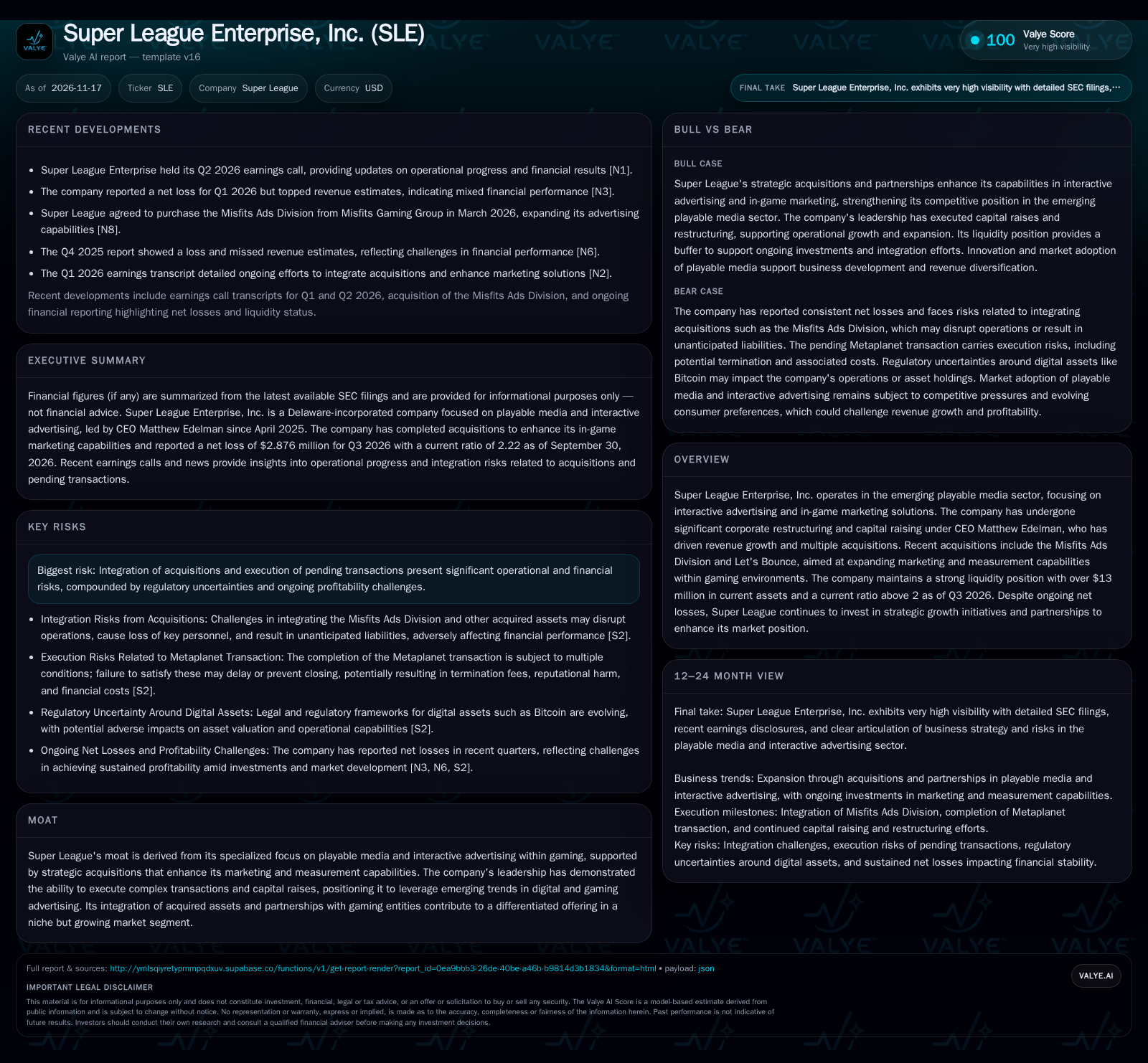
Super League Enterprise is building a business around interactive advertising and in-game marketing, expanding through acquisitions like Misfits Ads Division and Let's Bounce. The thesis now hinges on converting expanded capabilities into recurring, scalable revenue while navigating regulatory uncertainties and competition from established digital media players. [S2] [N8]
Super League Enterprise, Inc. is at a pivotal juncture, seeking to leverage recent acquisitions and a strengthened balance sheet to build a defensible position in the emerging playable media and interactive advertising sector. Under new CEO Matthew Edelman, the company has aggressively restructured, raised capital, and expanded its portfolio with the aim of capturing new digital advertising opportunities within gaming environments. However, persistent net losses, integration challenges, and regulatory uncertainty complicate the path to sustainable profitability. The next phase will test whether Super League can translate its expanded capabilities and partnerships into scalable, defensible economics—or whether execution and market headwinds will slow its ambitions.
Recent Acquisitions, Capital Raises, and the Financial State: What Sets the Stage
The company reported cash and liquidity metrics for the period; these figures do not by themselves establish operating runway, investment capacity, financial flexibility, or financing capacity. Despite this liquidity, the company posted a net loss of $2.876 million for the quarter, with negative earnings per share. Over the past six months, CEO Matthew Edelman led capital raises totaling over $26 million and executed multiple acquisitions, notably the Misfits Ads Division and Let's Bounce, in a bid to strengthen the company’s in-game marketing and measurement offerings. However, these moves come with integration risks, as well as exposure to the outcome of a pending Metaplanet transaction that could carry termination fees and execution costs if not completed. [S2] [N8]
Playable Media Monetization: Where Revenue and Risk Intersect
At its core, Super League’s economics hinge on driving value for advertisers seeking to reach gaming audiences through more immersive, interactive formats—so-called playable media. Revenue may be generated from direct in-game advertising, interactive content sponsorships, campaign measurement services, and potentially data analytics or performance-based pricing. The company’s acquisitions are designed to expand both reach and sophistication, suggesting a shift from one-off or campaign-based revenue to potentially more recurring or programmatic models, though specific contract structures have not been disclosed.
The mix of fixed and variable costs is likely evolving: platform development, content creation, and acquired technology add to fixed costs, while campaign execution and media placement are more variable. Operating leverage could improve if the company succeeds in scaling its platform and client base, as incremental ad campaigns and measurement services could be delivered at relatively low marginal cost. However, ongoing net losses indicate that the business has yet to reach the scale where fixed costs are absorbed and margins improve. Capital needs remain significant, both for integration and to support continued product development, suggesting further reliance on external funding if revenue growth does not accelerate.
Can Super League Carve Out Defensibility in a Fragmented Digital Ad Landscape?
Super League is attempting to differentiate itself through a focus on playable, interactive advertising within gaming environments—a niche that is rapidly gaining attention as brands seek deeper engagement with Gen Z and millennial consumers. Its recent acquisitions aim to enhance both the technical capability and the scale of its offering, potentially making it a more attractive partner for gaming publishers and advertisers.
The competitive landscape, however, is intense. Super League faces competition from established digital ad networks, gaming-focused advertising firms, and even game developers building their own direct ad platforms. Barriers to entry are moderate—while technology and publisher relationships matter, switching costs for advertisers are not inherently high unless Super League can demonstrate superior targeting, engagement, or measurement. The company’s defensibility may ultimately rest on its ability to build proprietary data, deliver unique campaign outcomes, and integrate seamlessly with major gaming platforms. Without visible evidence of network effects, exclusive contracts, or clear switching frictions, sustainable competitive advantage is plausible but not yet proven.
If Integration and Adoption Succeed: Pathways to Scalable, Recurring Revenue
In a favorable scenario, Super League successfully integrates its recent acquisitions, creating a unified platform that delivers differentiated, measurable value for advertisers. Advertisers shift more spend into playable media, attracted by higher engagement rates and improved campaign analytics, while gaming publishers see Super League as a trusted intermediary. Recurring revenue streams emerge as advertisers commit to multi-campaign or annual contracts, and the company’s data and measurement capabilities enable premium pricing.
Evidence that would confirm this scenario includes: sustained sequential revenue growth, improved gross margins, public disclosure of recurring or multi-year contracts, and reductions in quarterly net losses. Additional signals would be expansion of publisher partnerships, increased advertiser renewals, and references to proprietary platform capabilities or network effects in earnings calls. If these milestones are met, Super League could transition from a high-risk growth story to a credible player in the next wave of digital advertising.
Navigating Integration While Seeking Revenue Momentum
The most plausible near-term outcome is a period of operational complexity as Super League works to integrate its acquisitions, stabilize its offering, and gradually grow its advertiser and publisher base. Revenue may grow incrementally, but continued net losses are likely as fixed costs from platform development and integration remain high relative to scale. The company may secure some recurring or larger campaign contracts, but these are offset by the costs and challenges of building new commercial relationships and competing against better-capitalized digital ad players.
Confirming this scenario would be continued, though modest, revenue growth paired with persistent operating losses, ongoing disclosure of integration challenges, and a lack of clear evidence for network effects or major competitive wins. Falsification would come from either a sharp reduction in losses (evidence of scale or cost control) or a reversal in revenue momentum, possibly due to failed integration or competitive displacement.
When Integration Falters and Market Adoption Lags: Risks to the Growth Thesis
In the adverse scenario, integration of recent acquisitions proves more disruptive than anticipated—resulting in operational inefficiencies, loss of key personnel, or client defections. Advertiser adoption of playable media plateaus as brands opt for established channels or in-house solutions, and Super League struggles to differentiate its offering or deliver on measurement promises. The pending Metaplanet transaction could fail, triggering termination fees and undermining confidence in management’s execution.
This scenario would be confirmed by missed revenue targets, widening net losses, negative commentary on acquisition integration in filings or calls, and potential write-downs of acquired assets. Additional warning signs include churn in publisher or advertiser relationships, delays in product development, and any regulatory action or adverse developments related to digital asset holdings. In this environment, Super League could be forced to pursue dilutive financings or strategic alternatives under pressure.
Milestones That Will Determine Whether Super League Can Scale Playable Media Economics
Quarterly revenue growth rates—especially sequential growth post-acquisition—would help test whether expanded capabilities are translating into market traction.
Gross margin trends, if disclosed, would indicate whether the company is moving toward operating leverage or if cost pressures are eroding profitability.
Disclosure of recurring revenue or multi-year advertiser contracts would signal progress toward a more durable, less campaign-driven revenue base.
Integration updates regarding the Misfits Ads Division and Let's Bounce, including any commentary on personnel retention or operational disruptions.
Progress and outcomes related to the pending Metaplanet transaction, including any announcements of closing, delays, or termination.
Changes in publisher and advertiser partnership counts, if disclosed, would reflect the company’s ability to scale its network and create competitive stickiness.
Any material regulatory developments or disclosures regarding digital asset holdings and their impact on operations or financial results.
Cash burn rate and capital-raising activity, as persistent operating losses may necessitate further external funding if revenue does not accelerate.
Disclaimer: This is research-only, informational analysis and not investment advice. It may include AI-generated interpretation and general industry context. Always verify important details using primary sources.

Comments