
Silver Pegasus Acquisition Corp.: Countdown to Combination—Capital, Constraints, and the SPAC Execution Window
Silver Pegasus Acquisition Corp. faces a narrowing timeline to secure a business combination, leveraging a substantial trust account and experienced leadership but contending with limited operating liquidity and the inherent uncertainties of the SPAC model.
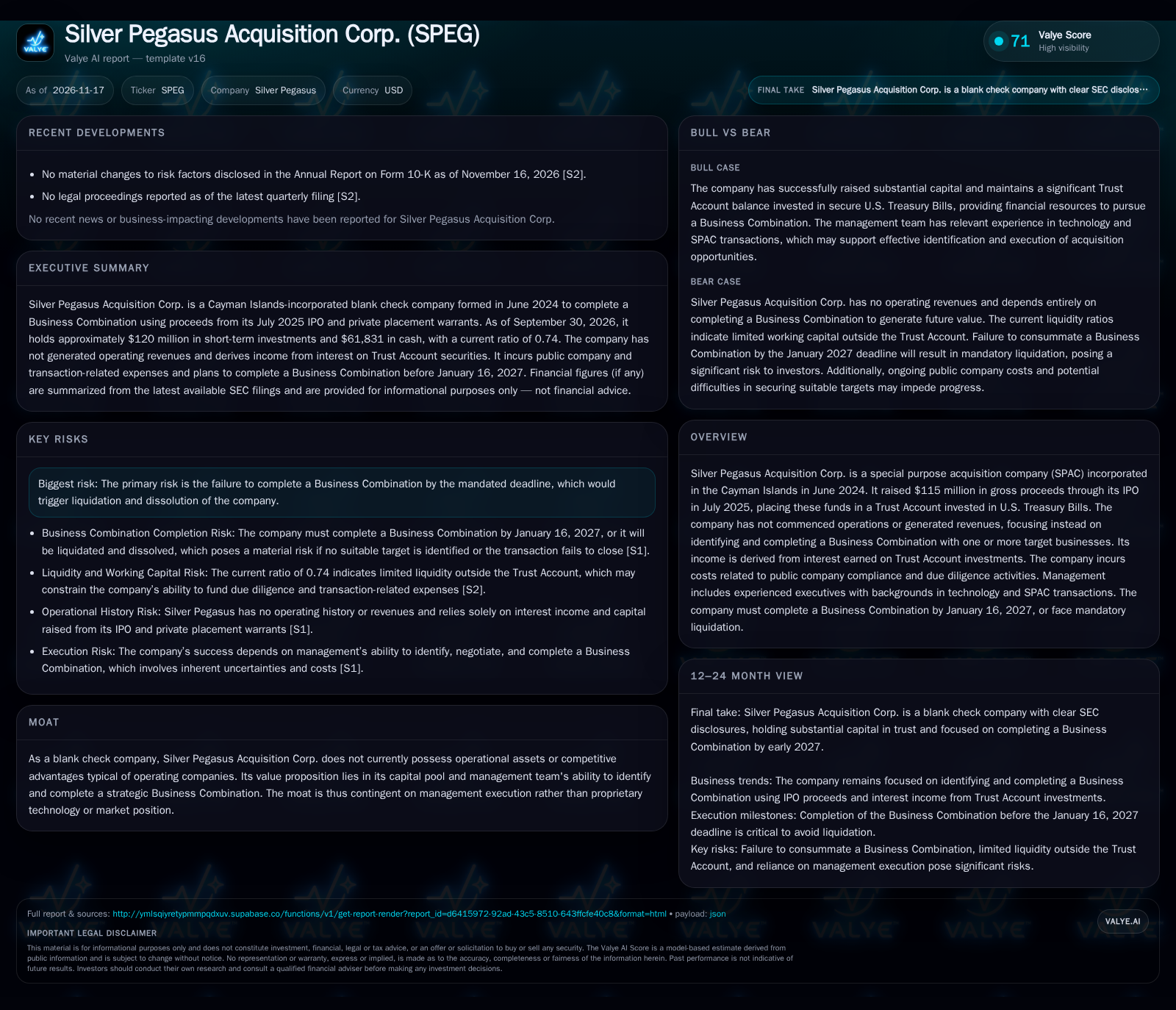
Silver Pegasus Acquisition Corp. is a Cayman Islands-based SPAC with $115 million in IPO proceeds held in trust, earning interest but generating no operating revenue. The company must complete a business combination by January 16, 2027, or face liquidation. Its prospects depend entirely on management’s ability to identify and execute a suitable acquisition within the prescribed window, while limited working capital outside the trust adds urgency to the process. The outcome will hinge on deal execution, target quality, and market conditions as the deadline approaches. [S1] [S2]
Silver Pegasus Acquisition Corp. exemplifies the purest form of the SPAC model: a substantial capital pool, a fixed timeline, and a singular focus on executing a transformative deal. With $115 million in IPO proceeds earning interest in a trust account and no revenue-generating operations, the company’s future hinges entirely on its ability to identify and consummate a business combination before the January 2027 deadline. This structure concentrates both opportunity and risk—success or liquidation—with limited margin for error and real consequences for investor capital.
A Finite Window and a Trust-Funded Balance Sheet Define the Present
As of September 30, 2026, Silver Pegasus Acquisition Corp. reported cash and equivalents of $61,831 and short-term investments of approximately $120.3 million, reflecting the proceeds from its $115 million IPO in July 2025 and subsequent interest income [S2]. The company reported cash and liquidity metrics for the period; these figures do not by themselves establish operating runway, investment capacity, financial flexibility, or financing capacity. [S2] All income to date has been derived from trust account interest; no operating revenues have been generated [S2]. The most material fact shaping the thesis is the looming January 16, 2027, deadline for completing a merger or acquisition, after which Silver Pegasus will be liquidated and investor funds returned [S1].
How the SPAC Structure Translates Capital Into Value—Or Returns It
Silver Pegasus’s business model is binary: it earns interest on trust-held funds until a business combination is completed or the entity is liquidated. The company incurs legal, accounting, due diligence, and public company costs, funded by limited working capital outside the trust account [S1] [S2]. Its economic upside is entirely contingent on closing an acquisition—after which the combined entity’s economics would take over. Until then, there is no revenue, no product, and no margin expansion opportunity. The trust’s capital is largely untouchable for operating expenses, ensuring principal protection for investors but leaving little funding flexibility for aggressive deal sourcing or negotiation.
If a business combination occurs, shareholders may benefit from value creation if the acquired business is high-quality, accretive, and well-structured. If no deal is reached, the trust is unwound and returned to shareholders, minus modest expenses. The SPAC model thus imposes a strict capital discipline while amplifying the importance of deal quality, structure, and timing. Operating leverage is irrelevant pre-deal; post-deal, it depends entirely on the target’s economics.
The SPAC structure inherently limits operational flexibility prior to a business combination, as the trust account funds are legally segregated and primarily earmarked for eventual shareholder return or transaction financing. This constraint means that management must carefully balance the use of limited working capital for essential expenses against the imperative to preserve investor capital. Furthermore, the cost structure of maintaining a public company status—including compliance, reporting, and governance obligations—creates a fixed overhead that can erode available resources if a deal is delayed. Consequently, the timing of deal execution is as critical as deal quality, since protracted search periods increase costs without generating revenue, compressing the economic runway.
Deal-Making in a Crowded SPAC Landscape: What Sets Silver Pegasus Apart?
Silver Pegasus competes not as an operator but as a financial sponsor vying for attractive acquisition targets. Its only current differentiators are the capital in trust and the experience of its management team, which includes Cesar Johnston with prior technology and SPAC execution credentials [S1]. However, the broader SPAC universe is saturated: hundreds of blank check companies are simultaneously seeking targets, often chasing similar sectors such as technology, healthcare, and disruptive growth niches.
The ability to strike a favorable deal is shaped by target availability, sponsor reputation, network, and willingness to structure terms that appeal to both target management and public investors. Silver Pegasus’s trust size ($115 million plus interest) is typical for mid-market SPACs, affording moderate flexibility but limiting pursuit of very large targets or highly competitive auctions. The absence of operational assets or proprietary sourcing channels means the company’s competitive edge, if any, rests on speed, creativity in deal structuring, and the management’s ability to identify overlooked or undervalued opportunities.
In a competitive SPAC environment, differentiation may also arise from the ability to structure transactions that align incentives across stakeholders, such as earnouts, founder shares, or contingent payments that mitigate valuation risk. Silver Pegasus’s management must therefore not only identify targets but also negotiate terms that balance the interests of public investors, PIPE participants, and target shareholders. The absence of operational assets means reliance on financial engineering and deal creativity to enhance attractiveness. Additionally, the reputational capital of the sponsor can influence access to proprietary deal flow, which is often a decisive factor in crowded sectors where high-quality targets attract multiple bidders.
How an Accretive Acquisition Could Unlock Value for Shareholders
The most favorable outcome is a timely, well-structured business combination with a high-growth or undervalued private company, ideally one that benefits from public market access and aligns with the management team’s domain expertise. If Silver Pegasus secures such a deal—potentially leveraging its leadership’s technology background—it could deliver significant value through multiple expansion, access to new capital, or operational synergies.
Confirmation of this scenario would come from a definitive merger announcement featuring a credible, scalable target, favorable deal terms, and positive market reception (e.g., minimal redemptions, strong PIPE or follow-on financing interest). Early disclosure of target identity, sector fit, and pro forma financials would further support the upside thesis. Conversely, a lack of credible targets, poor deal quality, or excessive dilution would falsify the scenario.
A successful acquisition could also catalyze strategic partnerships or unlock access to ancillary financing sources beyond the initial PIPE, thereby enhancing capital structure flexibility post-combination. If the target company possesses scalable operations and strong cash flow generation potential, Silver Pegasus could leverage this to pursue organic growth or complementary acquisitions, further expanding shareholder value. Moreover, the public listing provides a currency for future capital raises or equity incentives, which can be instrumental in attracting and retaining talent. These dynamics underscore that the initial business combination is a foundational step, with subsequent execution on growth and integration critical to realizing the full value proposition.
Most Likely: Intense Deal Sourcing, High Uncertainty, and a Binary Outcome
The most plausible path is a period of intense deal sourcing and negotiation, with Silver Pegasus working under deadline pressure to identify and close a business combination before January 2027. The majority of SPACs that reach this stage either announce a deal late in the window or return capital to shareholders if no suitable target materializes. Given market saturation and increased scrutiny of SPAC targets, the company may have to compromise on deal size, sector, or valuation.
Evidence confirming this scenario would include escalating transaction expenses, extensions or amendments to the combination window (if permitted), and increased public communications about deal progress. Failure to reach an agreement, or a last-minute deal with a suboptimal target, would falsify the base case and tilt the outcome toward liquidation.
Failure to Combine: Liquidation Risk and the Erosion of Investor Time Value
If Silver Pegasus is unable to secure and close a business combination by the January 16, 2027 deadline, it will be forced to liquidate, returning trust account funds to shareholders [S1]. This scenario would result in minimal or no capital loss for investors (apart from opportunity cost and any deviation from trust value due to expenses or redemptions), but it would represent a zero-sum outcome with no upside for warrant holders or sponsors.
Early warning signs would include persistently low deal activity, lack of target disclosures, increasing general and administrative expenses relative to available working capital, and potential negative market sentiment around the SPAC’s ability to execute. If the company files for extension or amends its charter to delay liquidation, it may signal difficulty in securing a suitable target.
Even in liquidation scenarios, investors face subtle risks beyond principal return, such as dilution from warrant exercises or the impact of redemption dynamics on remaining shareholder value. Additionally, the erosion of time value—reflecting the opportunity cost of capital tied up without productive deployment—can be material, especially in low-interest environments. Sponsor incentives may also diverge from shareholder interests as deadlines approach, potentially leading to riskier deal pursuits or less favorable terms in an effort to avoid liquidation. These factors highlight that the binary nature of SPAC outcomes masks nuanced economic considerations that influence investor returns and risk profiles.
Milestones and Metrics That Will Decide Silver Pegasus’s Outcome
Announcement of a definitive agreement for a business combination, including target identity, sector, and transaction terms.
Redemption rates by public shareholders upon deal announcement and in the lead-up to the combination vote.
PIPE (private investment in public equity) participation or alternative financing commitments, if disclosed.
Disclosure of pro forma financials and management projections for the target business, if available.
Monthly general and administrative expense trends relative to the remaining working capital outside the trust account.
Extensions or amendments to the business combination deadline, if pursued.
Public communications or regulatory filings indicating progress or setbacks in deal negotiations.
Changes in sponsor or management structure, which could impact deal execution capability.
Disclaimer: This is research-only, informational analysis and not investment advice. It may include AI-generated interpretation and general industry context. Always verify important details using primary sources.

Comments