
Mangoceuticals: Diversification, Regulatory Exposure, and the Search for Scalable Pharma-Nutraceutical Economics
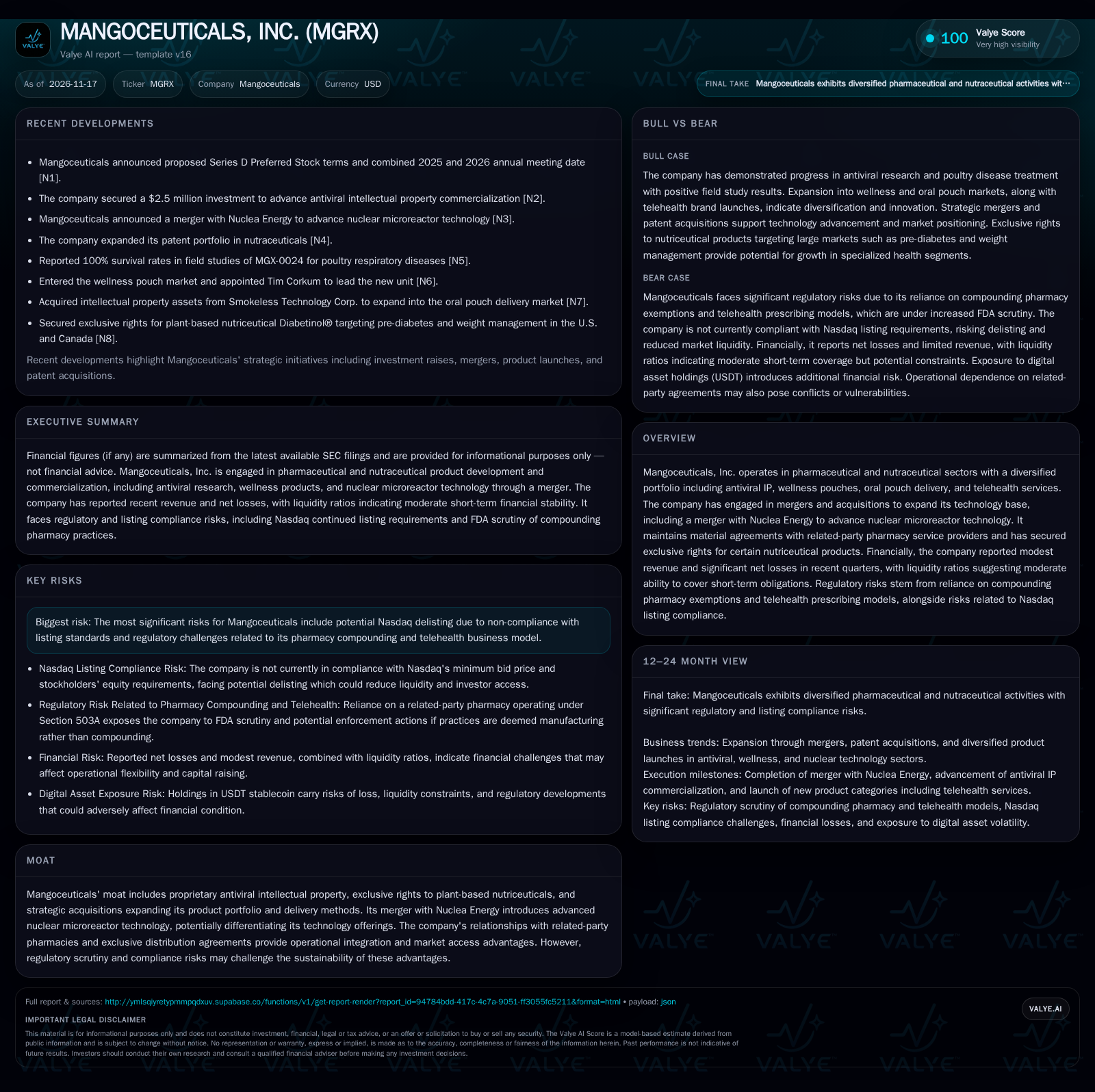
Mangoceuticals is expanding its footprint across pharmaceuticals, nutraceuticals, and telehealth, leveraging exclusive rights and IP acquisitions to target high-growth health segments. However, ongoing net losses, regulatory scrutiny of its compounding pharmacy model, and Nasdaq listing compliance risks create acute uncertainty about its ability to reach sustainable scale and defend its market position.
Mangoceuticals is navigating a multi-pronged growth strategy—advancing antiviral R&D, launching wellness and telehealth brands, and acquiring nutraceutical assets—while contending with persistent financial losses, regulatory risk from its compounding pharmacy-dependent model, and the threat of Nasdaq delisting. The next phase hinges on converting IP and exclusivities into defensible, scalable revenue, and addressing structural vulnerabilities in compliance and capital.
Mangoceuticals, Inc. has pursued an aggressive diversification strategy, building a portfolio that spans antiviral therapeutics, nutraceuticals, oral pouch delivery, and telehealth platforms. While recent product launches and exclusive rights—such as Diabetinol® for pre-diabetes and weight management—underscore its ambitions, the company’s operating reality remains challenged. Mangoceuticals continues to report significant net losses, depends on related-party pharmacy platforms that face regulatory headwinds, and is at risk of losing its Nasdaq listing. The central question is whether Mangoceuticals can translate its differentiated assets into scalable revenue streams before financial and regulatory pressures force a strategic realignment or retrenchment.
Recent Developments Highlight Growth Initiatives and Mounting Pressures
Mangoceuticals reported a net loss of $3,553,512 for the quarter ended September 2026, on revenue of just $68,757 for the preceding quarter, signaling that new product launches and exclusive rights have yet to translate into meaningful commercial momentum [S2]. The company reported cash and liquidity metrics for the period; these figures do not by themselves establish operating runway, investment capacity, financial flexibility, or financing capacity. [S2]
The company’s expansion into new verticals is evidenced by its exclusive rights to Diabetinol® for pre-diabetes and weight management in the U.S. and Canada [N8], acquisition of IP for oral pouch delivery [N7], and launch of PeachesRx, a women’s telehealth wellness brand. To fuel antiviral IP commercialization, Mangoceuticals secured a $2.5 million investment [N2]. However, the business is not currently compliant with Nasdaq listing requirements, including minimum bid price and stockholders’ equity thresholds, putting its public market status at risk [S2].
Operationally, Mangoceuticals relies on a related-party compounding pharmacy operating under Section 503A, exposing it to heightened FDA scrutiny and regulatory uncertainty, particularly as the telehealth and compounding pharmacy landscapes evolve [S2].
Unpacking the Path to Sustainable Economics in a Diversified Health Portfolio
Mangoceuticals’ business model is predicated on leveraging proprietary and exclusive assets—antiviral IP, nutraceutical exclusivities, and telehealth brands—across both prescription and over-the-counter channels. The commercial mechanics likely combine direct-to-consumer (DTC) telehealth platforms, pharmacy partnerships, and possibly third-party distribution for nutraceuticals. However, the current revenue base is small relative to fixed operating costs, as evidenced by persistent quarterly net losses exceeding $3.5 million [S2].
The company’s agreements with Epiq Scripts, a related-party compounding pharmacy, suggest a revenue model involving consulting and service fees tied to prescription pill sales, but it is unclear whether this structure offers attractive gross margins, recurring revenue, or customer lock-in. The cost structure is likely dominated by R&D, regulatory compliance, marketing, and pharmacy service fees—expenses that may not scale down easily if commercial uptake lags.
[N2] [S2] Exposure to $500,000 in Tether (USDT) adds a volatile and potentially illiquid element to its asset base [S2].
How Regulatory Flux and Channel Dependence Shape Competitive Dynamics
Mangoceuticals’ competitive position is a blend of asset exclusivity and operational risk. Exclusive rights to Diabetinol® and proprietary antiviral IP provide entry points into large addressable markets—pre-diabetes, weight management, and animal health—where brand differentiation, clinical validation, and distribution reach are key. However, the company’s heavy reliance on a single, related-party compounding pharmacy for distribution and fulfillment introduces both concentration risk and vulnerability to regulatory change.
The telehealth and compounding pharmacy sectors are increasingly competitive, with players ranging from large, vertically integrated telehealth brands to specialized digital health startups and established pharmacy networks. Regulatory scrutiny of compounding practices and online prescribing is intensifying, raising the possibility that business models built on Section 503A exemptions will face margin compression, compliance costs, or outright disruption.
In nutraceuticals and wellness, barriers to entry are generally low, and success is often driven by marketing, consumer trust, and channel access. Mangoceuticals’ IP portfolio and exclusive rights may provide a temporary moat, but sustained advantage will depend on clinical evidence, payer acceptance, and the ability to build recognizable brands in crowded segments.
If Commercialization Accelerates: Leveraging Exclusivity into Scalable Revenue Streams
A favorable scenario for Mangoceuticals would see accelerated uptake of its proprietary and exclusive products—such as Diabetinol®—in the pre-diabetes and weight management markets, coupled with successful monetization of antiviral IP and new wellness offerings. The company could leverage its telehealth and pharmacy partnerships to drive direct-to-consumer adoption, while expanding into B2B channels or licensing deals for broader distribution.
Confirmation of this scenario would require a marked increase in reported revenue, evidence of recurring or growing prescription volumes, and margin expansion driven by operating leverage as fixed costs are spread over a larger sales base. Clinical validation of core products and favorable regulatory outcomes for compounding and telehealth models would further de-risk the business and potentially unlock new capital sources.
Plausibly, successful execution could attract strategic partnerships or acquisition interest, especially if Mangoceuticals demonstrates the ability to translate IP and exclusivities into defensible market share and customer loyalty.
Commercial Progress Remains Incremental Amid Regulatory Uncertainty
The most plausible near-term outcome is that Mangoceuticals achieves only modest commercial progress, with incremental revenue growth from new product launches offset by ongoing regulatory and operational headwinds. The company’s dependence on related-party pharmacy agreements and Section 503A compounding exemptions may constrain growth, especially if regulatory scrutiny leads to compliance costs or operational disruptions.
Delisting from Nasdaq, if it occurs, would further constrain capital access and market visibility, potentially accelerating the need for business model adjustments.
Evidence supporting this scenario would include continued net losses, only incremental revenue increases, ongoing Nasdaq compliance warnings, and limited disclosure of large-scale commercial contracts or customer adoption.
Regulatory Clampdown or Delisting Forces Strategic Retrenchment
In a negative scenario, intensified FDA scrutiny of compounding pharmacies or telehealth prescribing could result in enforcement actions, supply chain disruption, or loss of the company’s core pharmacy distribution platform. If Nasdaq delisting proceeds before Mangoceuticals achieves commercial scale, reduced market liquidity and investor access could compound financial strain and limit capital raising options.
Such developments could force Mangoceuticals to curtail R&D, divest non-core assets, or pursue a distressed sale, especially if cash burn remains high and access to new funding dries up. The volatility and potential illiquidity of the company’s digital asset holdings (USDT) could further erode its ability to meet obligations in a crisis.
Evidence confirming the downside would include regulatory enforcement actions, pharmacy partnership disruptions, a formal Nasdaq delisting, rapid cash depletion without offsetting financing, or public statements about strategic alternatives or business restructuring.
Milestones That Will Clarify Mangoceuticals’ Path to Sustainable Scale
Quarterly revenue growth relative to fixed operating expenses—especially any step-change in prescription or nutraceutical product sales—would help validate commercialization progress.
Disclosure of recurring revenue metrics, average order value, or customer retention rates (if disclosed) would clarify the durability and scalability of the DTC and pharmacy-driven models.
Updates on Nasdaq listing status, including any compliance plan acceptance or delisting notices, will be critical to gauging capital market access.
Regulatory developments affecting Section 503A compounding pharmacies or telehealth prescribing models—such as new guidance, enforcement actions, or legislative changes—could materially impact the business model.
Evidence of successful clinical trials, large-scale field studies, or peer-reviewed publications supporting the efficacy of proprietary or exclusive products would increase commercial credibility.
Capital raising events, strategic partnerships, or non-dilutive funding arrangements would signal management’s ability to sustain operations and invest in growth.
Material changes in related-party agreements or pharmacy network structure could alter the company’s cost base, operational flexibility, or regulatory exposure.
Shifts in the value, liquidity, or regulatory treatment of the company’s digital asset holdings (USDT) could affect near-term financial resilience.
Disclaimer: This is research-only, informational analysis and not investment advice. It may include AI-generated interpretation and general industry context. Always verify important details using primary sources.

Comments