
Beneficient: Legal Uncertainty, Negative Revenue, and Ongoing Leadership Flux Create a Complex Turnaround Challenge
Negative revenue, persistent net losses, and unresolved legal disputes frame Beneficient’s current operating reality. Leadership transitions and targeted financing deals suggest efforts to stabilize, but continued uncertainty over business model viability and litigation outcomes keep the company’s future highly contingent.
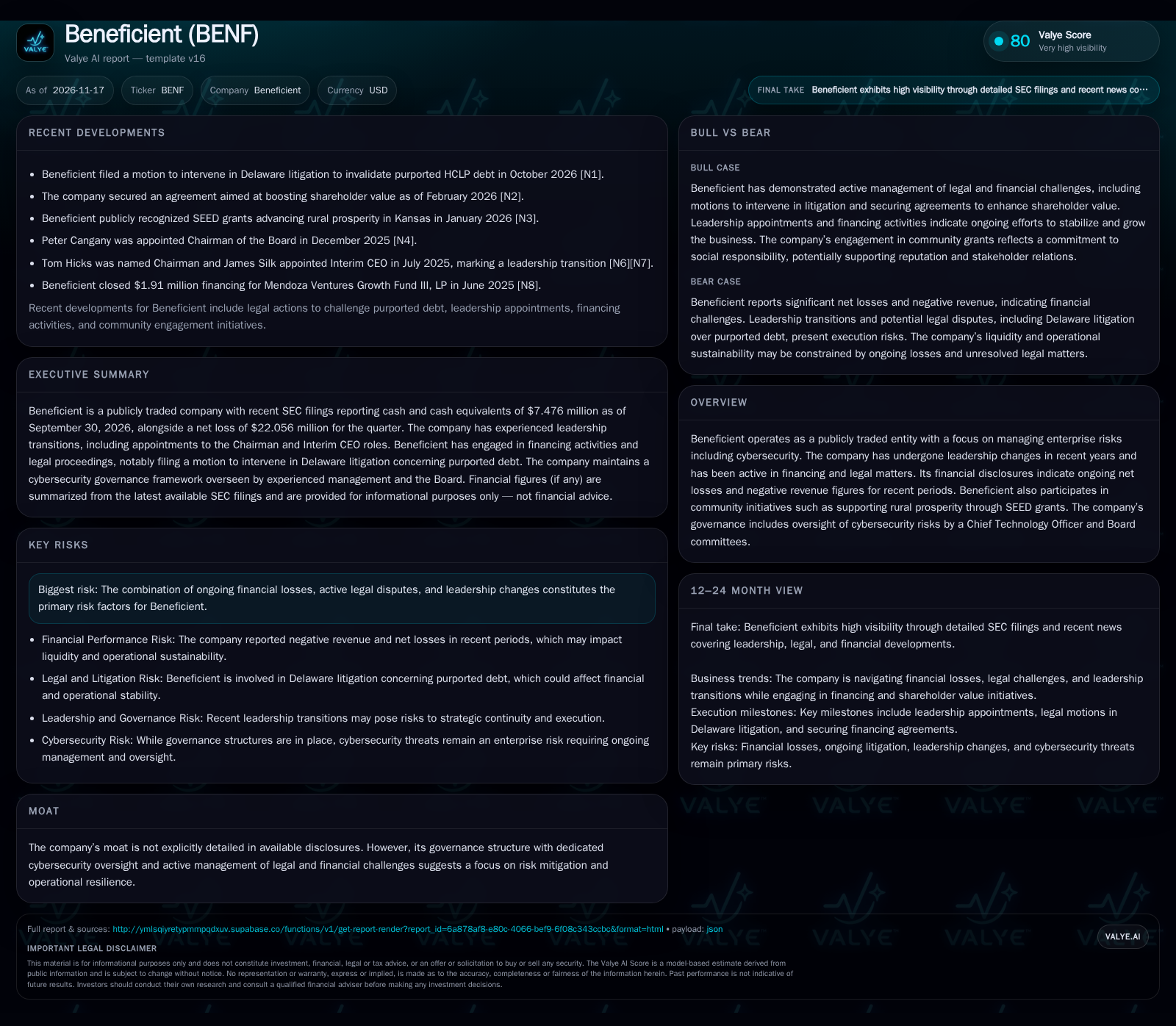
Beneficient reported negative revenue of $25.3 million and a net loss of $22.1 million for the September 2026 quarter, with cash reserves of $7.5 million. Ongoing Delaware litigation over purported HCLP debt, repeated leadership changes, and recent targeted financings all signal a business in transition. The company’s path forward depends on resolving legal uncertainties, restoring positive revenue momentum, and clarifying a sustainable operating model. [S2] [N1] [N6] [N8]
Beneficient’s current operating landscape is defined by persistent financial distress, unresolved legal disputes, and ongoing leadership turnover. Recent leadership changes and targeted financing efforts suggest an active search for stability and strategic direction, but the outcome remains highly uncertain, especially given the legal contest over purported HCLP debt and the lack of clarity around the company’s sustainable business model.
Negative Revenue, Legal Disputes, and Boardroom Instability: The Immediate Landscape
As of September 30, 2026, Beneficient reported negative revenue of $25.286 million and a net loss of $22.056 million for the quarter, highlighting acute operational and financial strain. [S2] The business is also embroiled in Delaware litigation as it seeks to invalidate purported HCLP debt—a legal process with the potential to reshape Beneficient’s financial obligations and balance sheet. [N1] Leadership remains in flux, with three changes to the Chairman role since July 2025, most recently with the appointment of Peter Cangany in December 2025. [N4] [N6] [N7] Targeted financing activities, such as the $1.91 million secured for Mendoza Ventures Growth Fund III, LP, signal a tactical approach to capital needs but do not yet indicate a broader solution to the company’s negative cash flow trajectory. [N8]
Unpacking Beneficient’s Economic Model: Revenue, Costs, and Financial Leverage
The company’s negative revenue for the September 2026 quarter likely reflects either asset impairments, reversals of previously recognized revenue, or adverse fair-value adjustments—rather than traditional operating sales. This dynamic suggests that Beneficient’s business model may rely on financial products, investment funds, or alternative asset management strategies where mark-to-market swings can dominate reported results. If so, revenue volatility is structurally embedded, with outcomes tied to asset values and legal recoveries as much as operating execution.
The persistent net losses indicate that fixed operating costs—potentially including legal, compliance, and governance expenses—outstrip any recurring income or gains. With only $7.5 million in cash, the company may face a near-term need for further financing or asset sales unless it can reverse the negative revenue trend. This environment limits Beneficient’s ability to invest for growth, constraining strategic flexibility and heightening vulnerability to external shocks.
Operating leverage is likely negative in the current phase: incremental revenue declines or expense increases directly worsen losses, while any recovery in asset values or successful litigation outcomes could have an outsized positive effect. The company’s capital needs thus hinge on both unpredictable legal outcomes and the pace of operational turnaround.
A deeper understanding of Beneficient’s cost structure would be instrumental in assessing its financial resilience. If fixed costs such as legal fees, compliance, and governance remain disproportionately high relative to any recurring revenue, the company’s break-even point will be elevated, constraining operational flexibility. Conversely, if a significant portion of these expenses is variable or subject to reduction through restructuring, there may be pathways to improve margins even absent immediate revenue growth. Moreover, the interplay between financial leverage and operational leverage is critical; high financial leverage could amplify losses in adverse scenarios but also magnify gains if asset recoveries or legal wins materialize, underscoring the binary nature of the company’s risk profile.
Where Beneficient Sits: Competitive Dynamics and Substitution Risks
Beneficient operates in a segment where financial engineering, alternative asset management, and legal risk management intersect. The company’s current challenges—negative revenue, litigation, and leadership flux—make it vulnerable to both direct competitors (other specialty finance or asset management firms) and indirect substitutes, such as traditional banks, private credit funds, or fintech platforms offering more stable and transparent products.
Competitive advantages are difficult to sustain in this environment without proven differentiation in sourcing, structuring, or managing alternative assets. Regulatory scrutiny, reputational risk, and the complexity of legal entanglements further erode any potential moat. Beneficient’s focus on risk management and cybersecurity governance is a positive, but it is not clear that these elements are sufficient to drive customer preference or pricing power. Unless the company can demonstrate a repeatable, scalable, and profitable model—supported by transparent performance metrics—it risks being outcompeted by better-capitalized or more operationally stable players.
From a competitive standpoint, Beneficient’s positioning depends heavily on its ability to differentiate through proprietary sourcing, structuring expertise, or risk management capabilities. In markets characterized by heightened regulatory scrutiny and legal complexity, firms with robust compliance frameworks and transparent governance may command premium valuations or customer loyalty. However, without demonstrable scale or a track record of consistent performance, these advantages may be insufficient to offset the reputational and operational risks posed by ongoing litigation and leadership instability. The company’s ability to articulate and evidence a clear value proposition relative to both traditional financial institutions and emerging fintech disruptors will be critical in defending and expanding its market share.
Substitution risk is also heightened by the availability of alternative financing and asset management options that offer greater transparency, lower legal risk, and more predictable returns. Beneficient must therefore assess the elasticity of demand for its products and services in the face of competition that may offer simpler or less risky alternatives. Strategic partnerships, enhanced client service models, or innovation in product offerings could mitigate these risks, but only if supported by stable leadership and a coherent operational strategy. The company’s future competitive viability will likely depend on its capacity to navigate these dynamics while resolving its internal challenges.
Unlocking Value: A Legal Win and Revenue Turnaround Could Drive a Rapid Reversal
A favorable outcome in the Delaware litigation—such as invalidating the purported HCLP debt—could materially improve Beneficient’s balance sheet and relieve financial pressure. If paired with successful execution on recently announced agreements to boost shareholder value [N2], this could set the stage for a reset in stakeholder confidence. Should the company also manage to reverse negative revenue trends, either by stabilizing asset values or developing new, recurring revenue streams, operating leverage could swing sharply positive.
Confirmation of this scenario would come from: (1) a public legal victory or settlement that reduces or eliminates the challenged debt; (2) a shift to positive or at least neutral revenue in subsequent quarters; (3) announcements of new, multi-year client contracts or fund mandates; and (4) evidence of leadership stability and strategic clarity. Falsification would be continued negative revenue, further legal setbacks, or additional leadership turnover.
Protracted Restructuring: Legal, Financial, and Operational Uncertainties Persist
The most plausible near-term trajectory is one of continued operational and legal uncertainty. Beneficient may secure interim financing, manage further cost reductions, and pursue legal remedies, but with revenue still negative and net losses accumulating, the business remains in a holding pattern. Leadership transitions could continue to distract from execution, while legal proceedings may prove protracted and unpredictable.
Evidence supporting this scenario would include: (1) additional small-scale financings or asset sales; (2) ongoing or delayed legal processes without clear resolution; (3) modest improvements in quarterly losses but no return to positive revenue; and (4) limited product or customer traction. A sudden legal resolution or a clear shift in revenue trends would challenge this base case.
Escalating Losses, Adverse Judgments, and Liquidity Exhaustion
In a downside scenario, Beneficient loses the Delaware litigation, is forced to recognize or repay the full purported HCLP debt, and continues to report negative revenue and widening losses. Leadership instability and negative headlines further erode stakeholder confidence, making customer and capital acquisition more difficult.
Indicators of this scenario would be: (1) adverse court rulings or settlements requiring significant cash outflows; (2) rapid decline in cash and current assets; (3) further increases in quarterly net losses; (4) resignations or board exits; and (5) regulatory or market interventions. Falsification would require clear, positive legal outcomes and evidence of financial stabilization.
Milestones to Assess Beneficient’s Turnaround Prospects
Resolution or substantive progress in the Delaware litigation over the HCLP debt, including public court filings or settlements.
Quarterly revenue trends: a move from negative to neutral or positive revenue would signal business model stabilization.
Leadership continuity: sustained tenure for executive and board positions, or further turnover if disclosed.
Announcement and execution of new agreements or mandates aimed at boosting shareholder value, with details on commercial terms if disclosed.
Updates on operational cost structure and any disclosed restructuring or expense reduction initiatives.
Disclosure of new customer wins, fund launches, or recurring revenue contracts, if any are announced.
Disclaimer: This is research-only, informational analysis and not investment advice. It may include AI-generated interpretation and general industry context. Always verify important details using primary sources.

Comments