
Tevogen Bio: AI-Driven Immunotherapy Ambitions Meet Acute Liquidity Pressures and Strategic Acquisition Bets
Success hinges on execution, access to capital, and the ability to translate AI and acquisition strategies into sustainable revenue.
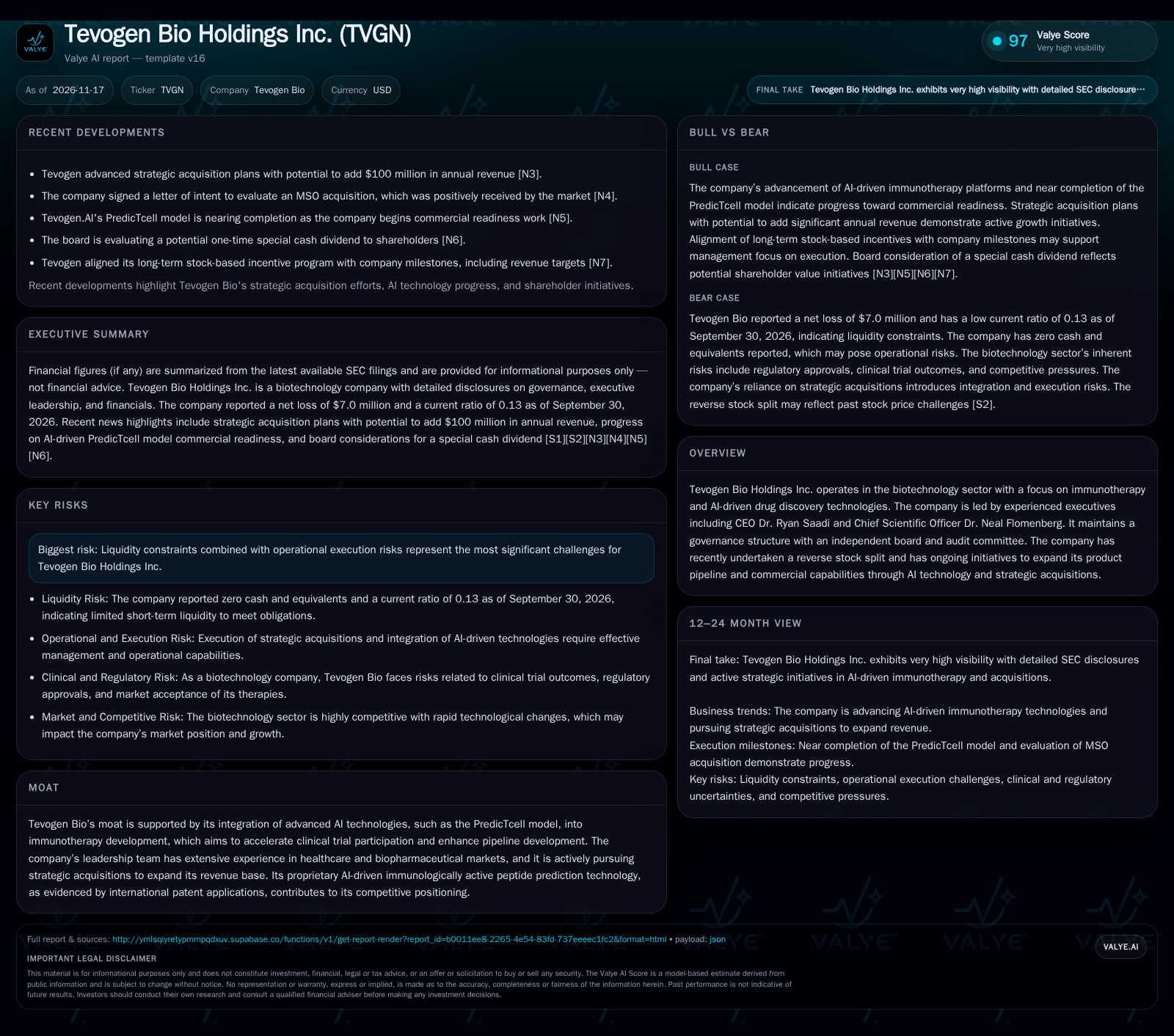
Tevogen Bio is nearing commercial readiness for its AI-driven PredicTcell model and is pursuing a strategic acquisition that could add $100 million in annual revenue. However, the company reported zero cash and a current ratio of 0.13 as of September 30, 2026, highlighting immediate liquidity concerns. The thesis rests on whether Tevogen can secure funding, integrate acquisitions, and rapidly commercialize its technology before operational risks or capital constraints force strategic retrenchment. [S2] [N3] [N5]
Tevogen Bio Holdings Inc. typifies the high-stakes tension found in early-stage biotech: on one hand, the company is nearing commercial launch of its AI-enabled immunotherapy platform and pursuing a major acquisition that could reshape its revenue base. On the other, it faces a stark liquidity crunch, with zero cash and a current ratio of just 0.13 as of late 2026. The next year will test Tevogen’s ability to secure funding, integrate new business lines, and prove that its AI-driven approach can translate to real-world adoption and sustainable economics.
Liquidity Crisis and Strategic Moves Define Tevogen’s Present
As of September 30, 2026, Tevogen Bio reported zero cash and equivalents, with current assets of $841,136 and current liabilities of $6,371,539, resulting in a current ratio of 0.13 and a cash ratio of 0. [S2]
Despite these financial headwinds, Tevogen is pushing forward on two major fronts: (1) it is close to commercializing its AI-driven PredicTcell model for immunotherapy, and (2) it has signed a letter of intent to evaluate an MSO (management services organization) acquisition that could potentially add $100 million in annual revenue. [N3] [N4] [N5] The board is also considering a one-time special cash dividend, a move that seems incongruous with the company’s liquidity profile. [N6]
How Tevogen Could Monetize AI Immunotherapy and MSO Expansion
Tevogen’s business model is predicated on two pillars: proprietary AI-enabled immunotherapy development and the potential integration of healthcare service operations through acquisition. If the PredicTcell platform reaches commercial deployment, revenue could be generated through direct licensing, partnership deals with pharmaceutical companies, or usage-based fees from clinical trial sponsors. The economics of such models in biotech typically rely on high upfront R&D costs, followed by high-margin software or IP licensing once the technology is validated and adopted.
The MSO acquisition, if consummated, would introduce a services revenue stream that is likely more predictable and recurring, potentially smoothing Tevogen’s lumpy biotech cash flows. However, MSO businesses typically operate on modest margins compared to drug development, requiring scale and integration to drive operating leverage. The combination of capital-intensive R&D and service operations would create a complex funding profile—Tevogen may need bridge financing or partnership capital to sustain both tracks.
The operational leverage of AI-driven platforms could be significant if adoption is rapid, but the fixed cost base and integration costs of an MSO could offset early margin gains.
AI, Intellectual Property, and the Labyrinth of Biotech Competition
Tevogen’s competitive positioning hinges on its proprietary AI technologies, specifically the PredicTcell model, and its ability to integrate these tools into the immunotherapy value chain. In principle, leveraging AI to accelerate drug discovery and optimize clinical trial recruitment could offer a first-mover advantage, especially if supported by international patent applications and a seasoned leadership team.
However, the competitive landscape is crowded: established pharmaceutical firms, AI-driven biotech startups, and contract research organizations are all racing to deploy similar predictive and optimization technologies. Many competitors possess significantly greater financial resources and commercial infrastructure. The value of Tevogen’s moat will depend on whether its AI models deliver superior predictive accuracy, faster trial enrollment, or demonstrable improvements in drug development timelines.
The planned MSO acquisition could provide immediate scale and a diversified revenue stream, but exposes Tevogen to competition from large healthcare services organizations and integrated care networks. The ability to cross-sell AI tools within the acquired MSO’s client base could increase switching costs if the integration is successful—but this remains unproven.
A Turnaround Fueled by Timely Funding, Acquisition Execution, and AI Adoption
In the most favorable outcome, Tevogen secures sufficient bridge capital to resolve its liquidity crunch, closes the MSO acquisition, and rapidly commercializes the PredicTcell platform. If the AI model can demonstrate clear value in clinical trial acceleration or outcome prediction, early licensing deals or partnerships with pharma companies could generate non-dilutive revenue.
The integration of a cash-flow-positive MSO would immediately diversify Tevogen’s revenue base, potentially providing both cross-selling opportunities for its AI technology and operational synergies. The company’s alignment of executive incentives with revenue milestones could drive focused execution.
Evidence confirming this scenario would include: successful capital raises, signed commercial contracts for PredicTcell, completion and smooth integration of the MSO, and positive initial revenue contributions from both the AI platform and the services segment.
Navigating a Tightrope: Funding Shortfalls and Delayed Commercialization
The most plausible path is one of continued operational stress: Tevogen may secure only partial funding, forcing it to prioritize either the AI platform or the MSO acquisition. Commercialization of PredicTcell could be slower than hoped, as hospital systems and pharmaceutical partners typically require extensive validation and regulatory clearance before adopting novel AI tools.
The MSO transaction may be delayed or renegotiated due to financing constraints, and integration could proceed in stages rather than as a single transformative event. Revenue growth would be lumpy, with initial contracts or pilot programs generating modest income but not fully offsetting ongoing R&D and integration costs.
Falsifying this scenario would require evidence of either a near-term collapse (failure to secure any funding or a forced asset sale) or, conversely, clear signs of rapid, broad-based commercial adoption and margin expansion.
Liquidity Exhaustion and the Threat of Forced Restructuring
If Tevogen is unable to secure bridge financing or monetize assets quickly, the company could exhaust its liquidity before the AI platform or MSO acquisition can deliver material revenue. In this scenario, Tevogen may be forced into asset sales, layoffs, or even bankruptcy protection to preserve remaining value.
Regulatory setbacks, failed clinical validation of the AI platform, or adverse market conditions could accelerate this outcome.
Confirmation of this scenario would include: lack of new funding announcements, missed payroll or vendor payments, delayed SEC filings, or public disclosures of restructuring, asset sales, or insolvency proceedings.
Milestones That Will Determine Whether Tevogen’s AI Bet Pays Off
Any announcement of new equity, debt, or strategic funding sufficient to resolve short-term liquidity, as evidenced by SEC filings or press releases.
Completion of the MSO acquisition, including terms and integration timeline, and subsequent revenue impact disclosures.
First commercial contracts or licensing agreements for the PredicTcell platform—customer names, contract values, and terms would help test adoption.
Progress reports or case studies demonstrating PredicTcell’s impact on clinical trial speed or outcomes, if disclosed.
Revenue and margin trends post-acquisition—specifically, whether the combined entity shows improved cash flow and operating leverage.
Disclosures regarding regulatory progress, such as FDA or international approvals, for new immunotherapy or AI-enabled products.
Any board decisions or public updates regarding the proposed special cash dividend, and the rationale for such a move given liquidity constraints.
Executive or board turnover, especially in the CFO or CEO roles, which could signal operational distress or a strategic pivot.
Disclaimer: This is research-only, informational analysis and not investment advice. It may include AI-generated interpretation and general industry context. Always verify important details using primary sources.

Comments