
TruGolf’s Strategic Bet on Virtual Golf: Integration, Innovation, and the Challenge of Financial Sustainability
TruGolf Holdings, Inc. is pursuing growth through acquisitions and new product launches in the virtual golf sector, with recent moves to regain Nasdaq compliance and strengthen its technology stack.
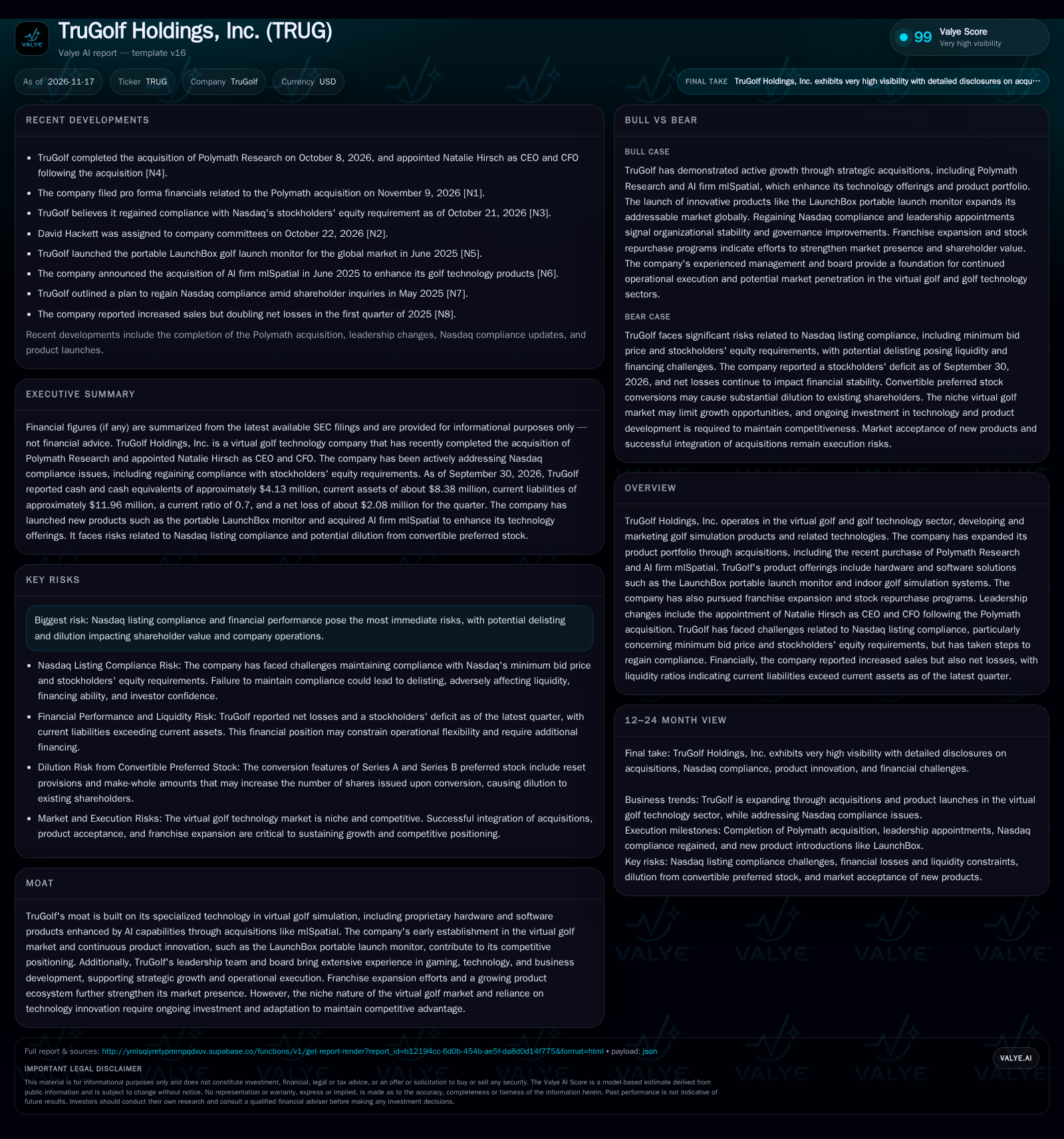
TruGolf Holdings, Inc. is seeking to transform its position in the virtual golf technology market through acquisitions, leadership changes, and product innovation. The company regained Nasdaq equity compliance after acquiring Polymath Research and raising new capital, but continues to report net losses and faces shareholder dilution from preferred stock conversions. The ability to integrate new technologies and achieve profitable growth amidst ongoing financial and market pressures will determine whether TruGolf’s expansion strategy delivers sustainable value. [S2] [N3] [N4]
TruGolf Holdings, Inc. is at a critical juncture: the company has made bold moves to expand its footprint in the virtual golf technology industry through acquisitions and product innovation, while simultaneously navigating the financial and regulatory pressures of maintaining a Nasdaq listing. With the recent acquisition of Polymath Research and the appointment of Natalie Hirsch as CEO and CFO, TruGolf is betting on technology integration and leadership renewal to drive its next phase of growth. However, persistent net losses, a stockholders’ deficit, and the prospect of shareholder dilution from preferred stock conversions underscore the urgency of delivering operational improvements—and ultimately, profitability—in a niche and competitive market.
Recent Acquisitions, Nasdaq Compliance, and Persistent Losses: Where TruGolf Stands Now
TruGolf completed the acquisition of Polymath Research on October 8, 2026, bringing new leadership—Natalie Hirsch now serves as both CEO and CFO—and additional technology assets into the fold. The company quickly filed pro forma financials for this deal, and by October 21, 2026, stated that it believed it had regained compliance with Nasdaq’s stockholders’ equity requirement after factoring in the acquisition and a Series B preferred stock financing round. As of September 30, 2026, however, TruGolf reported a stockholders’ deficit of $22,716, current liabilities of $11.96 million versus current assets of $8.38 million (current ratio: 0.7), and cash and equivalents of $4.13 million. The company continues to operate at a net loss, with the most recent quarter showing a net loss of $2.08 million. These facts highlight both the company’s aggressive expansion efforts and the ongoing financial risks that could threaten its stability if not addressed through improved profitability or further capital raises. [N4] [N3] [S2]
How TruGolf’s Revenue Model Could Scale—and Where Margin Pressure Lurks
TruGolf’s core business revolves around selling golf simulators (hardware), related software (such as E6 Connect and E6 Golf), and multi-sport gaming applications, with both residential and commercial customers. Recent moves, such as the launch of the portable LaunchBox monitor and franchise expansion through TruGolf Links Franchising, LLC, suggest a strategy to broaden the revenue base beyond traditional simulator sales. If the company can shift its mix toward SaaS-like software subscriptions, data-driven coaching tools, or recurring service contracts, it could benefit from higher-margin, predictable income streams. However, the capital intensity of hardware manufacturing, inventory management, and R&D for ongoing product innovation means fixed costs are significant. Acquisitions like mlSpatial and Polymath may add operational leverage if integration yields cross-selling opportunities or technology synergies, but they also risk duplicating overhead and increasing short-term costs. The company reported cash and liquidity metrics for the period; these figures do not by themselves establish operating runway, investment capacity, financial flexibility, or financing capacity.
Pricing power in this sector is typically constrained by competition from established simulator brands and lower-cost alternatives, as well as the discretionary nature of golf simulation purchases. If TruGolf can establish a compelling value proposition—such as superior AI-driven features or exclusive content partnerships—it may be able to defend margins, but this is not assured without clear evidence of customer willingness to pay premium prices for these enhancements.
Specialization, Technology, and the Realities of Niche Market Competition
TruGolf operates in a specialized segment where product differentiation is rooted in technology, user experience, and ecosystem breadth. The company’s moat is supported by proprietary hardware/software integration and recent AI upgrades via the mlSpatial acquisition. Early market entry and a history of innovation, such as with the LaunchBox, provide some brand recognition, especially in North America. However, the market for virtual golf technology remains relatively niche, and barriers to entry are moderate: competitors range from large consumer electronics companies offering basic simulators to established golf technology firms with deeper R&D budgets and wider global distribution.
Switching frictions for commercial customers (e.g., golf centers, entertainment venues) may be moderate if TruGolf’s platform integrates with existing software or offers unique features, but price sensitivity and rapid technology cycles mean loyalty cannot be taken for granted. Franchise expansion could build a recurring revenue base and increase switching costs, but the success of this approach depends on execution and market acceptance. Ultimately, TruGolf’s competitive position hinges on its ability to continuously innovate and deliver tangible value to both end-users and commercial partners.
Unlocking Value through Integration and Market Adoption
The most favorable outcome for TruGolf would involve successful integration of Polymath Research and mlSpatial, leading to a step-change in product capabilities—particularly in AI-powered analytics, user engagement, and cloud-enabled features. If the company can leverage these enhanced offerings to capture commercial contracts with golf facilities, entertainment venues, or training academies, and if the LaunchBox gains traction in the consumer market, revenue growth could accelerate. Franchise expansion, if executed well, might further diversify income and reduce dependence on lumpy hardware sales.
Confirmation of this scenario would come from evidence of accelerating top-line growth outpacing costs, a shift in revenue mix toward higher-margin software and services, and clear customer adoption of new AI-enhanced features. A narrowing of quarterly net losses or a move toward operating profitability would further validate this trajectory. Announcements of strategic partnerships or marquee customer wins in new geographies would also indicate successful market penetration.
Incremental Progress, Ongoing Financial Pressure, and the Test of Execution
The most plausible near-term scenario is that TruGolf achieves moderate revenue growth as new products and acquired technologies are gradually integrated and marketed. However, ongoing net losses and reported liquidity position mean that operational improvements may be slow to materialize, especially if integration costs, R&D investment, or customer acquisition expenses remain elevated. Shareholder dilution from preferred stock conversions is likely to persist as a drag on per-share value.
Confirmation of this scenario would be quarterly results showing steady but unspectacular sales increases, continued negative operating cash flow, and periodic capital raises or cost control measures to address liquidity needs. If the company maintains Nasdaq compliance and avoids major setbacks in product launches or integration, it could sustain its current trajectory—but meaningful margin expansion or market share gains may remain elusive until more dramatic operational changes are made.
Liquidity Squeeze, Delisting Risk, and the Consequences of Integration Missteps
The adverse scenario for TruGolf involves a failure to generate sufficient revenue or margin improvement from recent acquisitions and new product launches, exacerbating its liquidity pressures. If integration costs outpace anticipated synergies, or if new products fail to gain traction, the company could face mounting net losses and be forced to seek additional financing on unfavorable terms. Continued shareholder dilution, combined with a persistent stockholders’ deficit, could erode market confidence and lead to renewed Nasdaq compliance issues or even delisting.
This scenario would be confirmed by a widening net loss, deteriorating current ratio, or news of missed product milestones. Any indication that TruGolf is unable to raise new capital or must divest assets to stay afloat would further validate this outcome. Signs of customer or partner attrition, or public acknowledgment of integration or execution challenges, would also point to deeper structural problems.
Milestones and Metrics That Will Determine TruGolf’s Trajectory
Quarterly revenue growth rates, especially the mix between hardware, software, and franchise/service income, if disclosed, would illuminate adoption of new offerings and the shift toward recurring revenue.
Gross margin and operating margin trends will show whether TruGolf is capturing value from technology integration or facing ongoing cost pressures.
Updates on cash and cash equivalents, as well as current ratio movements, will reveal the company’s ability to manage liquidity without serial equity raises.
Evidence of preferred stock conversions, new equity financings, or share count increases would clarify the pace and impact of shareholder dilution.
Progress on integration of Polymath Research and mlSpatial—such as product releases or new feature rollouts—would support the thesis that these acquisitions are accretive.
Announcements of major franchise agreements, commercial contracts, or marquee customer wins would indicate success in market expansion.
Nasdaq compliance updates and any correspondence about listing status will be critical for assessing regulatory risk.
Customer retention rates, net promoter scores, or other indicators of user engagement, if disclosed, would help test product-market fit and switching frictions.
Disclaimer: This is research-only, informational analysis and not investment advice. It may include AI-generated interpretation and general industry context. Always verify important details using primary sources.

Comments