
Samos Energy Acquisition Corp: SPAC Structure, Financial Position, and the Countdown to a Business Combination
Samos Energy Acquisition Corp is a newly listed energy-focused SPAC with strong initial liquidity, no operating business, and a finite window to identify and close a value-accretive acquisition. The company's financial disclosures reveal a cash-rich, pre-deal vehicle generating interest income, but the absence of operational progress or target announcements places all value on future deal execution and sector timing.
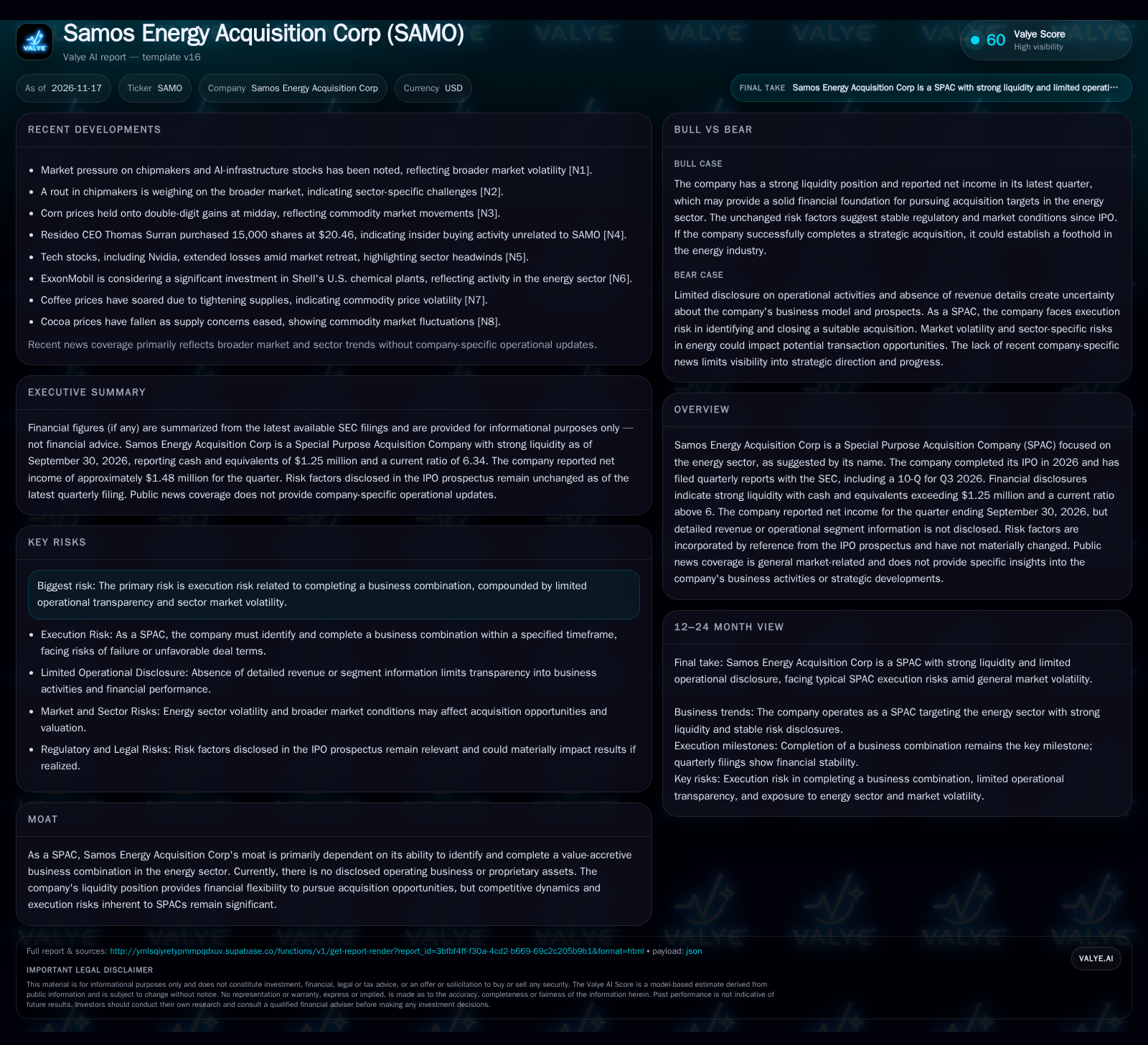
Samos Energy Acquisition Corp is a blank-check company with $1.25 million in cash, a reported current ratio, and no operating revenues as of Q3 2026. Its sole mandate is to find and close an energy-sector business combination. Net income to date is from interest on IPO proceeds, not operations. With risk factors unchanged and no deal announced, the thesis hinges entirely on the quality and timing of its eventual target and the wider SPAC market's appetite for energy deals. [S1]
Samos Energy Acquisition Corp exemplifies the high-stakes, binary nature of modern SPACs: flush with IPO proceeds, but without a defined business or acquisition announced as of Q3 2026. The company's reported $1.25 million in cash and net income from interest highlight its status as a financial vehicle awaiting a transformative transaction. With sector volatility in energy and a finite window to identify a compelling target, the ultimate outcome for shareholders will hinge not on current operations, but on the quality, timing, and market appetite for its eventual business combination. The next twelve months will be decisive for Samos as it seeks to turn potential into tangible enterprise value. [S1]
Current Financial State: Liquidity, Income, and the Absence of Operations
As of September 30, 2026, Samos Energy Acquisition Corp had cash and cash equivalents of $1,254,032 and current assets of $1,334,157 against current liabilities of $210,435, resulting in a current ratio of 6.34. The company reported net income of $1,477,921 for the quarter—entirely attributable to interest income from funds held in trust, with no operating revenues or business activities disclosed. Since its IPO in July 2026, Samos has not announced any acquisition target, and all activity remains related to its formation, IPO execution, and target search. Risk factors remain unchanged since the IPO, and there is no operational or strategic update in public news or filings. [S1]
SPAC Economics: How Value Is Created—Or Lost
As a SPAC, Samos Energy Acquisition Corp’s economics are fundamentally different from an operating company. The vehicle raised $230 million in gross IPO proceeds, with the vast majority of capital held in trust and invested in low-risk instruments, generating only modest interest income. The $1.25 million cash position outside the trust is used for administrative and due diligence expenses. Value for shareholders will only materialize if Samos can identify, negotiate, and close a business combination that is perceived as accretive relative to the trust redemption value.
SPACs face a fixed cost structure and a finite timeline—often 18-24 months—to complete a deal, with the risk of forced liquidation and capital return if unsuccessful. Operating leverage is effectively zero until a business combination is completed. Any upside is contingent on acquiring a target at attractive terms and successfully transitioning to an operating entity. Conversely, dilution from sponsor warrants and the possibility of high redemptions at the time of deal announcement can erode value. The economics for Samos hinge entirely on execution and the post-merger performance of the acquired business, if any.
SPAC Competition: The Race for Quality Energy Assets
Samos Energy Acquisition Corp operates in a highly competitive SPAC landscape, particularly within the energy sector. Numerous other blank-check companies are pursuing similar acquisition mandates, increasing competition for attractive targets. Traditional private equity, strategic buyers, and sector-focused investment funds further intensify the race for quality assets. The energy market itself is volatile, with commodity price swings, regulatory uncertainty, and shifting investor sentiment around fossil fuels versus renewables.
SPACs with experienced sponsors, strong sector relationships, and a clear investment thesis may be able to differentiate themselves, but Samos’s filings do not disclose any proprietary sourcing capability or target pipeline. The lack of disclosed operational or strategic advantages means Samos is likely competing on terms and sponsor credibility alone. The crowded field and rising deal skepticism post-2021 SPAC boom suggest that only the most compelling transactions will generate sustainable shareholder value.
What Would a Value-Accretive Energy Acquisition Look Like?
The optimal scenario for Samos is the identification and closing of a business combination with a cash-generative, growth-oriented energy company at an attractive valuation. This could be a midstream infrastructure asset, a renewable energy platform, or a differentiated technology player in the energy transition. A successful deal would need to withstand high SPAC redemption rates and deliver a clear value proposition to public market investors—such as strong EBITDA, visible cash flows, and credible growth prospects.
Confirmation of this scenario would come from: a public announcement of a definitive agreement with a high-quality target; robust investor support with low redemption rates at merger vote; and positive post-deal trading performance. Falsification would occur if Samos fails to announce a target before its deadline, or if the market reacts negatively to a proposed acquisition, resulting in heavy redemptions or deal termination.
Most Likely Outcome: The Wait for a Deal and the Reality of SPAC Timelines
Given the absence of a disclosed target and the typical SPAC lifecycle, the most plausible path is that Samos continues its search over the coming quarters, incurring administrative costs while drawing down on its limited operating cash. The company may announce a letter of intent or enter into negotiations, but the probability of a successful, value-accretive business combination is highly variable and historically less than 50% for SPACs post-2022.
Evidence confirming this base case would include ongoing non-operating income from trust investments, additional administrative expense disclosures, and, eventually, either a deal announcement or a proxy statement for an extension of the SPAC’s merger deadline. Falsification would be an unexpectedly early or high-profile acquisition agreement, or a voluntary liquidation if no suitable target is found.
Deal Failure, Liquidation, or Value Erosion: Risks Facing Samos Shareholders
The most adverse outcome is that Samos fails to identify or close a business combination within the required timeframe, triggering a mandatory liquidation and return of trust capital to shareholders (less expenses). In this scenario, public shareholders may receive only their pro rata trust value, while warrants expire worthless and sponsor capital is lost.
Other downside risks include a rushed or low-quality deal to avoid liquidation, leading to high redemption rates, post-merger share price declines, or operational underperformance by the acquired business. Confirmation would come from missed deal deadlines, shareholder votes on SPAC termination, or negative market reaction to a proposed acquisition. Falsification would require evidence of strong target pipeline, extension approvals with high shareholder support, or a successful, accretive merger.
Milestones and Metrics That Will Define Samos’s Trajectory
Announcement of a letter of intent or definitive agreement with an energy sector target would be the clearest signal of progress.
Disclosure of deal terms—including target valuation, projected financials, and sponsor/founder incentives—would help assess alignment and upside potential.
Redemption rates at the time of merger vote, if a deal is announced, will indicate shareholder confidence and the likelihood of post-merger stability.
Updates on the SPAC’s remaining timeline and any requests for deadline extensions are critical to gauge urgency and risk of liquidation.
If disclosed, the composition and sector expertise of the sponsor and management team will affect market confidence in deal sourcing and execution.
Trust account balance and any changes to interest income or administrative expenses may offer insight into ongoing financial health.
Sector-specific news—such as regulatory changes or major M&A activity in energy—could impact the attractiveness and availability of potential targets.
A useful metric would be the number and quality of potential targets under active negotiation, if disclosed by management.
Disclaimer: This is research-only, informational analysis and not investment advice. It may include AI-generated interpretation and general industry context. Always verify important details using primary sources.

Comments