
BluSky AI’s Capital-Intensive Pursuit of AI Compute: Liquidity, Scale, and the Challenge of Competing with Hyperscalers
Its growth trajectory hinges on securing powered land, raising capital, and bridging the gap between technological ambition and operational scale.
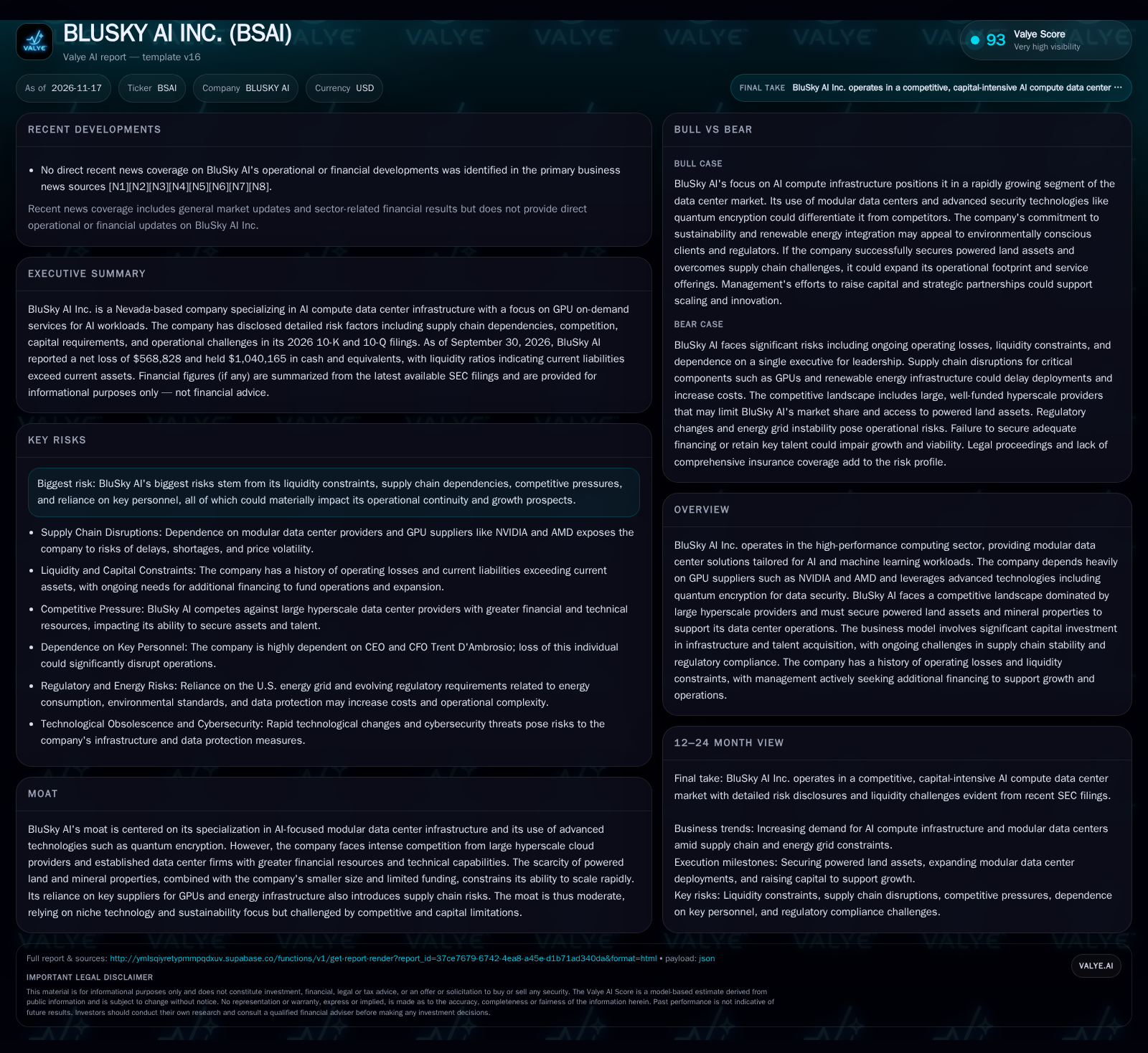
BluSky AI provides modular data center solutions for AI and machine learning workloads, relying on GPU suppliers and the U.S. energy grid. Despite advanced technology focus, it faces ongoing operating losses, a cash ratio of 0.33, and intense competition from larger hyperscale players. The company's future depends on overcoming capital, supply chain, and regulatory hurdles to achieve scale and profitability. [S2]
BluSky AI Inc. is pursuing growth in the capital-intensive AI compute data center sector, targeting AI and machine learning customers with modular, GPU-driven infrastructure and advanced security features. However, the company’s Q3 2026 financials reveal deep ongoing losses and acute liquidity pressure, while sector dynamics amplify its exposure to supply chain, regulatory, and competitive threats. BluSky AI’s future will depend on its ability to secure both the physical resources and financial backing needed to compete with much larger hyperscale rivals, as well as to execute on its sustainability and technology promises.
Liquidity Pressure and Operating Losses Define BluSky AI’s Immediate Reality
As of September 30, 2026, BluSky AI reported cash and cash equivalents of $1,040,165 and current liabilities of $3,472,173, resulting in a current ratio of 0.31 and a cash ratio of 0.33. The company posted a net loss of $568,828 for the quarter, continuing its history of operating losses and bringing its accumulated deficit to $34.4 million as of December 31, 2025. [S1] [S2]
Beyond the numbers, BluSky AI’s business model is capital-intensive, requiring ongoing investment in modular data center infrastructure, powered land, and talent. With large current liabilities and limited cash, the company’s ability to seize growth opportunities or withstand operational shocks is constrained. This financial profile is central to the company’s risk and opportunity set.
Modular Data Centers and GPU Leasing: Economics, Leverage, and Capital Needs
BluSky AI’s core revenue proposition is providing modular data center capacity tailored for AI and machine learning workloads, likely through GPU on-demand or leasing models. In this segment, revenue is typically driven by utilization rates, pricing per compute hour or GPU instance, and the ability to attract high-value, compute-intensive customers such as AI startups, research labs, or enterprise teams.
The economics of modular data centers are characterized by high upfront capital expenditures (land, infrastructure, GPUs), relatively fixed operating costs (energy, maintenance, staff), and variable costs tied to energy consumption and hardware depreciation. If utilization is high, operating leverage can be significant, allowing incremental revenue to flow through at attractive margins. However, underutilization can rapidly erode profitability since most costs are fixed or committed.
BluSky AI’s dependence on GPU suppliers such as NVIDIA and AMD exposes it to hardware price cycles, supply shortages, and potential margin compression if hardware costs rise or if it cannot secure favorable supply terms. Similarly, the company’s reliance on the U.S. energy grid for power introduces volatility in operating costs, especially as AI compute is energy-intensive and subject to regulatory scrutiny on consumption and sustainability.
The capital-intensive nature of the business creates a persistent need for external financing, especially during scale-up phases or hardware refresh cycles. Without access to low-cost capital or strong cash flow from operations, BluSky AI may struggle to maintain competitiveness or invest in the next generation of data center infrastructure.
Niche Focus Meets Hyperscale Dominance: BluSky AI’s Competitive Landscape
BluSky AI operates in a rapidly growing but highly competitive segment, facing direct competition from hyperscale cloud providers and established data center operators. Larger players benefit from economies of scale, deeper access to powered land, superior supply chain relationships, and the ability to offer bundled cloud and AI services. These advantages can translate to lower unit costs, broader service portfolios, and stronger brand recognition.
BluSky AI’s differentiation efforts center on modularity, advanced security (such as quantum encryption), and a sustainability focus. While these features may appeal to certain customer niches—such as enterprises with heightened security needs or ESG mandates—such specialization can be difficult to monetize at scale unless paired with sustained capital investment and execution discipline.
Securing powered land and mineral properties is a gating factor for all data center operators, but BluSky AI’s smaller scale and funding constraints may limit its ability to compete for prime locations. Additionally, the company’s reliance on a single executive for leadership heightens key-person risk, especially in a market where technical and operational expertise is at a premium. Retaining talent and maintaining operational continuity are ongoing challenges.
If BluSky AI Secures Funding and Assets: Scaling Niche Technology to Capture AI Compute Demand
A favorable scenario would see BluSky AI successfully raise substantial new capital, enabling it to secure powered land assets, expand its modular data center footprint, and invest in next-generation GPU hardware. By leveraging its focus on quantum encryption and sustainability, the company could carve out a defensible niche among AI customers with stringent security or ESG requirements.
To realize this upside, BluSky AI would need to demonstrate sustained growth in high-value customer acquisition, rising utilization rates, and improving operating margins as scale increases. Evidence confirming this scenario would include announced capital raises, new site acquisitions, major customer wins, or partnerships with technology providers. Conversely, failure to close financing rounds or delays in expanding infrastructure would falsify the scenario.
Sustained Liquidity Constraints Limit Growth and Heighten Execution Risk
The most plausible near-term scenario is that BluSky AI continues to operate under significant liquidity pressure, limiting its ability to scale or invest aggressively in infrastructure. The company may be forced to prioritize maintaining existing operations, seeking bridge financing, or exploring strategic alternatives. Growth is likely to be incremental, tied to opportunistic customer wins rather than systemic expansion.
In this environment, BluSky AI’s financials would likely show continued operating losses, tight cash balances, and a reliance on short-term liabilities. Confirmation would come from ongoing negative cash flow, limited expansion announcements, or further warnings about capital constraints in SEC filings. Falsification would require a demonstrable improvement in liquidity or a step-change in operational scale.
Capital Shortfall or Supply Chain Disruption Forces Retrenchment or Restructuring
A downside scenario could unfold if BluSky AI fails to secure needed capital or faces significant supply chain disruptions (e.g., GPU shortages or energy grid instability). In this case, the company could be forced to curtail operations, delay or cancel planned expansions, or even consider asset sales or restructuring.
Triggers confirming this scenario would include missed debt payments, workforce reductions, asset impairments, or public statements regarding going-concern risks. Prolonged inability to access new GPUs or powered land would further exacerbate operational risk, while legal or regulatory setbacks could accelerate the need for drastic measures.
Milestones That Will Shape BluSky AI’s Viability in the AI Compute Race
Progress in raising additional capital or closing new financing rounds—public disclosures or SEC filings would be direct evidence.
Announced acquisitions or leases of powered land and modular data center sites, which are critical for scale.
Utilization rates and revenue per GPU or compute instance—if disclosed, these metrics would indicate demand strength and operating leverage.
Updates on supply agreements with GPU vendors (NVIDIA, AMD) or evidence of hardware procurement difficulties.
Disclosure of new large customer wins, long-term contracts, or strategic partnerships, especially with enterprise or AI-focused clients.
Changes in regulatory environment or energy cost structures impacting operational expenses or expansion feasibility.
Retention and stability of key personnel, especially CEO/CFO Trent D'Ambrosio, given concentrated leadership risk.
Resolution or escalation of legal proceedings, or changes in insurance coverage that could affect financial exposure.
Disclaimer: This is research-only, informational analysis and not investment advice. It may include AI-generated interpretation and general industry context. Always verify important details using primary sources.

Comments