
CDT Equity’s AI-Enabled Drug Repurposing Model Faces a Race Against Liquidity and Execution Risk
CDT Equity Inc. is betting on AI-driven asset selection, solid-form chemistry, and capital-light partnerships to accelerate drug development and IP creation.
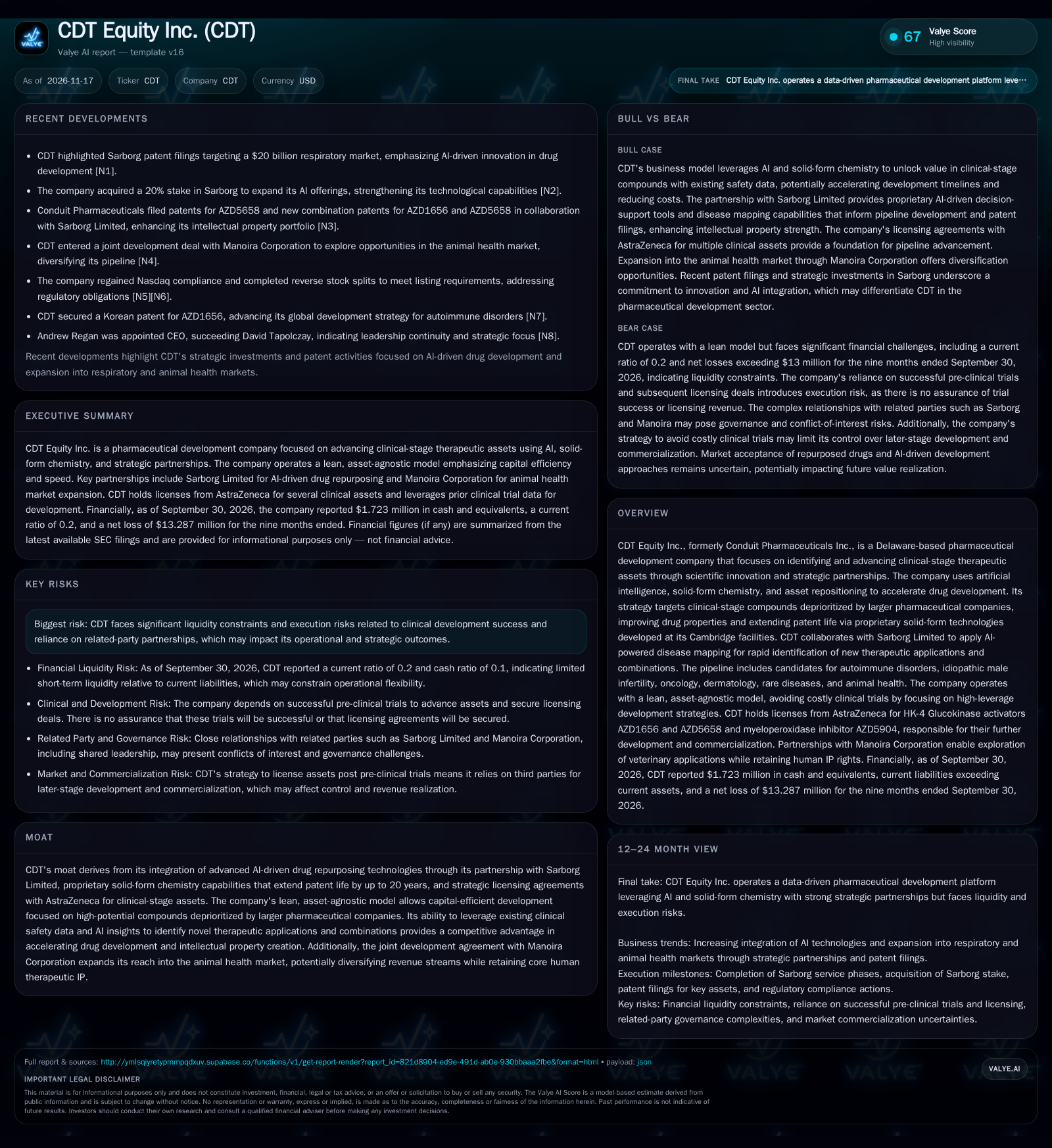
CDT Equity Inc. is advancing a lean, AI-powered drug development strategy targeting clinical-stage compounds neglected by larger pharma. Recent Sarborg patent filings in the respiratory space and ongoing AstraZeneca asset licenses highlight pipeline progress. However, as of September 30, 2026, CDT’s current liabilities far exceed current assets with only $1.7M in cash and a $13.3M net loss YTD, raising urgent questions about runway and the company’s ability to execute on its ambitious partnership-driven model. [S2] [N1]
CDT Equity Inc. is attempting to rewire the economics of drug development by using AI and proprietary chemistry to extract value from overlooked clinical-stage compounds. Its recent Sarborg-driven patent push into the $20 billion respiratory market shows scientific momentum, but the company’s $1.7 million in cash and negative working capital as of September 30, 2026, underscore a precarious financial position.
Recent Patent Activity and Acute Liquidity Set the Stage for a Make-or-Break Period
CDT Equity has recently highlighted new Sarborg-driven patent filings targeting the $20 billion respiratory market, signaling both scientific momentum and the company’s intention to compete in high-value therapeutic areas [N1]. The company retains active licensing agreements with AstraZeneca for clinical-stage assets, providing a foundation for its pipeline [S2]. [S2] These facts point to a business at an inflection point: while scientific and partnering activity is advancing, the financial runway is limited, making near-term asset monetization or fundraising a critical determinant of future viability.
How CDT’s Asset-Agnostic Model Attempts to Redefine Drug Development Economics
CDT Equity’s business model centers on acquiring or licensing clinical-stage compounds that have been deprioritized by large pharmaceutical firms, then using AI-driven disease mapping and solid-form chemistry to identify new indications, improve drug properties, and extend patent life. By leveraging prior clinical safety data and avoiding costly late-stage trials, CDT aims to accelerate development and reduce capital intensity. Commercial value is expected to be realized through out-licensing, co-development partnerships, or outright asset sales after pre-clinical or early clinical de-risking.
The economics of this model hinge on three levers: (1) rapid identification of high-potential assets via AI and chemistry; (2) the ability to create new or extended IP around known compounds, potentially adding up to 20 years of patent life; and (3) capital efficiency by focusing on preclinical/early clinical value inflection points rather than full commercialization. The lean structure minimizes fixed costs but also limits control over downstream commercialization and revenue realization, making the timing and magnitude of licensing deals highly uncertain.
A critical consideration for CDT’s model is the balance between speed and scientific rigor. While AI can accelerate target identification and hypothesis generation, the validation of new indications or improved drug properties still requires robust experimental and clinical confirmation. This creates a tension between rapid asset progression and the need to generate convincing data that will satisfy partners and regulators. Furthermore, the ability to extend patent life through solid-form chemistry depends on the novelty and non-obviousness of the modifications, which may face challenges from patent examiners or competitors. Therefore, the model’s success hinges not only on technological innovation but also on navigating complex intellectual property landscapes and regulatory pathways.
AI Integration, IP Extension, and Partner Leverage: Competitive Advantages and Counterforces
CDT’s integration of AI-driven asset selection (via Sarborg) and proprietary solid-form chemistry for patent extension provides a potential moat in the asset-repurposing segment of pharma. By targeting compounds with existing safety data, CDT may be able to move faster and at lower cost than traditional drug developers. Strategic partnerships with Sarborg (AI) and Manoira (animal health) also offer diversification opportunities and access to additional domains.
However, the model faces several counterforces. First, the asset-repurposing space is increasingly competitive, with numerous biotech startups and established pharma deploying AI for similar purposes. Second, CDT’s reliance on external partners for late-stage development and commercialization means it must share economics, faces execution risk, and may have limited negotiating leverage. Third, the market’s acceptance of repurposed drugs—especially those discovered via AI—remains uncertain, which could limit demand or pricing power. Finally, governance complexity and potential conflicts of interest from related-party partnerships (notably with Sarborg and Manoira) introduce additional risk.
The reliance on partnerships introduces both strategic flexibility and vulnerability. While collaborations with specialized firms like Sarborg and Manoira allow CDT to access cutting-edge AI capabilities and diversify into animal health, they also create dependencies that can limit CDT’s control over timelines and strategic decisions. If partners prioritize other projects or encounter their own operational setbacks, CDT’s pipeline progression could be delayed. Additionally, the shared economics inherent in licensing and co-development agreements may dilute potential returns, especially if CDT lacks leverage to negotiate favorable terms. This dynamic underscores the importance of selecting partners with aligned incentives and complementary strengths to mitigate execution risk.
If CDT Delivers Rapid Licensing or Monetization, the Model Could Unlock Capital-Efficient Growth
A favorable outcome would see CDT successfully leveraging its AI-powered disease mapping and solid-form chemistry to rapidly identify and reposition clinical assets, culminating in lucrative licensing or co-development deals—potentially in the respiratory market, given recent Sarborg patent activity [N1]. If even one or two assets attract commercial partners or acquirers, the resulting non-dilutive cash inflow could extend runway, validate the business model, and enable reinvestment in further pipeline expansion.
Confirmation of this scenario would come from announced asset licensing deals, milestone or upfront payments, or new partnerships that provide near-term capital. Additional evidence would include expanded patent coverage, positive preclinical or early clinical data, and progress in human or animal health verticals. If the company is able to close a material funding round, it would further reduce liquidity risk and signal external confidence in the model.
Scientific Progress but Ongoing Funding Strain Likely to Define the Next Chapter
The most plausible path is that CDT continues to generate scientific and IP momentum—such as additional patent filings, preclinical data, and exploratory partnerships—while facing persistent funding challenges. Pipeline progression could be steady but constrained by capital availability, forcing CDT to prioritize a small subset of assets.
Evidence supporting this scenario would include continued news flow around patent activity, exploratory collaborations, or preclinical milestones, but without large-scale licensing revenue or transformative funding.
Funding Shortfall or Partner Execution Failure Could Force Pipeline Retrenchment or Strategic Sale
The adverse scenario is driven by a combination of liquidity exhaustion and lack of near-term monetization. Further, if key partnerships (e.g., with Sarborg or Manoira) stall or fail to deliver commercial progress, CDT’s ability to generate future value could be severely impaired.
This scenario would be confirmed by announcements of workforce reductions, asset sales under pressure, default or forbearance on liabilities, or a going-concern warning. A lack of new patent filings, partnership activity, or preclinical progress would also point to a company in retrenchment mode. In the extreme, strategic alternatives—including a sale of the company or its IP portfolio—could be pursued to preserve residual value.
Operational and Financial Milestones That Will Define CDT’s Next Phase
Closure of asset licensing or co-development deals, particularly in the respiratory or animal health verticals, that generate upfront or milestone payments.
Announcement of a material funding round, bridge financing, or non-dilutive capital infusion to address the current liquidity gap.
Expansion of patent coverage or successful prosecution of new IP filings—especially those leveraging AI-driven insights from Sarborg.
Progression of pipeline candidates into new preclinical or early clinical studies, with positive data readouts, if disclosed.
Evidence of commercial traction or exploratory partnerships with external pharma or animal health companies beyond existing related parties.
Disclosure of any shifts in partnership terms, governance structure, or related-party transaction oversight that could mitigate or exacerbate conflict-of-interest risk.
Any regulatory or market feedback on AI-enabled drug repurposing approaches, which could affect acceptance and future licensing opportunities.
Disclaimer: This is research-only, informational analysis and not investment advice. It may include AI-generated interpretation and general industry context. Always verify important details using primary sources.

Comments