
Longduoduo’s Agency-Driven Healthcare Model: Concentration Risks, Regulatory Headwinds, and a Narrow Path to Viability
With nearly all revenue tied to a single agency agreement in China’s evolving healthcare sector, Longduoduo Co Ltd faces acute concentration risk, persistent operating losses, and formidable regulatory barriers. The company’s ability to survive hinges on regulatory stability, relationship continuity, and a shift from dependency toward a more diversified and resilient business model.
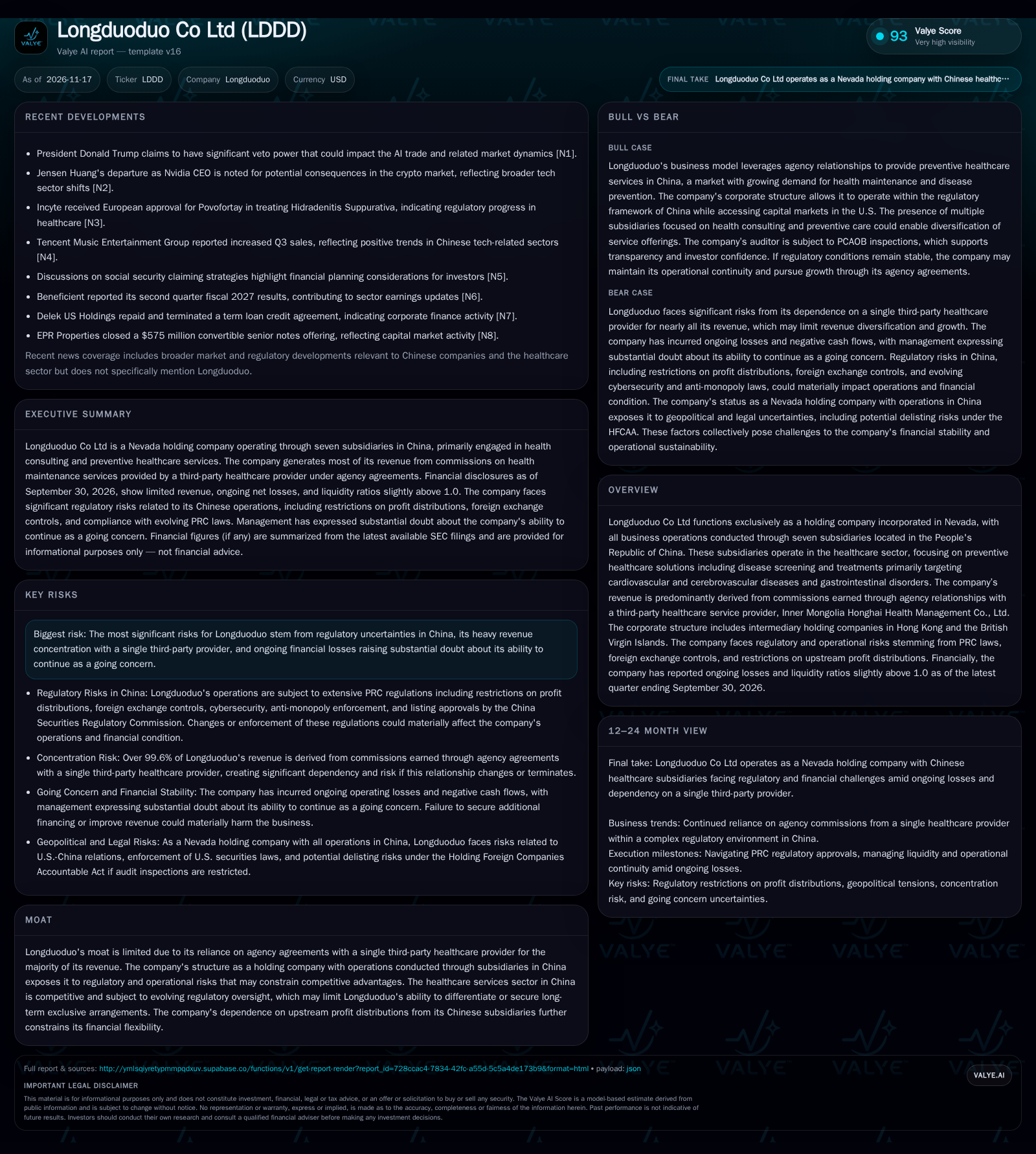
Longduoduo Co Ltd operates as a Nevada holding company with Chinese healthcare subsidiaries, deriving over 99.6% of its revenue from a single agency agreement. The company continues to post operating losses and negative cash flows, with management expressing substantial doubt about its ability to continue as a going concern. Regulatory constraints in China—particularly on profit distributions and foreign exchange—compound its operational fragility. Longduoduo’s future viability depends on maintaining its key agency relationship, navigating PRC regulatory risk, and developing a pathway to more diversified and sustainable revenue.
Longduoduo Co Ltd exemplifies the challenges faced by U.S.-listed holding companies operating exclusively in China’s heavily regulated healthcare sector. With virtually all revenue tied to a single agency relationship and persistent operating losses, the company’s future is precarious. Regulatory complexity—especially around profit repatriation and foreign ownership—adds further uncertainty. For Longduoduo to move beyond survival mode, it will need to diversify its revenue base, address its structural vulnerabilities, and adapt to China’s evolving regulatory landscape.
Longduoduo’s Operating Reality: Revenue Dependence and Regulatory Barriers
Longduoduo Co Ltd functions as a Nevada holding company with all operations conducted through seven subsidiaries in China. As of September 30, 2026, the company reported just $17,595 in revenue for the quarter and a net loss of $436,962, continuing a pattern of negative operating cash flows and accumulated losses [S2]. Over 99.6% of its gross revenue derives from commissions under agency agreements with Inner Mongolia Honghai Health Management Co., Ltd., which are set to expire in 2029 [S2]. This extreme revenue concentration heightens business fragility, as any disruption to this single relationship could be existential. The company reported cash and liquidity metrics for the period; these figures do not by themselves establish operating runway, investment capacity, financial flexibility, or financing capacity. [S2] Management has formally expressed substantial doubt about Longduoduo's ability to continue as a going concern.
Commission-Driven Model: Limited Scale, High Fixed Costs, and Structural Constraints
Longduoduo’s economics are defined by its role as an agent—earning commission revenue from health maintenance services provided by a third-party rather than delivering services directly. This model can offer asset-light scalability if volumes grow, but in Longduoduo’s case, the lack of volume and total reliance on a single provider leave little room for positive operating leverage. With quarterly revenue below $20,000 and ongoing operating losses, fixed costs (corporate overhead, compliance, and subsidiary management) overwhelm the commission stream [S2].
The agency structure means Longduoduo avoids the capital intensity of operating clinics or developing proprietary healthcare technology. However, this also limits its pricing power and margin potential: commission rates are typically set by the principal, and the agent’s negotiating leverage is minimal without alternative relationships or material patient flow. Furthermore, the company’s ability to invest in growth or diversification is constrained by PRC restrictions on profit repatriation and the lack of internally generated cash flow.
If Longduoduo were to pursue direct service delivery or develop proprietary offerings, capital requirements would rise sharply, along with regulatory and operational risk. Absent a shift in business model or a dramatic increase in agency volumes, the basic economics remain unfavorable.
Competitive Context: Agency Model Vulnerabilities and the Fight for Relevance in Chinese Preventive Healthcare
Within China’s preventive healthcare sector, Longduoduo competes indirectly with a broad range of service providers—including hospital networks, specialized health management chains, and technology-enabled digital health platforms. Its agency-only approach, with no proprietary services, data, or brand, leaves it highly exposed to principal risk: should its lone partner (Inner Mongolia Honghai Health Management Co., Ltd.) change agency terms, internalize distribution, or switch partners, Longduoduo would have no fallback revenue streams [S2].
Other healthcare service companies in China often pursue integrated models, building direct-to-patient relationships, proprietary clinical assets, or differentiated technology. These approaches can support higher margins, recurring revenue, and stickier customer engagement—advantages that Longduoduo currently lacks. The company’s holding structure and regulatory exposure may provide some access to U.S. capital markets, but they do little to offset its weak positioning in the value chain or its dependence on regulatory permissions for upstream cash movement.
In this environment, agency intermediaries without unique capabilities or multiple principal relationships are structurally disadvantaged.
What Would It Take for Longduoduo to Unlock Growth and Margin Expansion?
A favorable scenario for Longduoduo would require several concurrent developments: (1) continued and expanded agency commissions from Inner Mongolia Honghai Health Management Co., Ltd., with increased volumes and/or improved commission terms; (2) regulatory stability in China, permitting reliable profit distributions and currency conversion; and (3) successful diversification, either by adding new agency relationships, developing proprietary healthcare offerings, or expanding into adjacent markets.
Confirmation of this scenario would require clear evidence of rising commission revenue, new service partnerships, or direct expansion into higher-margin preventive care segments. Announcements regarding new commercial agreements, growing patient volumes, or regulatory approvals for profit repatriation would be early signals. Falsification would occur if the principal agency relationship is terminated, if regulatory intervention restricts upstream cash movement, or if losses accelerate without a path to scale.
Prolonged Stagnation: Dependency and Regulatory Drag Impede Progress
Absent a change in its agency relationship, business mix, or regulatory environment, Longduoduo is most likely to remain in a state of operational stasis. Modest commission income from its existing agency agreement may continue through 2029, but with fixed costs and regulatory friction, ongoing net losses and negative cash flows are likely [S2].
Evidence for this scenario includes continued low revenue, static or declining volumes, and no meaningful change in the company’s agency portfolio or business structure. Any modest improvements in liquidity or cost containment may only delay eventual insolvency unless a transformative event occurs. The thesis would be falsified if the company manages to secure new agency partners, demonstrate sustained revenue growth, or unlock profit distributions from its PRC subsidiaries.
Critical Failure Points: Agency Termination, Regulatory Clampdown, or Insolvency
The most acute risk for Longduoduo is the loss or non-renewal of its core agency agreement, which would immediately eliminate nearly all revenue. The company’s lack of diversification means it would have no alternative income streams, likely forcing rapid cost cuts or liquidation. Regulatory tightening—particularly a crackdown on foreign holding structures, stricter controls on profit distributions, or adverse rulings under the Holding Foreign Companies Accountable Act—could also sever access to cash or capital markets, accelerating insolvency [S2].
Early warning signs of this downside scenario would include negative developments in agency negotiations, public disclosures of regulatory investigations or adverse PRC rulings, or further deterioration in operating cash flow. Falsification would require clear evidence of new revenue sources, regulatory relief, or a credible financing arrangement that extends runway beyond the near term.
Milestones and External Cues That Will Determine Longduoduo’s Viability
Renewal terms, performance metrics, and continuity of the agency agreement with Inner Mongolia Honghai Health Management Co., Ltd.; any public disclosure of renegotiation or early termination would be critical.
Quarterly commission revenue growth or decline; if disclosed, patient volume or transaction counts would help test the scalability of the agency model.
Progress in securing new agency relationships or launching proprietary healthcare services; announcements of new commercial partners or diversification initiatives would materially affect the business outlook.
Evidence of regulatory approval or successful upstreaming of profits from PRC subsidiaries to the holding company; concrete disclosures on dividend payments or foreign exchange conversions would signal improved potential financial flexibility.
Changes in PRC healthcare regulation, foreign ownership laws, or enforcement actions targeting U.S.-listed Chinese holding structures; tracking official PRC or CSRC communications is essential.
Cash burn rate and remaining liquidity as reported in future filings; an accelerating depletion of cash reserves would heighten going concern risk.
Any disclosure of financing arrangements, capital raises, or strategic investments that could extend runway or support diversification.
Disclaimer: This is research-only, informational analysis and not investment advice. It may include AI-generated interpretation and general industry context. Always verify important details using primary sources.

Comments