
Limitless X Holdings: Celebrity-Driven Wellness Ambitions Meet Financial and Operational Hurdles
Limitless X Holdings is building a multi-pronged ecosystem of health supplements, digital wellness tools, and entertainment brands, but faces acute liquidity pressure and structural dependency on licensing and celebrity relationships. The next phase hinges on scaling fulfillment, unlocking new digital revenue streams, and converting brand reach into recurring customer value.
Limitless X Holdings combines dietary supplements, AI-powered wellness tech, and celebrity brand partnerships in a direct-to-consumer model. Sustainable growth will require successful integration of technology, expansion of fulfillment infrastructure, and conversion of brand-driven attention into loyal, high-value customers. [S1] [S2]
Limitless X Holdings is attempting to fuse the reach of celebrity-driven branding with the scale of direct-to-consumer e-commerce and the promise of AI-powered wellness technology. Its diversified product portfolio and integration of content, events, and digital platforms reflect a modern ambition to capture health-conscious consumers across physical and digital touchpoints. However, with liquidity stretched and the business model dependent on licensing and the ongoing appeal of celebrity partners, Limitless X’s thesis will be tested by its ability to scale operations, launch new digital services, and turn high-profile attention into sustainable, recurring revenue streams. The coming quarters will reveal whether the company can navigate these challenges or whether its ambitions outpace its financial and operational foundation.
Liquidity Strain, Celebrity Licensing, and Technology Bets Define the Present
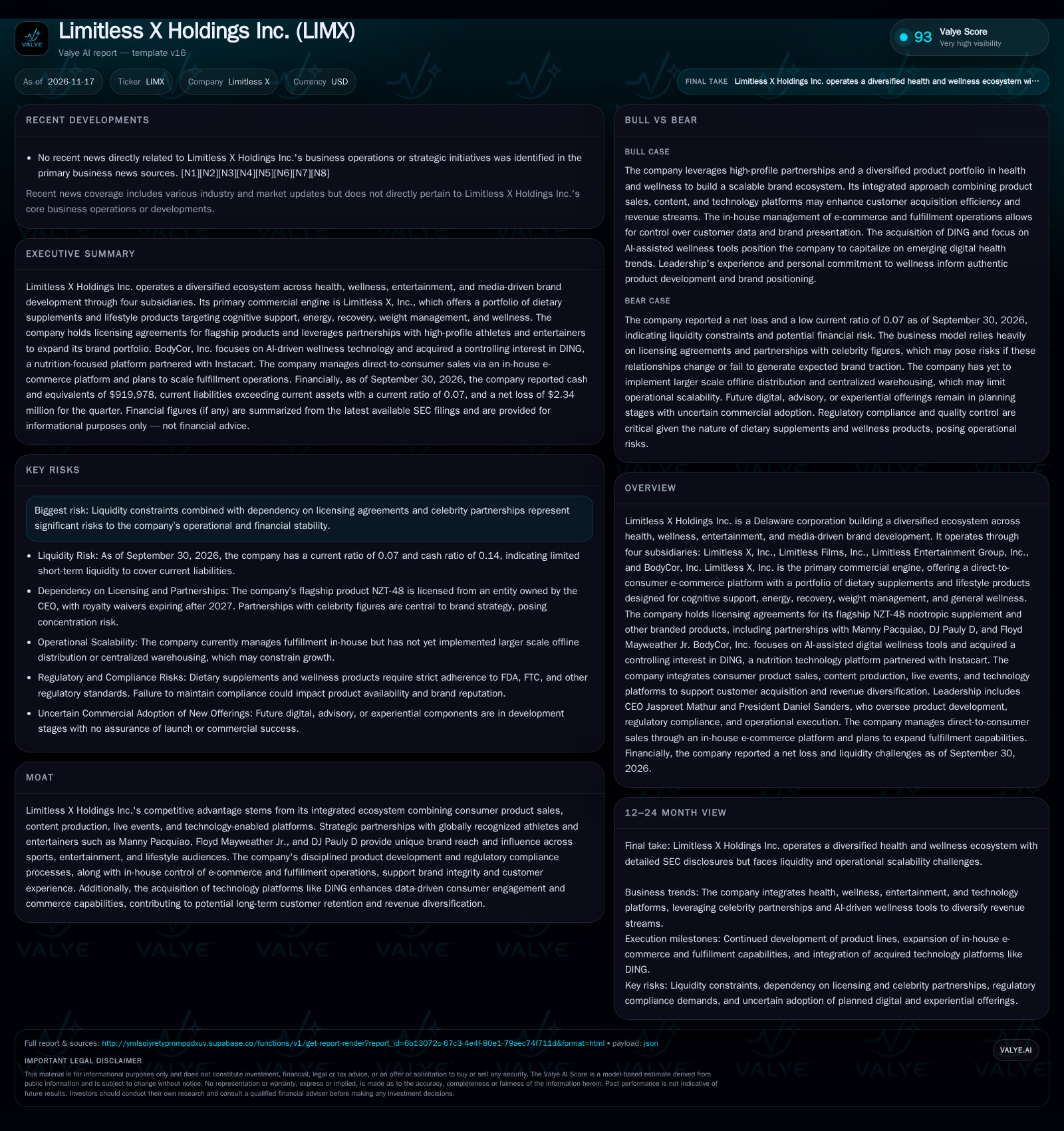
As of September 30, 2026, Limitless X Holdings reported cash and equivalents of $919,978, current assets of $464,647, and current liabilities of $6,611,170, resulting in a current ratio of just 0.07. The company posted a net loss of $2,341,669 and an EPS of -$0.12 for the quarter. [S2] These figures signal acute liquidity pressure and raise questions about the company's ability to meet short-term obligations without external funding or a rapid turnaround in operating cash flow.
The commercial engine remains its direct-to-consumer e-commerce business, which markets a range of supplements and wellness products under brands like NZT-48 and SuperSlim Gummies. The flagship NZT-48 product is licensed from Limitless Performance, Inc., with a royalty waiver in place until December 2027, after which a 4% royalty on gross sales may apply unless renegotiated. [S1]
Brand visibility is amplified through licensing and development agreements with global personalities such as Floyd Mayweather (TMT brand), Manny Pacquiao, and DJ Pauly D. These partnerships are central to the company's marketing strategy, offering both reach and potential customer affinity, but also risk if the relationships falter or fail to convert fans into customers. [S1]
A notable strategic move is the acquisition of a 60% stake in DING, a nutrition-focused tech platform partnered with Instacart, aimed at integrating AI-enabled wellness guidance and commerce into the company's ecosystem. [S1]
How the Model Could Scale: Direct Sales, Brand Premium, and Tech-Enabled Upsell
Limitless X’s core revenue stream is direct-to-consumer (DTC) sales of proprietary and licensed health supplements and lifestyle products. The model relies on premium positioning, often justified by celebrity branding and perceived product quality, allowing for higher price points relative to generic competitors. Gross margins in the supplement space can be attractive, particularly with in-house e-commerce and fulfillment, but are highly sensitive to customer acquisition costs (CAC), retention rates, and the effectiveness of digital marketing.
The company’s current in-house fulfillment uses Shopify and ShipStation, with plans to expand into dedicated warehouse facilities. This could unlock operational leverage through better inventory control and improved customer experience—but also requires meaningful upfront investment and carries execution risk if demand does not scale as anticipated.
Licensing agreements represent both an asset and a liability: while the NZT-48 royalty waiver supports near-term gross margins, the scheduled 4% royalty post-2027 could pressure margins unless product volume or pricing power increases. The dependency on external IP and celebrity brands could also limit margin expansion or create renegotiation risk.
BodyCor’s investment in DING and AI-driven wellness tools points to a future in which subscription-based digital services, personalized nutrition plans, or commerce enablement could diversify revenue. However, the economics of digital wellness platforms are unproven at this scale, and success would require high engagement, low churn, and effective cross-selling to the existing product base. Capital requirements for tech development and customer onboarding may remain high in the near term.
Can Celebrity Partnerships and Tech Integration Fend Off Industry Giants?
Limitless X’s competitive edge is built around its ability to fuse celebrity influence, direct e-commerce, and emerging technology. In the crowded supplement and wellness market, most brands struggle for attention and differentiation. Celebrity partnerships with globally recognized athletes and entertainers provide immediate brand legitimacy and an initial funnel of potential customers. This can reduce CAC in the short term, but the sustainability of this advantage depends on the renewal and relevance of these partnerships—and on the company’s ability to translate ‘fan’ engagement into product loyalty.
On the technology front, the acquisition of DING and focus on AI-driven wellness could allow Limitless X to offer personalized digital experiences not easily replicated by legacy supplement companies. If successfully integrated, this could increase switching costs and recurring engagement, particularly if wellness recommendations drive repeat product purchases or subscriptions.
However, the company faces formidable competition from established supplement conglomerates, digitally native vertical brands, and tech-enabled wellness startups. Many of these rivals have deeper capital reserves, broader distribution, and existing digital platforms. The company’s reliance on licensing and external personalities exposes it to risks that vertically integrated or proprietary brands may not face, while its operational scale remains modest relative to the industry leaders.
Unlocking Recurring Revenue through Brand Ecosystems and Digital Wellness
In a favorable scenario, Limitless X leverages its celebrity partnerships and diversified product portfolio to rapidly grow its DTC customer base, using content and live events to deepen engagement. The integration of DING and AI-driven wellness tools creates a compelling digital layer, enabling personalized recommendations and commerce that could support larger baskets and retention.
Expansion into dedicated fulfillment infrastructure improves delivery times, customer satisfaction, and repeat purchase rates, supporting operating leverage. If the company successfully launches digital subscriptions or advisory services, it could unlock high-margin, recurring revenue streams that stabilize cash flow and reduce reliance on episodic product launches.
Key evidence confirming this scenario would include: material growth in active subscribers to digital wellness offerings, improved gross and operating margins, extension of celebrity partnerships with measurable impact on customer acquisition, and successful renegotiation or extension of the NZT-48 royalty waiver beyond 2027. Signs of positive cash flow from operations and a strengthening balance sheet would further validate the thesis.
Business Model Iteration Amid Liquidity Constraints and Execution Risk
The most plausible trajectory is that Limitless X continues to experiment with product launches and digital initiatives, but faces a lumpy growth pattern constrained by reported liquidity position and execution bandwidth. Celebrity partnerships generate episodic spikes in sales and customer acquisition, but conversion to loyal, recurring customers remains challenging in the crowded wellness space.
The company gradually builds out fulfillment capacity and integrates DING’s capabilities, but digital adoption and cross-selling into the core supplement business prove slower than hoped. Gross margins are pressured by marketing spend, royalty obligations (as the NZT-48 waiver expiration approaches), and the costs of scaling tech platforms.
External funding may be needed to bridge liquidity gaps, and the company’s negotiating leverage with licensors and celebrity partners is tested by ongoing financial strain. Evidence supporting this scenario would include continued net losses, periodic capital raises, moderate growth in digital engagement metrics, and only incremental improvement in cash conversion cycles.
Liquidity Crunch and Partnership Risk Trigger Strategic Contraction
If key celebrity partners disengage, or if licensing terms become more onerous (such as the NZT-48 royalty waiver expiring without extension), brand reach diminishes and customer acquisition costs rise.
Operational bottlenecks—such as fulfillment delays, regulatory missteps, or failed integration of DING—could erode customer trust and trigger negative word-of-mouth. If digital wellness offerings fail to gain traction, the company may be left with a costly tech investment that does not deliver meaningful revenue.
Confirmation of this scenario would come from further deterioration in liquidity metrics, a spike in short-term borrowing or dilutive equity raises, loss or non-renewal of major partnerships, and stagnant or declining product sales and digital engagement.
What Will Determine Whether Limitless X Converts Brand Buzz into Sustainable Value?
Gross margin trends by product line, especially as royalty obligations on NZT-48 approach reinstatement after 2027. If disclosed, margin expansion or compression will clarify pricing power and cost control.
Monthly active users and engagement rates for DING and any other digital wellness platforms, if disclosed, would indicate traction for the company’s tech-driven strategy.
Fulfillment efficiency metrics: order-to-delivery times, inventory turnover, and customer satisfaction scores as the company transitions to dedicated warehouse facilities.
Renewal, extension, or renegotiation of key celebrity licensing agreements, particularly as contracts mature or if any high-profile partner disengages.
Conversion rates from celebrity-driven marketing campaigns—how many engaged fans become repeat buyers or subscribers.
Regulatory compliance milestones: any FDA, FTC, or quality control developments that could impact product availability or brand reputation.
Evidence of successful launch, adoption, or monetization of planned digital/advisory offerings, as these are critical to the long-term revenue mix.
Disclaimer: This is research-only, informational analysis and not investment advice. It may include AI-generated interpretation and general industry context. Always verify important details using primary sources.

Comments