
Vivos Therapeutics: Integrated Sleep Care Ambition Meets Liquidity and Execution Hurdles
Vivos Therapeutics’ pivot from dental appliance sales to an integrated, medical-provider-led model for obstructive sleep apnea aims to capture more value per patient and expand its addressable market.
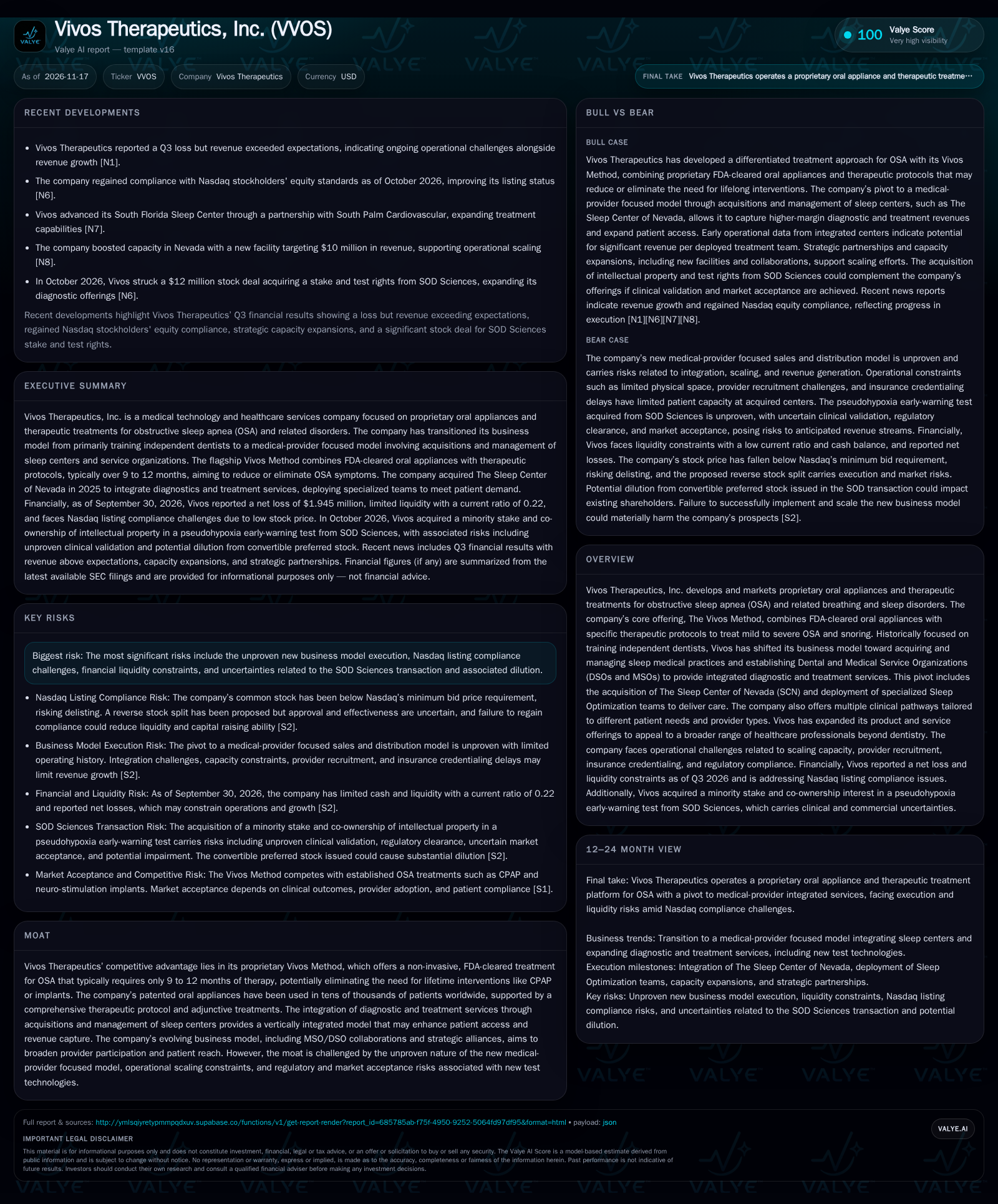
Vivos Therapeutics is betting on a vertically integrated, medical-provider-focused model to address obstructive sleep apnea, moving beyond its historical dentist channel. The success of its new model and recent diagnostic IP acquisition will hinge on rapid operational scaling, payer acceptance, and its ability to secure fresh capital—without overwhelming dilution to existing shareholders. [S1] [S2] [N6] [N8]
Vivos Therapeutics is attempting a complex transformation, moving from a dental appliance-centric business to a vertically integrated provider of sleep disorder care. By acquiring and managing sleep centers, deploying multidisciplinary teams, and expanding into diagnostics, Vivos aims to boost revenue per patient and improve clinical outcomes. The company's future now pivots on its ability to operationalize its new model at scale, secure reimbursement, and maintain capital access before financial constraints force difficult choices.
Recent Moves: Liquidity Crunch, Diagnostic Bet, and Operational Bottlenecks
The company reported cash and liquidity metrics for the period; these figures do not by themselves establish operating runway, investment capacity, financial flexibility, or financing capacity. Current liabilities stand at $16.16 million, raising near-term solvency questions. [S2]
In October 2026, Vivos acquired a minority stake and a 50% co-ownership interest in a pseudohypoxia early-warning diagnostic test from SOD Sciences for $12 million in Series C Convertible Preferred Stock. This instrument is convertible into up to 80 million shares at $0.15 per share, posing significant dilution risk if exercised. The diagnostic is unproven and may not achieve clinical validation or market acceptance. [S2]
The company’s new Sleep Optimization teams at the Sleep Center of Nevada are reportedly fully booked through April 2026, but physical capacity and operational bottlenecks are limiting patient intake despite demand. Each team has the potential to generate collections exceeding $500,000 per month with contribution margins above 50%, according to limited operational data. [S1]
Vivos’ stock price has fallen below the Nasdaq $1.00 minimum bid requirement, triggering a compliance notice and prompting a proposed reverse split. The effectiveness of this move—and continued listing—remains uncertain as of mid-November 2026. [S2] [N6]
How the Integrated Model Could Drive Revenue and Margin Expansion
Vivos’ legacy business centered on selling proprietary oral appliances through independent dentists, generating revenue per device but with limited capture of downstream value. The strategic pivot to acquiring and managing sleep centers, deploying SO teams, and offering integrated diagnostics and therapy aims to capture a larger share of the OSA care value chain. This approach could shift revenue mix toward high-margin services, especially if Vivos can successfully bill payers for diagnostics, treatment planning, and follow-up care.
The reported potential for each Sleep Optimization team to generate over $500,000 per month in collections with contribution margins above 50%—if scalable—would dramatically improve unit economics over the legacy appliance-only model. However, these figures are based on limited operational data and may not be representative as the company expands or encounters payer/credentialing complexity. [S1]
The integrated model carries higher fixed costs (facility leases, staff, provider salaries) but could benefit from operating leverage if patient flow and reimbursement scale with team deployment. Conversely, recruiting and credentialing providers, managing insurance contracts, and maintaining high utilization rates are critical to realizing this leverage. Underutilized capacity or reimbursement shortfalls would quickly erode margins.
The acquisition of diagnostic IP could, if validated and adopted, allow Vivos to further expand its revenue base into early detection and risk stratification for sleep disorders—a potentially lucrative adjacency. However, the commercial mechanics, pricing, payer acceptance, and regulatory pathway for the pseudohypoxia test remain highly uncertain.
OSA Market Dynamics: Differentiation, Substitution, and Barriers
The obstructive sleep apnea market is dominated by entrenched therapies such as CPAP devices and, for severe cases, surgical interventions or neurostimulation implants. Vivos’ main differentiator is its non-invasive, FDA-cleared oral appliances combined with a protocol that may resolve OSA in 9–12 months for compliant patients, potentially obviating the need for lifelong therapy. This could be attractive to patients averse to CPAP adherence or invasive procedures. [S1]
However, the transition to a provider-owned, integrated model exposes Vivos to new competitive dynamics. Hospital-owned sleep centers, multi-specialty clinics, and established DSOs/MSOs may have greater scale, payer relationships, and referral networks. Success will hinge on Vivos demonstrating superior outcomes, streamlined care pathways, and efficient reimbursement—none of which are yet proven at scale.
The company’s ability to recruit and retain skilled sleep specialists, credential with insurers, and build referral relationships will be tested as it expands. Barriers to switching for providers may be low unless Vivos offers clear clinical or economic advantages. For patients, switching frictions are largely determined by insurance coverage, perceived efficacy, and convenience.
If the pseudohypoxia test proves clinically valuable and is adopted as a standard screening tool, it could strengthen Vivos’ position as a vertically integrated OSA care provider. Yet, established diagnostic players and sleep labs may respond with competing offerings or entrenched relationships.
What Success Looks Like: Scaling Teams, Validating Diagnostics, and Capturing Value
In a favorable scenario, Vivos rapidly scales its integrated sleep centers by deploying additional SO teams, efficiently recruiting providers, and securing payer contracts that allow for robust reimbursement of both diagnostics and therapy. Patient demand remains strong, and operational bottlenecks are resolved through facility expansion or process optimization.
The pseudohypoxia early-warning test achieves clinical validation, receives regulatory clearance, and gains traction with providers and payers as a valuable screening tool, providing a differentiated entry point for Vivos to capture upstream diagnostic revenue. The company leverages this to expand its referral base and cross-sell its core treatment protocols.
Revenue per patient and per SO team approaches the upper end of early operational estimates, driving positive operating leverage and moving the company toward profitability. Capital infusions—whether from equity, debt, or strategic partners—are secured on manageable terms, mitigating dilution.
Evidence confirming this scenario would include: rapid addition of SO teams and new center launches; published clinical outcomes or payer coverage decisions for the pseudohypoxia test; sequential improvements in gross margin and operating cash flow; and successful retention of Nasdaq listing without punitive dilution.
Most Likely Trajectory: Incremental Expansion Amid Persistent Financial Strain
The most plausible near-term path for Vivos is an incremental expansion of its integrated model, with growth constrained by capital availability and operational complexity. New sleep centers and SO teams are added gradually, but bottlenecks in provider recruitment, insurance credentialing, and patient intake persist.
The pseudohypoxia test enters pilot studies or limited clinical use, but broad adoption and reimbursement are delayed pending further validation. Appliance sales and service revenues grow modestly but remain insufficient to offset ongoing operating losses and fixed cost absorption challenges.
The company secures short-term capital through a mix of equity raises, asset sales, or partner funding, likely at the cost of substantial dilution. Nasdaq listing is preserved via a reverse split, but the stock remains volatile given uncertainty around business model execution and capital needs.
Evidence for this scenario includes: slow but steady expansion in center count and SO team deployment; lagging adoption or payer coverage of new diagnostics; continued net losses and working capital pressures; and incremental rather than transformative improvements in revenue and margin.
Where It Could Go Wrong: Capital Shortfall, Delisting, and Strategic Retrenchment
In an adverse scenario, Vivos is unable to secure sufficient new capital before liquidity runs out, forcing dramatic cost cuts, asset sales, or a halt to expansion. The reverse split fails to stabilize the stock price, leading to Nasdaq delisting and further limiting access to public capital markets.
Operationally, persistent delays in provider recruitment and insurance credentialing prevent the company from scaling SO teams or opening new centers. Utilization drops, fixed costs remain high, and negative operating leverage accelerates cash burn. Appliance sales stagnate as independent dentist engagement wanes.
The pseudohypoxia test fails to achieve clinical validation or regulatory clearance, resulting in impairment of the acquired IP and no incremental revenue. Dilution from conversion of Series C preferred stock further erodes existing shareholder value without offsetting operational improvement.
Evidence confirming this scenario would include: inability to raise capital before cash is exhausted; center closures or layoffs; Nasdaq delisting; asset impairments; and rapid increase in share count with no commensurate revenue growth.
Milestones That Will Reveal Whether Vivos’ Integrated Model Can Deliver
The rate at which new Sleep Optimization teams are added and reach full utilization—if disclosed—will indicate scalability and demand.
Monthly collections and contribution margin per SO team, as reported in future filings, would help test the economic viability of the integrated model.
Progress toward insurance credentialing and payer contracts for both treatment and diagnostics; updates on reimbursement rates and coverage decisions would be critical.
Clinical validation, regulatory milestones, and initial commercial agreements for the pseudohypoxia early-warning test will signal whether the diagnostic expansion is likely to pay off.
Nasdaq compliance status and the outcome of the proposed reverse split; ongoing listing is vital for capital access and credibility.
Provider recruitment and retention rates, as well as patient intake trends at owned and affiliated centers, would illuminate operational execution.
If disclosed, patient outcomes and satisfaction metrics post-treatment could help differentiate Vivos from incumbent CPAP and surgical alternatives.
Disclaimer: This is research-only, informational analysis and not investment advice. It may include AI-generated interpretation and general industry context. Always verify important details using primary sources.

Comments