
Freedom Metals Acquisition Corp.: SPAC Structure, Opportunity Optionality, and the Challenge of Target Selection
Freedom Metals Acquisition Corp. (FDMM) is a newly formed SPAC with a mining and critical minerals focus, a substantial trust account, and strong near-term liquidity. Its value proposition now shifts from capital structure to the successful identification and execution of a business combination, with investor upside and risk hinging on sponsor strategy, deal discipline, and market conditions for mining sector targets.
FDMM is a blank check company with $275M in trust and a stated focus on mining and critical minerals, but as of Q3 2026, it has not identified a merger target or begun operations. Current income is limited to interest on its trust assets, and future value depends entirely on the successful execution of a business combination. Investors face high uncertainty until a concrete deal is announced and evaluated.[S1]
Freedom Metals Acquisition Corp. (FDMM) presents a classic special purpose acquisition company (SPAC) profile: substantial cash in trust, positive net income from interest, and no operating business as of its latest filing. With a declared intent to pursue a merger in the mining and critical minerals sector, FDMM’s current state is defined by its capital structure and sponsor strategy rather than fundamentals or operations. For investors, the story is one of optionality and binary risk—until a target is identified and a deal is executed, the path forward is speculative and highly dependent on sponsor execution and market opportunity.[S1]
SPAC Structure and Financial Position Define the Present
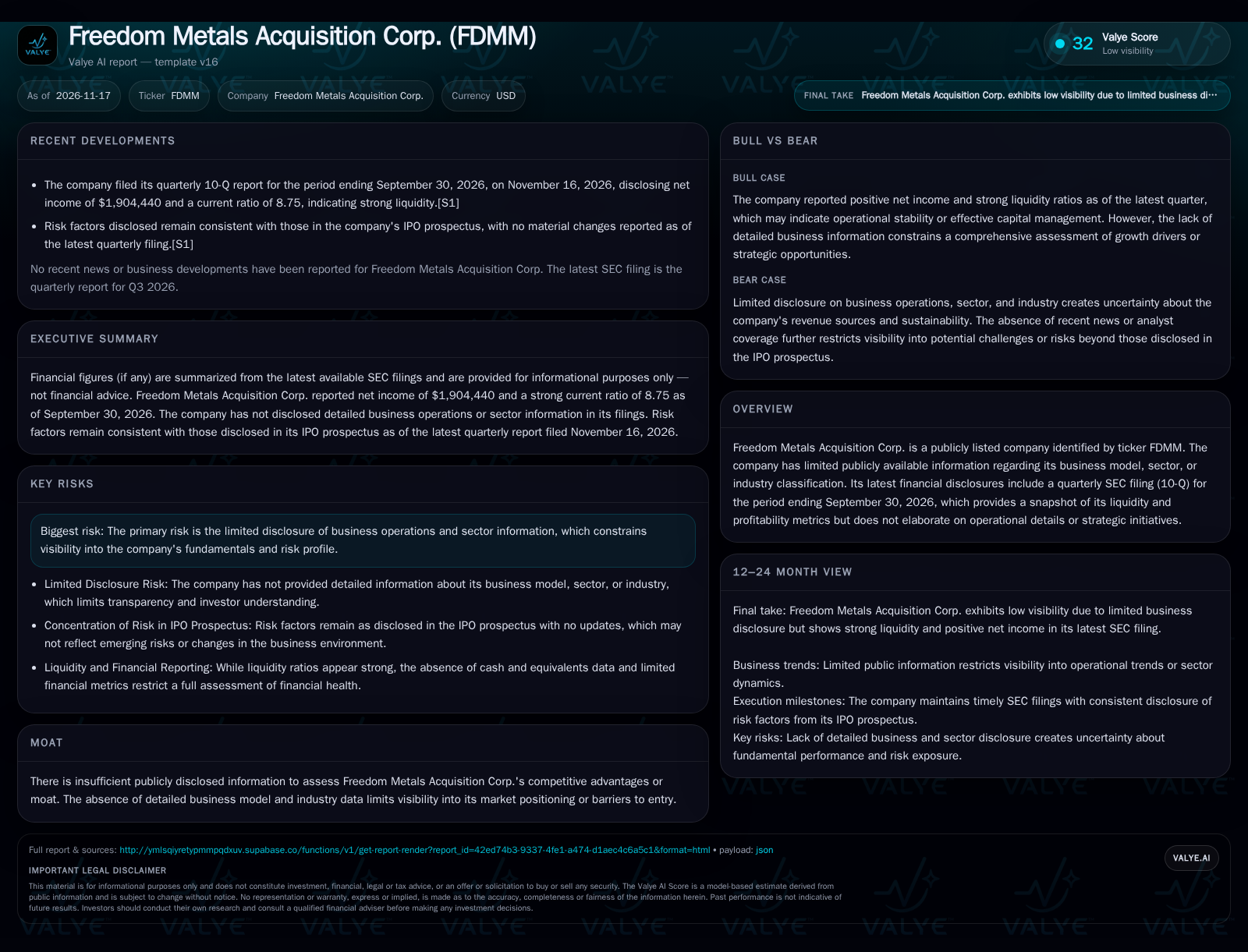
Freedom Metals Acquisition Corp. closed its IPO on July 9, 2026, raising $275 million through the sale of 27.5 million units at $10 each, supplemented by $8.25 million from a private placement. The company reported a current ratio of 8.75 for the period. [S1] The current facts underscore that FDMM’s value is entirely contingent on future deal execution, with no operational revenues or sector-specific momentum yet in play.
How Value Could Be Created: SPAC Economics and the Merger Imperative
FDMM’s business model, like all SPACs, is to deploy its capital by merging with or acquiring a target company—potentially in mining or critical minerals, per its stated focus. Until a transaction closes, economics are limited to interest earned on the trust account, offset by public company operating costs and non-cash expenses. The capital structure—$275 million in trust—provides significant dry powder, but this capital is ring-fenced for the eventual business combination or potential redemption by shareholders.
SPACs typically face a fixed timeline (often 18-24 months post-IPO) to complete a deal, after which funds are returned to shareholders if no acquisition is made. Sponsor economics are heavily skewed toward successful deal completion, with founder shares and warrants providing upside only if a merger occurs and the post-combination entity performs. For public shareholders, the opportunity set is binary: if a compelling target is secured and the deal is well-structured, upside can be substantial, especially in sectors like critical minerals where public market access is limited; if not, capital is returned with modest interest, minus deal and administrative costs.
Operating leverage is essentially zero until a merger closes. After a combination, economics would shift entirely to those of the acquired company—potentially high capital intensity, commodity price exposure, and significant execution risk if the target is an early-stage mining asset. Until then, FDMM’s income statement is a function of trust yields and G&A burn.
SPAC Competition and the Hunt for Scarce Mining Assets
FDMM’s competitive environment is defined by the broader SPAC market and, more specifically, by the universe of acquirers seeking attractive mining and critical mineral assets. The mining SPAC space is crowded, with significant sponsor capital chasing a limited pool of public-ready targets. Traditional mining companies, private equity, and corporate acquirers also compete aggressively for high-quality assets, often with greater technical expertise or operating synergies.
SPACs may offer speed, public listing access, and sponsor expertise as selling points to targets, but they are sometimes disadvantaged by market skepticism, dilution from sponsor/founder shares, and the need to achieve post-merger investor buy-in. For critical minerals, geopolitical and supply chain urgency could make SPAC capital attractive to certain targets, but the field is noisy and many deals have struggled to deliver post-merger value. The key differentiator for FDMM will be its ability to source and negotiate a credible, value-accretive target in a sector where asset quality, jurisdiction, and capital needs vary widely.
A Successful, Accretive Business Combination in Critical Minerals
The most favorable outcome is that FDMM identifies and merges with a high-quality mining or critical minerals business—ideally one with advanced-stage assets, strong management, and a credible path to cash flow. If the sponsor can negotiate favorable terms and minimize dilution, the merged entity could benefit from public market access, capital for project development, and sector tailwinds driven by demand for battery metals or supply chain reshoring.
Upside would be confirmed by the announcement of a binding business combination agreement with a recognized, credible mining asset, clear deal terms, and evidence of strong institutional investor support (e.g., PIPE investments or anchor shareholders). Further confirmation would come from post-announcement market reaction, regulatory approvals, and successful closing of the transaction. Falsification would occur if the company fails to announce a deal within the SPAC’s permitted timeframe, or if the proposed target is low-quality, highly speculative, or rejected by shareholders.
Waiting Game: Capital Preservation with Deal Uncertainty
The most probable scenario is that FDMM continues to search for a target, incurring modest G&A and compliance costs while earning interest on its trust assets. Over the next several quarters, investors can expect limited earnings, no operating revenue, and minimal change in risk disclosures. If market conditions in the mining sector remain competitive or volatile, the sponsor may face challenges in sourcing a suitable target or negotiating favorable terms.
The base outcome is that FDMM either announces a deal with a modest or early-stage asset—potentially with significant technical or jurisdictional risk—or, if no deal is found, returns capital to shareholders at the end of the SPAC’s permitted window, net of expenses. Confirmation would come from periodic SEC filings showing continued capital preservation and clean audit trails; falsification would occur if the trust is meaningfully depleted or a deal is announced that fails to clear shareholder or regulatory approval.
Sponsor Fails to Deliver: Redemption or Value Destruction
The primary risk is the failure to secure a quality business combination within the required timeline, triggering the return of funds to shareholders minus expenses and opportunity cost. In this scenario, investor returns are capped at the trust value plus interest, less any costs associated with the SPAC’s operation. A more adverse outcome would involve the sponsor pursuing a poor-quality or speculative target—such as an early-stage mining project with little resource certainty or a company with significant environmental or geopolitical risk—leading to post-merger value destruction as the market discounts the new entity.
This scenario would be confirmed by repeated extensions without substantive progress, trust account erosion from operating costs, or the announcement of a controversial or poorly received target. Falsification would require evidence of a credible, well-supported business combination or sustained trust capital preservation with clear communication from the sponsor.
Milestones That Will Determine FDMM’s Strategic Trajectory
Announcement of a letter of intent or definitive agreement for a business combination, with clear disclosure of target sector, asset quality, and deal structure.
Updates on the SPAC’s permitted window for deal completion, including any extensions or shareholder votes on timeline changes.
Level and source of G&A and compliance expenses, as trust account erosion would impact eventual redemption value.
Disclosure of any PIPE (private investment in public equity) commitments or anchor investor participation in a proposed deal, as this would signal external validation.
Regulatory or shareholder approval milestones for any announced transaction, including proxy filings and redemption rates.
If disclosed, details on sponsor alignment and dilution, including founder share structure and potential earnouts.
Material changes in risk disclosures or new risk factors in SEC filings, which could indicate evolving strategy or operational developments.
Market and sector conditions for mining and critical minerals, as these will affect both target availability and post-combination investor appetite.
Disclaimer: This is research-only, informational analysis and not investment advice. It may include AI-generated interpretation and general industry context. Always verify important details using primary sources.

Comments