
Hallmark Venture Group: IP Limits, Capital Gaps, and Dependency Risks Define a Precarious Drone Ambition
Hallmark Venture Group’s recent pivot around Korea-only drone IP, substantial capital shortfalls, and operational reliance on a related party create a business model with sharply constrained upside and acute execution risk. The company’s inability to exploit its technology in its only protected market, combined with regulatory and dilution pressures, sets a high bar for any turnaround scenario.
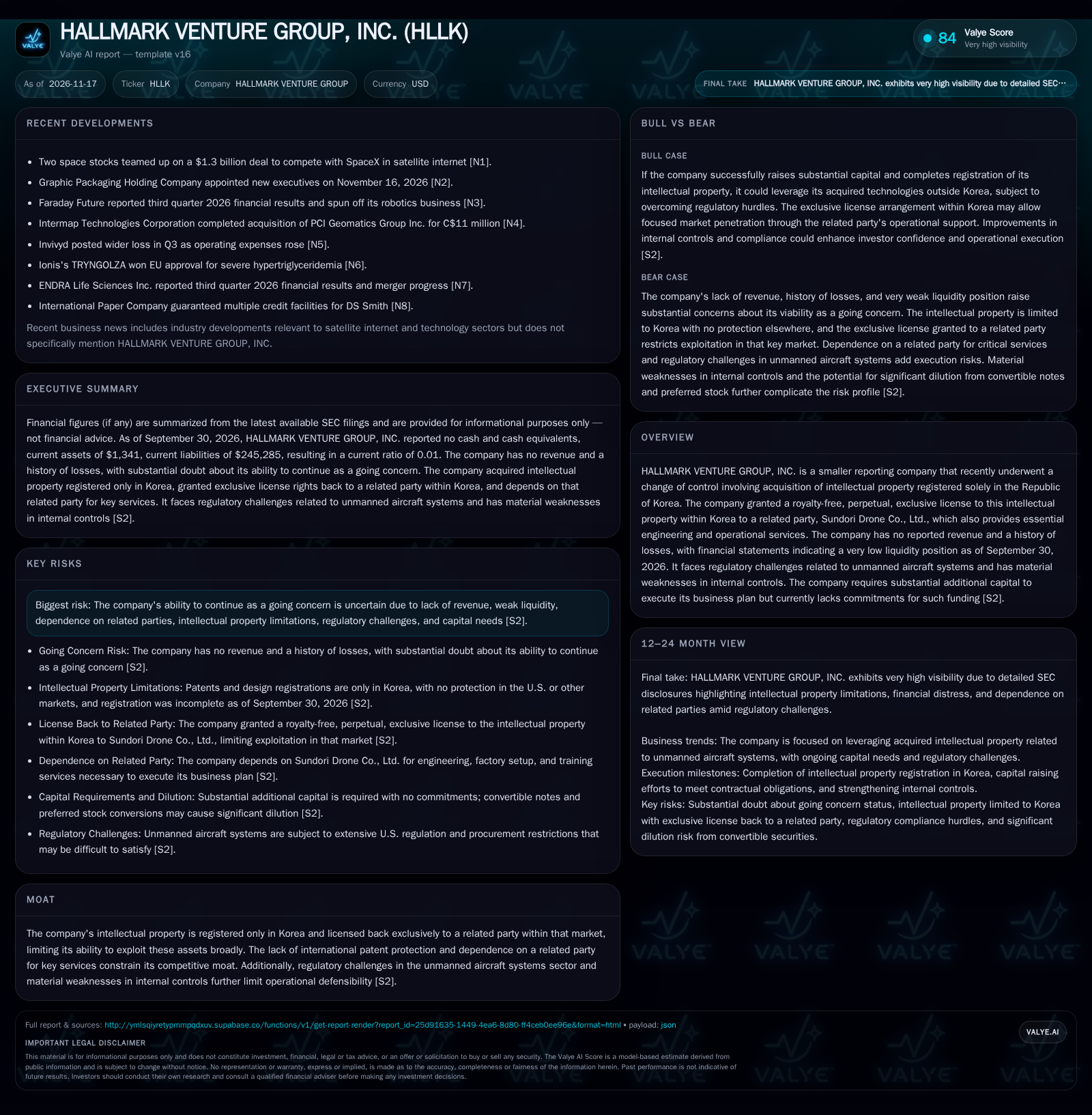
Hallmark Venture Group has no revenue, no cash, and material weaknesses in internal controls, with its only intellectual property registered in Korea and licensed back exclusively to a related party. Execution of its unmanned aircraft ambitions is hampered by capital shortages, regulatory barriers, and the need for related-party support, while convertible securities and preferred stock raise the threat of severe dilution. The business faces existential risk unless it can secure significant new funding and resolve core structural limitations. [S2]
Hallmark Venture Group, Inc. stands at a critical juncture, with its entire business plan staked on intellectual property registered only in Korea and operationalized through a complex, highly constrained relationship with a related party. The company’s inability to generate revenue, absence of cash, and lack of control over its sole protected market—compounded by severe regulatory and capital hurdles—underscore daunting structural barriers. Unless Hallmark can raise significant new capital and somehow expand or meaningfully exploit its technology portfolio, its prospects are defined less by growth potential than by a struggle to survive.
Recent Capital and IP Moves Sharply Limit Strategic Options
As of September 30, 2026, Hallmark Venture Group reported no cash, current assets of just $1,341, and current liabilities of $245,285, resulting in a current ratio of 0.01 and a cash ratio of 0. The company has no revenue and a persistent record of operating losses, with its auditors expressing substantial doubt about its ability to continue as a going concern [S2].
In a recent change-of-control transaction, Hallmark acquired intellectual property registered only in Korea, but immediately granted a royalty-free, perpetual, exclusive license to that IP within Korea to Sundori Drone Co., Ltd., a related party. This move effectively eliminates Hallmark’s ability to monetize its sole protected technology in the only jurisdiction where it is recognized. Registration of the IP assignments with the Korean Intellectual Property Office remained incomplete as of the reporting date, further muddying enforcement prospects [S2].
The company is contractually obligated to use commercially reasonable efforts to raise and deliver at least $5 million in capital by December 9, 2026, and in every subsequent six-month period, but as of the latest filing, it has no committed sources for such funding. Hallmark’s business plan depends on Sundori Drone for engineering, factory setup, and training, creating a deep operational dependency on a single related-party vendor [S2].
How the Business Could (or Might Never) Make Money
The company’s stated ambition is to commercialize unmanned aircraft systems (UAS), but its only tangible asset is Korean-registered IP that it cannot exploit in Korea due to the exclusive license granted to Sundori Drone. This arrangement leaves Hallmark with little to no direct revenue opportunity from the only market where its technology is protected.
Commercialization outside Korea is theoretically possible, but the absence of patent protections elsewhere means any product or service based on this IP is vulnerable to immediate copying or competitive circumvention. Without enforceable IP rights, Hallmark’s prospects to generate high-margin licensing or product revenue are severely compromised.
Hallmark’s fixed costs are likely dominated by public company expenses, compliance costs, and any R&D or engineering fees paid to Sundori Drone for services. Variable costs would only materialize if the company managed to launch or sell products. Given the lack of cash and the need for substantial new capital, any operational ramp-up would require external funding—likely at highly dilutive terms due to the presence of convertible notes and preferred stock that could convert into more than the current outstanding common shares [S2].
Thus, Hallmark’s business model is capital-intensive with no clear path to revenue or positive gross margin, and faces a structural inability to generate cash flows under current arrangements.
Competitive Prospects Are Hobbled by Structural and Regulatory Barriers
In the UAS sector, competitive advantage is typically driven by proprietary technology, regulatory certifications, and the ability to scale manufacturing or integrate with defense and commercial ecosystems. Hallmark does not currently possess enforceable intellectual property outside Korea, nor does it have control over its own technology in Korea due to the exclusive license.
The company’s dependence on Sundori Drone for engineering and operational capability creates both a supplier risk and a strategic conflict: Sundori, as exclusive licensee, has every incentive to prioritize its own interests in Korea, and Hallmark’s ability to oversee, audit, or enforce performance is likely limited.
UAS competitors—ranging from established aerospace firms to agile startups—face equally daunting regulatory hurdles in the U.S. and other major markets, but usually have either broader IP portfolios, established customer bases, or direct manufacturing control. Hallmark is further disadvantaged by material weaknesses in internal controls, regulatory uncertainty, and a lack of operational track record.
Unless Hallmark can secure IP protection in additional markets or pivot to a differentiated service offering, it is difficult to see a path to sustainable market share or defensibility against both established and emerging competitors.
A Turnaround Would Require Capital, IP Expansion, and Operational Independence
In a best-case scenario, Hallmark could raise the required $5 million (or more) in new capital, complete the registration of its IP assignments in Korea, and negotiate access to additional markets or develop new intellectual property with broader protection.
If Hallmark were able to secure enforceable IP in key jurisdictions such as the U.S., EU, or China, it might attempt to partner with established drone manufacturers or defense contractors, offering technology integration or licensing. Successful execution would require the company to reduce its reliance on Sundori Drone, establish robust internal controls, and demonstrate at least one commercial proof point—such as a pilot program or a paid development contract.
Confirmation of this scenario would require: (1) disclosure of a major capital raise or strategic investment; (2) completion of IP registrations in multiple jurisdictions; (3) evidence of a third-party customer or partner agreement outside the related-party ecosystem; and (4) remediation of internal control weaknesses. Any such developments would signal a plausible path to revenue and improved competitive positioning.
Absent New Funding, Ongoing Losses and Strategic Drift Likely Persist
The most plausible outcome under current conditions is that Hallmark continues to operate at a minimal level, incurring public company and compliance costs, while failing to raise the capital needed to execute its business plan. The company’s inability to monetize its Korean IP, lack of protection elsewhere, and operational dependency on a related party suggest the business will remain stuck in a pre-revenue, structurally constrained state.
Dilution from convertible notes and preferred stock is likely to increase as the company seeks any form of bridge financing, further eroding the position of existing common shareholders. If Hallmark does not resolve its internal control weaknesses, its ability to attract credible outside investment or execute a business combination will be further compromised.
This scenario would be confirmed by continued going concern warnings, lack of material fundraising or business development announcements, and ongoing related-party reliance without evidence of new market entry or IP expansion.
Liquidity Exhaustion and Control Dilution Could Force a Restructuring or Wind-Down
If Hallmark is unable to raise capital in the near term, the company may be forced to curtail operations, seek bankruptcy protection, or enter into a distressed sale of assets (to the extent any are marketable). The lack of cash and inability to generate revenue means the business cannot meet ongoing obligations, including SEC reporting requirements and any future R&D or operational outlays.
Convertible noteholders and the controlling preferred shareholder (EQUORIX LLC) could exercise conversion rights, resulting in massive dilution and the potential loss of any remaining value for common shareholders. The unresolved IP registration and exclusive license in Korea could leave Hallmark with no enforceable assets to monetize in a wind-down scenario.
Evidence for this scenario would include default notices, bankruptcy filings, cessation of SEC reporting, or the announcement of a forced asset sale. Additional dilution events without a clear operational turnaround would also support this outcome.
Milestones That Will Decide Hallmark Venture Group’s Future Viability
Disclosure of any capital raised—particularly any transaction approaching or exceeding the $5 million threshold for the current six-month period—would be a critical test of survival.
Completion and public confirmation of IP assignment registration with the Korean Intellectual Property Office, as well as any new registrations outside Korea, would help clarify the company’s ability to enforce and monetize its technology.
Announcements regarding the reduction or remediation of material weaknesses in internal controls, including auditor commentary, would be crucial to attracting outside investment.
Evidence of revenue generation—customer contracts, pilot projects, or third-party licensing agreements (if disclosed)—would provide the first proof point for commercial traction.
Any material change in the relationship with Sundori Drone Co., Ltd., such as renegotiation of the license or a shift in operational dependency, would significantly alter the risk/reward profile.
Disclosure of further convertible note conversions, preferred stock conversions, or other dilutive events would materially affect shareholder value and control.
Regulatory developments or explicit challenges regarding unmanned aircraft systems in Hallmark’s target markets could either open or close potential commercialization pathways.
If disclosed, progress toward establishing patent protection or enforceable IP rights in additional jurisdictions would be a prerequisite for long-term value creation.
Disclaimer: This is research-only, informational analysis and not investment advice. It may include AI-generated interpretation and general industry context. Always verify important details using primary sources.

Comments