
SATIVUS TECH: Automated Saffron Ambition Meets Severe Liquidity Strain
SATIVUS TECH CORP. is advancing an automated, container-based saffron cultivation platform but is constrained by an acute liquidity shortfall, sharply reduced R&D, and ongoing net losses. The company's ability to realize its AgTech vision now hinges on urgent external funding or a radical operational pivot.
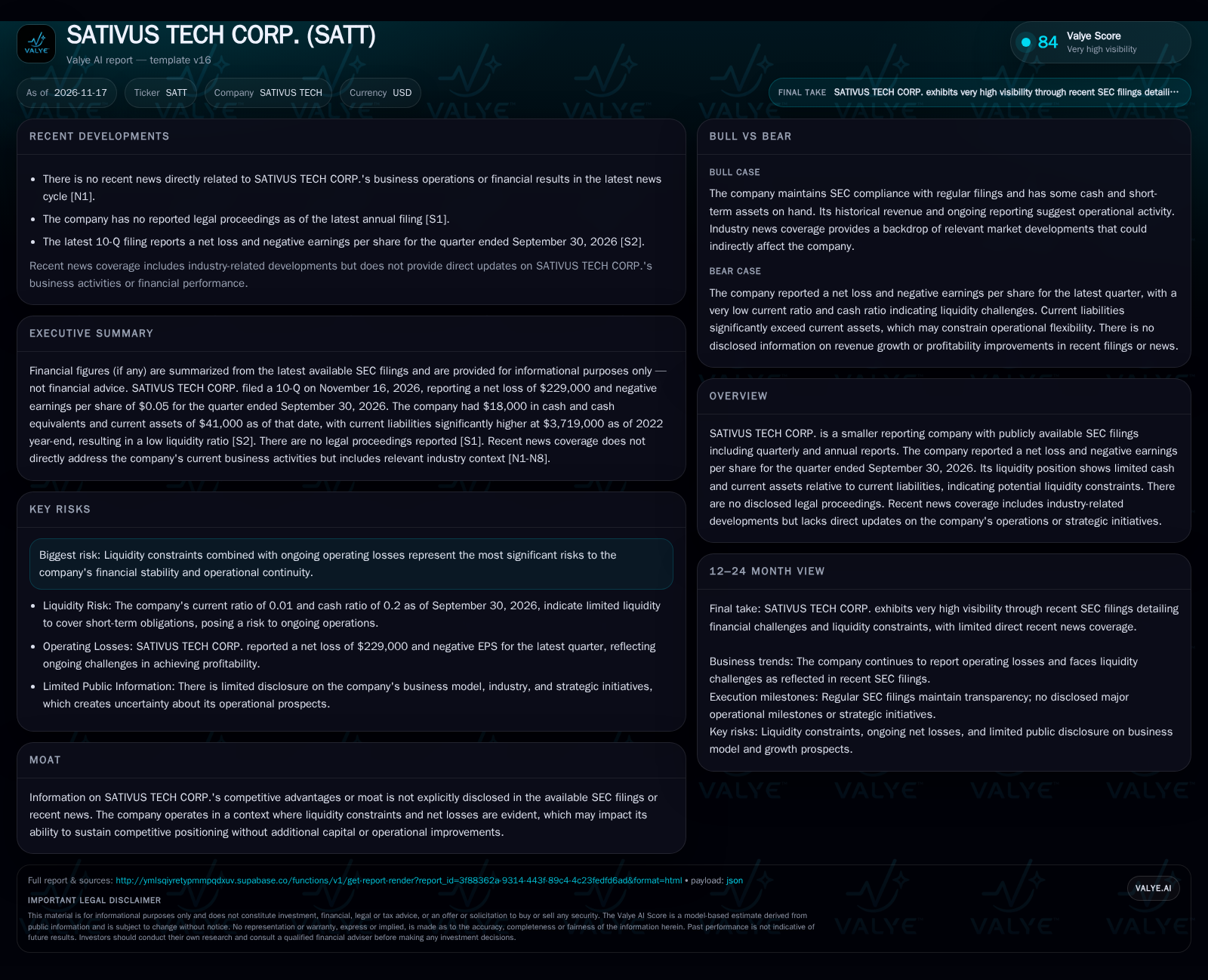
SATIVUS TECH CORP. is developing an indoor, automated saffron-growing system through its majority-owned Israeli subsidiary, Saffron Tech. Despite promising claims about yield and environmental benefits, the company faces immediate liquidity pressures: as of September 30, 2026, it held only $18,000 in cash against $41,000 in current assets and historical current liabilities in the millions. R&D and G&A spending have been sharply curtailed, suggesting cash preservation efforts. Commercial viability and future operations are now contingent on external capital or a significant strategic shift. [S2]
SATIVUS TECH CORP. is attempting to commercialize a fully automated, containerized saffron cultivation platform that promises high yield, year-round production, and sustainability advantages. However, the company's vision is now overshadowed by a dire liquidity situation: with just $18,000 in cash, a current ratio close to zero, and sharply curtailed R&D, Sativus Tech faces an existential financial crunch. The company’s future is now a race—either to secure new capital or to achieve a rapid commercial breakthrough with its technology.
Liquidity Squeeze and R&D Retrenchment Define the Present
As of September 30, 2026, SATIVUS TECH CORP. reported just $18,000 in cash and $41,000 in current assets, while historical current liabilities stood at $3.7 million as of year-end 2022, yielding a minuscule current ratio of 0.01. The company recorded a net loss of $229,000 for the most recent quarter, with negative earnings per share of -$0.05. Research and development spending has been slashed: R&D expenses for the third quarter of 2026 fell to $15,000 from $169,000 in the same period of 2025, and general and administrative expenses dropped to $51,000 from $151,000. These facts signal an acute liquidity crisis and a pivot toward cash preservation, with active product development and operational expansion likely on hold. No recent revenue, commercial contracts, or new financings are disclosed. [S2]
Automated Saffron: High-Value Crop, High Fixed Costs, and Funding Dependency
Sativus Tech’s economic thesis rests on its fully automated, remotely managed saffron cultivation containers, which aim to dramatically increase yields (up to 10x traditional farming per unit area) and reduce labor, water, and chemical inputs. If the platform works as described, it could enable premium saffron production in geographies previously unsuitable for the crop, targeting both culinary and potentially pharmaceutical markets. However, the business model is likely capital-intensive: upfront investment is required for container fabrication, automation hardware, and R&D. Fixed costs are high, while variable costs may be relatively lower if labor and resource inputs are minimized. Revenue generation would depend on either direct sales of cultivation systems, a leasing/subscription model, or vertical integration into saffron sales—mechanics not yet established in filings.
At present, the company’s ability to generate revenue is not evident: there are no reported recent sales or customer contracts. With cash nearly depleted, Sativus Tech’s economics are dominated by its funding gap. The company’s survival and operational leverage now depend almost entirely on its ability to raise capital or secure forward contracts.
The capital intensity of Sativus Tech’s model implies a critical dependency on achieving economies of scale to justify upfront investments. If the company can standardize container production and automation components, unit costs could decline substantially over time, improving margins. However, this scaling is contingent on securing sufficient early demand to support volume manufacturing and amortize fixed costs. Additionally, the company’s choice of revenue model—whether outright sales, leasing, or subscription—will heavily influence cash flow dynamics and capital requirements. For instance, a leasing model may generate recurring revenue but necessitate ongoing capital expenditure for inventory buildup, whereas direct sales would require robust sales channels and customer acquisition capabilities. Without clarity on these monetization mechanics, the financial sustainability of the business remains uncertain.
AgTech Automation Race: Saffron Focus Amid Broader Indoor Farming Competition
Sativus Tech is targeting a niche within the AgTech sector—automated, indoor production of high-value crops, with a current focus on saffron. The value proposition centers on yield, quality, and input efficiency. Competitively, the company faces a fragmented but increasingly well-funded landscape: vertical farming startups, containerized agriculture platforms, and established greenhouse producers are all pursuing automation and year-round cultivation, albeit often for more commoditized crops.
Saffron’s high price and traditional supply constraints offer an attractive target, but barriers to entry are falling as hydroponics, controlled environment agriculture, and IoT-based automation become more accessible. Without established IP, distribution, or customer relationships, Sativus Tech’s competitive moat is unproven. Its acute liquidity crisis further undermines its ability to invest in product development, marketing, or partnerships, leaving it vulnerable to both direct competitors and technology substitution from broader indoor farming innovations.
The competitive landscape in AgTech automation increasingly favors companies that can integrate advanced data analytics, machine learning, and IoT sensors into their platforms to optimize crop yield and resource efficiency. Sativus Tech’s ability to embed such capabilities into its containerized system would enhance its differentiation and could increase switching costs for customers. Conversely, failure to innovate beyond basic automation risks commoditization and price pressure. Moreover, partnerships with established agricultural distributors or food industry players could provide critical market access and validation, but building these relationships requires operational stability and investment. The company’s current financial constraints may limit its capacity to pursue these strategic collaborations, potentially ceding ground to better-funded competitors with broader ecosystems.
If Sativus Tech Secures Funding and Commercial Validation, Saffron Platform Could Scale Rapidly
In a favorable scenario, Sativus Tech raises sufficient capital—through equity, convertible debt, or strategic partnerships—to stabilize operations and reinvigorate R&D and commercialization. The company successfully completes its proof-of-concept for automated saffron cultivation, demonstrating superior yields and cost efficiency. Early adopters in the culinary, nutraceutical, or specialty agriculture sectors validate product-market fit, leading to initial orders or pilot deployments.
If this chain of events occurs, the company could rapidly scale by leveraging its modular, containerized design, potentially capturing meaningful share in a global saffron market constrained by traditional production bottlenecks. Evidence confirming this scenario would include new capital raised, resumed R&D and hiring, customer pilot announcements, and initial revenue bookings.
Most Likely Outcome: Ongoing Cash Preservation, Uncertain Continuity Without Immediate Funding
Given the current facts, the most plausible trajectory is continued cash conservation: Sativus Tech minimizes operating expenses, seeks bridge financing, and attempts to keep its core technology assets intact while searching for a strategic lifeline. With R&D and administrative spending already drastically reduced, further operational contraction is likely if new funding is not secured imminently.
In this scenario, the company may pursue licensing, asset sales, or a distressed strategic partnership as alternatives to outright shutdown. There is a risk of operations being suspended if no capital is obtained. Confirmation would come from further reductions in disclosed expenses, new bridge financing, or announcements regarding asset monetization or partnership talks. Falsification would require evidence of resumed spend, hiring, or product launch activity.
In the absence of immediate funding, the company’s operational contraction could lead to a loss of key technical personnel and intellectual capital, which are difficult to replace and essential for further product development. The erosion of human capital may create a negative feedback loop, reducing the company’s ability to innovate or respond to market feedback, thereby diminishing its attractiveness to potential investors or acquirers. Additionally, prolonged inactivity risks obsolescence, as competitors continue to advance their technologies and capture market share. Therefore, even if Sativus Tech survives in a minimal operational state, its long-term viability and value creation potential could be severely compromised without timely financial and strategic interventions.
Failure to Secure Funding Could Force Cessation or Fire-Sale of Assets
The adverse scenario is that Sativus Tech is unable to raise new capital or monetize its technology quickly enough to avoid running out of cash. With only $18,000 on hand and no current revenue, the company may be forced to cease operations, lay off remaining staff, and liquidate assets at distressed valuations. Intellectual property and inventory, if any, could be sold to competitors or auctioned.
In this case, the company’s equity would likely be wiped out, and creditors might recover only a fraction of outstanding liabilities. Confirming evidence would include a bankruptcy filing, going-concern warnings, or asset sale announcements. Falsification would require disclosure of new financing or a significant commercial breakthrough.
Milestones That Will Determine Sativus Tech’s Lifeline and Potential Value Creation
Disclosure of new financing (equity, debt, or convertible instruments) or a strategic investment—immediate capital is essential for continuity.
Evidence of resumed or increased R&D or hiring, indicating renewed operational momentum and confidence in product development.
Announced proof-of-concept completion or pilot deployment of automated saffron containers—would demonstrate technical and commercial progress.
First customer contracts, pre-orders, or letters of intent, validating market demand and the company’s ability to monetize its technology.
Any disclosure of asset sales, licensing deals, or distressed partnership negotiations—would signal a pivot or wind-down scenario.
Updates on Saffron Tech’s operational status (majority-owned subsidiary), especially regarding product readiness and go-to-market plans.
Regulatory or compliance developments, if any, that could impact the company’s ability to operate or raise capital.
Disclaimer: This is research-only, informational analysis and not investment advice. It may include AI-generated interpretation and general industry context. Always verify important details using primary sources.

Comments