
Cyabra’s AI Narrative Intelligence: Contract Momentum Meets Acute Liquidity and Listing Pressures
Cyabra, Inc. The company’s future hinges on converting strategic investment prospects and operational traction into sustainable growth before capital and market access narrow further.
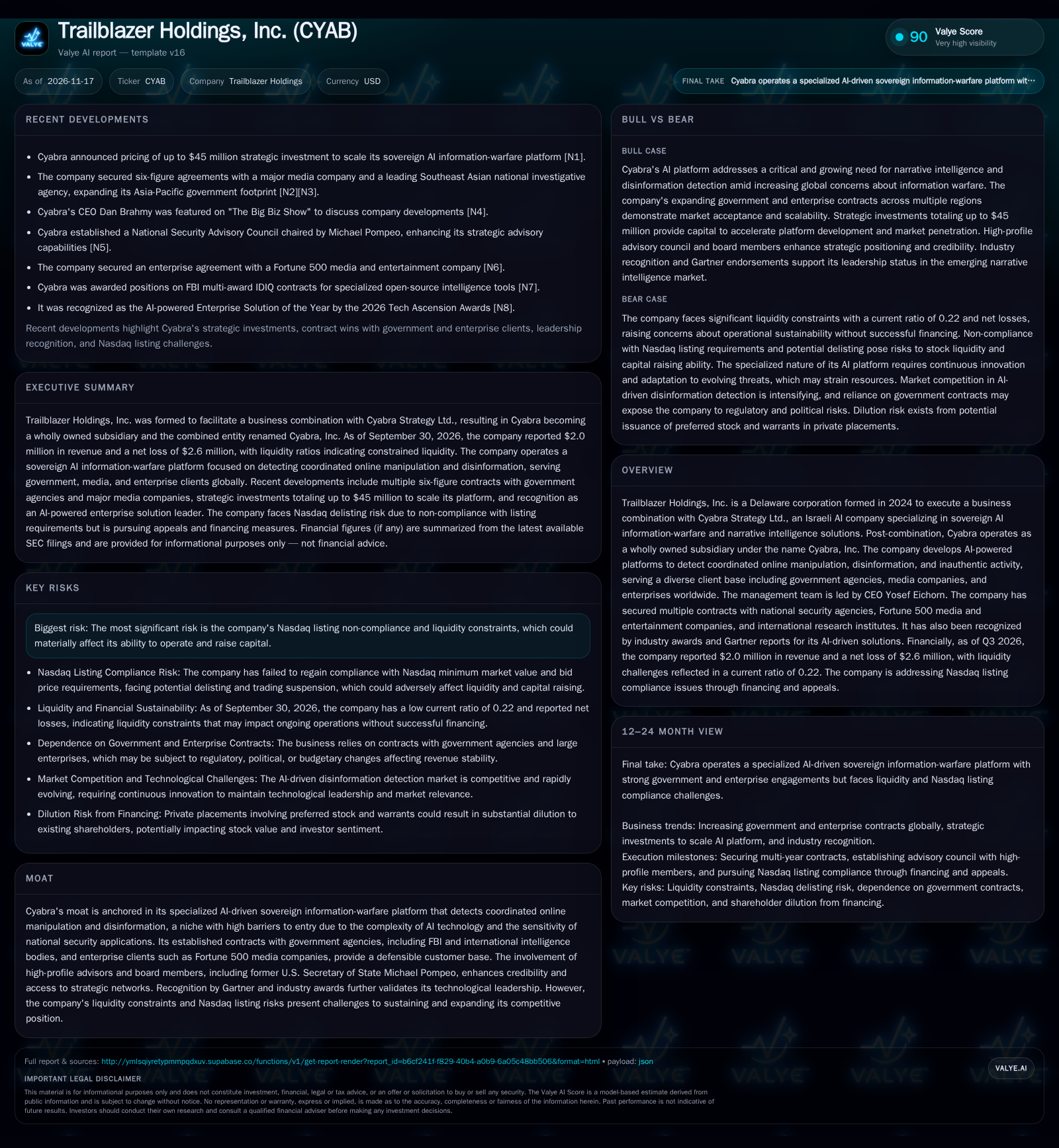
Cyabra, newly public through Trailblazer Holdings, is gaining traction with government agencies and Fortune 500 media contracts for its AI-powered disinformation detection platform. The company is pursuing up to $45M in strategic investment and must prove it can turn recent contract wins into recurring, scalable revenue before cash and market access run out. [S1] [S2]
Cyabra, Inc.—emerging from its Trailblazer Holdings SPAC transaction—embodies both the promise and perils of the AI-enabled narrative intelligence sector. Its AI-driven platform is winning contracts with government agencies and blue-chip media companies, signaling real commercial validation. The next phase will test both its operational leverage and its ability to navigate market-access headwinds.
Liquidity Crunch, Contract Wins, and Nasdaq Listing at Stake
As of September 30, 2026, Cyabra (via Trailblazer Holdings) reported $2.0 million in revenue and a net loss of $2.6 million, with cash and equivalents of $1.3 million and current liabilities of $10.9 million. The company reported cash and liquidity metrics for the period; these figures do not by themselves establish operating runway, investment capacity, financial flexibility, or financing capacity. [S2]
Despite its precarious balance sheet, Cyabra has secured recent six-figure contracts with major media companies and government agencies in Southeast Asia, Asia-Pacific, and Europe, as well as enterprise agreements with Fortune 500 media firms and FBI multi-award IDIQ positions [S1].
The company faces imminent Nasdaq delisting due to non-compliance with minimum market value and bid price requirements, with trading suspension pending appeal as of November 2026 [S2].
Cyabra has announced up to $45 million in strategic investment to scale its platform, but the timing and certainty of these funds remain undetermined [S1].
Revenue Model, Capital Demands, and the Sustainability Equation
Cyabra’s business model is built around providing AI-powered disinformation detection, narrative intelligence, and open-source intelligence (OSINT) tools to government agencies, media conglomerates, and large enterprises. The platform’s value proposition lies in automating the detection of sophisticated online manipulation campaigns, a function increasingly mandated by national security and regulatory bodies.
Revenue is likely structured through a mix of annual or multi-year contracts—especially for government and enterprise clients—potentially combining upfront license fees, recurring SaaS subscriptions, and professional services. However, with revenue at just $2.0 million and recent contracts described as 'six-figure,' the current customer base is still nascent relative to the scale required for profitability [S2].
Operating leverage could be significant if recurring software subscriptions scale, but near-term economics are challenged by high R&D and customer acquisition costs, as well as the need for continuous platform innovation. [S2]
The $8 million PIPE investment in preferred stock and warrants suggests some investor appetite but may also drive dilution, especially if further private placements are required before positive cash flow is reached [S1].
Defensible Niche or Crowded Arena? Cyabra’s Position in AI-Driven Narrative Intelligence
Cyabra operates in a rapidly expanding but increasingly crowded arena of AI-enabled disinformation detection and narrative intelligence. Its specialization in sovereign-grade information-warfare platforms creates high technical and regulatory barriers to entry, especially for government and security applications.
Notable contract wins with national security agencies in Asia-Pacific and Europe, as well as placements on FBI open-source intelligence contracts, indicate strong initial customer validation. The involvement of high-profile figures—such as Michael Pompeo on its advisory council—may enhance access and credibility, particularly in U.S. federal and allied markets [S1].
However, the market is populated by both established defense contractors and fast-moving AI startups, each vying for government and enterprise budgets. Competitive threats include larger firms with deeper balance sheets and broader product portfolios, as well as smaller, more agile AI specialists. The need for continuous algorithmic innovation, regulatory compliance, and relationship management with sensitive government customers creates both moat potential and ongoing execution risk.
Switching costs for government and regulated enterprise clients can be high once integrated, but initial sales cycles are long and procurement is rigorous. The question is whether Cyabra’s technology and commercial partnerships are differentiated enough to capture and retain a meaningful share of this evolving market.
From Contract Wins to Platform Scale: What a Breakout Looks Like
The favorable scenario envisions Cyabra successfully converting its recent six-figure government and media contracts into multi-year, recurring revenue streams. If the company is able to close the announced $45 million in strategic investment, it would gain sufficient capital to invest in platform enhancements, sales expansion, and international go-to-market initiatives [S1].
A breakout would be confirmed by evidence such as: a rapid increase in contracted annual recurring revenue, additional Fortune 500 or sovereign clients, and renewal/expansion of existing contracts into multi-year agreements. Public disclosure of contract duration, backlog, or expansion metrics would further validate the transition from pilot-stage to scalable operations.
Sustained industry recognition, new high-profile advisory appointments, or expansion into adjacent markets (such as regulatory compliance or election integrity monitoring) would support the narrative of a defensible, high-barrier business. Achieving or projecting positive cash flow within the next 12-24 months, even on the back of new financing, would be a strong signal of operating leverage and business model viability.
Commercial Traction Meets Capital Constraints: The Probable Middle Course
The most plausible path forward sees Cyabra leveraging recent contract momentum to modestly grow revenue, but facing continued capital constraints and operational losses through the next several quarters. Contract wins with government and enterprise clients could provide some revenue stability, but the scale and cadence of new deals may not be sufficient to offset high cash burn and working capital needs in the near term.
The company may succeed in raising a portion of the announced $45 million investment, but likely through dilutive private placements, given delisting risk and current financials. In this scenario, Cyabra remains a niche, strategically relevant player—valued for its technology and relationships but operating under persistent liquidity pressure and with limited negotiating leverage.
Evidence for this outcome would include incremental revenue growth, additional contract announcements, but continued negative operating cash flow and ongoing Nasdaq compliance struggles. Delisting could occur, forcing a move to OTC or private markets, but the company could still pursue growth if core customers and investor backers remain engaged.
Liquidity Exhaustion and Listing Loss: When Momentum Fails to Convert
In an adverse scenario, Cyabra’s acute liquidity constraints and inability to regain Nasdaq compliance precipitate a trading suspension and delisting. If the company fails to secure sufficient new financing—either due to investor hesitation or deteriorating market conditions—it may face a forced scaling-back of operations, loss of key personnel, or, in the extreme, insolvency.
Contract momentum could stall if government or enterprise customers delay renewals, reduce scope, or shift to larger, more stable competitors. Delisting would constrain future capital raising, reduce visibility with institutional partners, and could trigger covenants or customer contract renegotiations.
Confirmation of this scenario would be a sharp decline in disclosed new contracts, public layoffs or restructuring, deteriorating supplier or customer relationships, and an inability to close the announced strategic investment. Persistent net losses with no realistic path to positive cash flow would also be a warning sign.
Milestones and Metrics That Will Define Cyabra’s Next Chapter
The pace and scale of new contract announcements, especially with government or Fortune 500 enterprise clients, will be vital for assessing revenue momentum.
Evidence of multi-year contract renewals, expansions, or conversion of pilot projects into recurring revenue streams would help test the platform’s stickiness.
Public disclosure of annual recurring revenue (ARR), backlog, or contract duration, if provided, would clarify revenue visibility.
Progress on closing the announced $45 million strategic investment—including terms, timing, and participating investors—will determine near-term runway.
Updates on Nasdaq listing compliance, appeal outcomes, or contingency plans for alternative listings will affect market access and capital-raising options.
Trends in operating cash flow and net loss—particularly signs of narrowing losses or cost discipline—would signal progress toward sustainability.
Any changes in the composition or activity of the National Security Advisory Council could impact credibility and customer access.
A useful metric would be customer concentration—disclosure of revenue dependence on a handful of large contracts would help gauge risk.
Disclaimer: This is research-only, informational analysis and not investment advice. It may include AI-generated interpretation and general industry context. Always verify important details using primary sources.

Comments