
ConnectM Technology Solutions: Financial Strains, Legal Overhangs, and the Challenge of Achieving Sustainable Operations
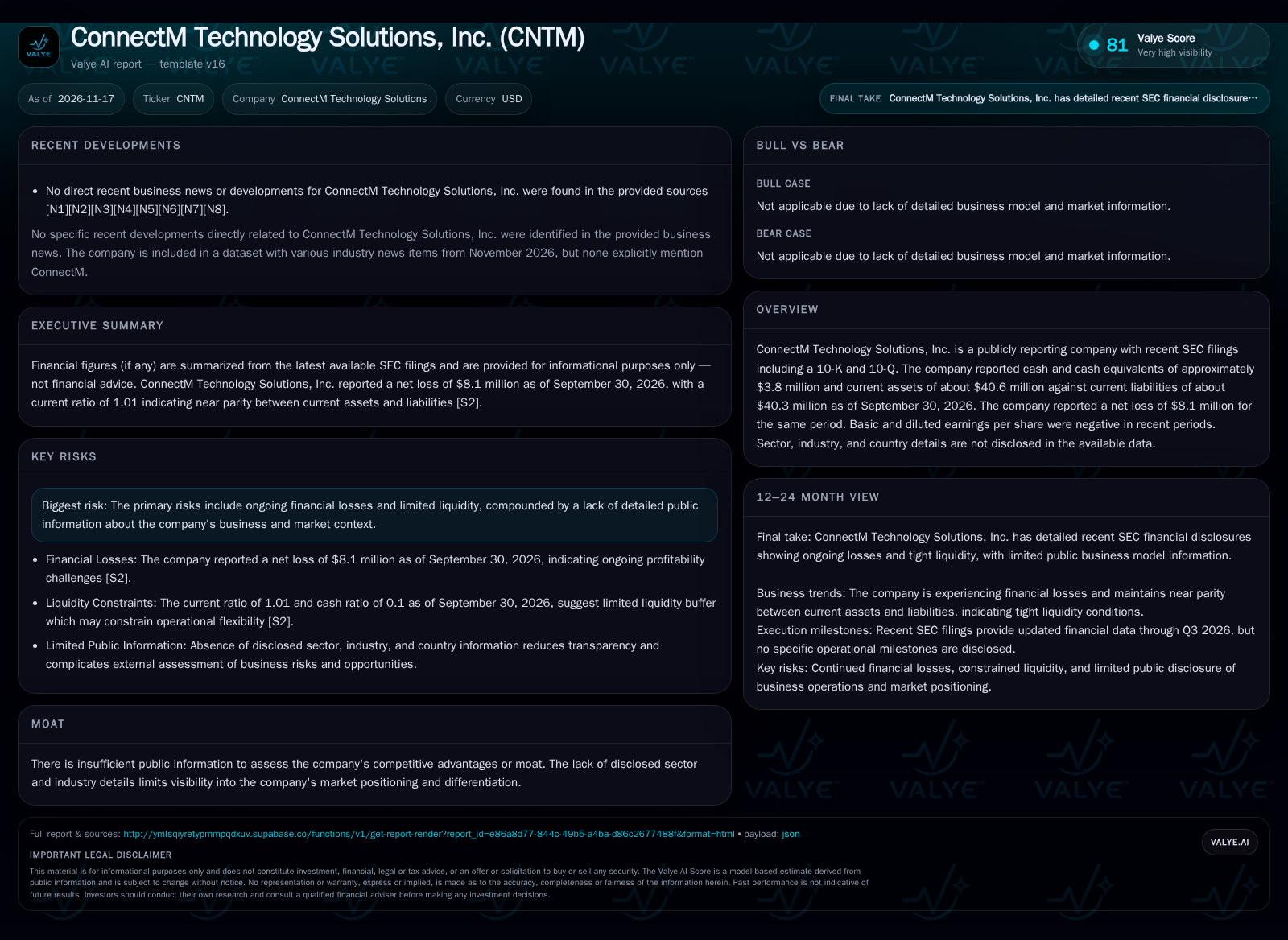
ConnectM Technology Solutions, Inc. faces acute profitability and liquidity pressures as ongoing net losses intersect with a reported cash balance and a newly confirmed litigation award. With little public disclosure about its sector or business model, the company’s path to operational stability remains highly uncertain.
The company is also confronting a proposed litigation judgment exceeding $2.5 million, with only $955,000 reserved. The lack of transparency around its sector, product set, or revenue model complicates any clear assessment of future prospects or competitive positioning. Near-term viability hinges on liquidity management, legal resolution, and evidence of a scalable business model. [S2]
ConnectM Technology Solutions, Inc. stands at a precarious crossroads. With no public clarity on its sector, business model, or market positioning, ConnectM’s prospects for achieving operational sustainability appear clouded by both financial and informational opacity.
Financial Losses, Liquidity Constraints, and Legal Liabilities Define the Immediate Landscape
As of September 30, 2026, ConnectM Technology Solutions, Inc. reported a net loss of $8.1 million and cash and cash equivalents of $3.8 million. Compounding these challenges, ConnectM is confronting a proposed litigation judgment of over $2.5 million tied to its Florida Solar acquisition, with only $955,000 reserved for potential losses. If enforced, this award could trigger an immediate cash shortfall, intensifying the company’s already acute liquidity constraints. [S2]
The lack of any disclosed sector, industry, or business model details in public filings further complicates assessment, leaving investors with little basis to evaluate revenue potential, customer stickiness, or competitive resilience.
Unclear Revenue Model and High Fixed Costs Undermine Path to Profitability
With no public disclosure of ConnectM’s sector or operating model, the company’s underlying business economics remain opaque. The reported net loss suggests that either gross margins are thin, fixed costs are high, or both. The scale of current liabilities relative to assets hints at a capital-intensive business, where working capital requirements may be significant. The negative earnings per share trend—basic EPS of -$1.33 as of March 2026 and diluted EPS of -$7.19 for 2025—implies persistent losses and potentially high operating leverage. [S2]
Without clarity on whether ConnectM’s revenues are subscription-based, transactional, or tied to hardware or services, it is difficult to assess the durability or scalability of its top line. If the company relies on lumpy project-based revenue, cash flow volatility may be high; if it offers recurring software or services, retention and churn would be critical metrics—none of which are disclosed. The pending legal award also raises the risk of forced asset sales or emergency financing that could further erode unit economics.
Given the lack of sector specifics, it is also unclear whether ConnectM’s cost structure is predominantly fixed or variable, or how sensitive its economics are to changes in volume or pricing. In capital-intensive or project-driven industries, negative operating leverage can amplify losses during downturns, while in recurring-revenue models, high churn or customer acquisition costs can undermine scalability. The absence of public information on these drivers leaves the company’s path to profitability highly uncertain.
Opaque Market Position Leaves Competitive Dynamics and Moat Unclear
The absence of any sector, industry, or country disclosure makes it impossible to benchmark ConnectM against peers or substitutes. If ConnectM operates in a technology, energy, or industrial vertical—as might be inferred from the Florida Solar subsidiary—it could face competition from established players with scale advantages, better access to capital, or stronger customer relationships. However, without specifics, the nature of its differentiation, pricing power, or switching costs remains unknown.
This opacity also means that ConnectM’s potential for network effects, intellectual property advantages, or ecosystem lock-in cannot be assessed. In markets where product commoditization and aggressive pricing are common, such as hardware or solar integration, lack of scale and balance-sheet strength could be particularly punitive.
Furthermore, the lack of public information on customer concentration, geographic exposure, or end-market trends prevents any meaningful analysis of competitive threats or opportunities. If ConnectM is exposed to cyclical or rapidly evolving markets, the absence of a clear moat or defensible niche could leave it vulnerable to both macroeconomic shocks and aggressive competitors.
Rapid Legal Resolution and Evidence of Scalable Revenue Could Shift Trajectory
A favorable scenario would require ConnectM to resolve the Florida Solar litigation for less than the proposed $2.5 million, preserving scarce cash. Simultaneously, the emergence of a credible, recurring revenue model—such as SaaS contracts, long-term service agreements, or a growing customer base in a defensible niche—could signal a path to positive operating cash flow.
Evidence that would support this scenario includes: a disclosed settlement below the reserve, new or expanded commercial partnerships, public release of sector and product details, and positive gross margin trends if and when disclosed. Conversely, failure to disclose business traction or resolution of the legal overhang would undermine any bullish case.
Additionally, if ConnectM were to announce new capital-raising initiatives, strategic partnerships, or customer wins, these could provide both financial runway and external validation of its business model. However, such developments would need to be accompanied by greater transparency regarding the company’s operations and financial drivers to meaningfully shift investor sentiment.
Continued Opacity and Cash Burn Sustain Uncertainty
In a base case, ConnectM continues to operate with limited public disclosure, ongoing net losses, and gradual cash depletion. The company may seek to manage liquidity through incremental cost controls or small-scale financing, but without clarity on its underlying business model or sector, external confidence is unlikely to improve.
Absent a favorable legal resolution or new business disclosures, ConnectM’s financial statements may continue to reflect negative operating leverage and tight liquidity. The lack of sector and revenue transparency could also limit access to new capital, as investors remain wary of underwriting unknown risks.
In this scenario, ConnectM’s operational flexibility is constrained, and the company may be forced to defer investments, reduce headcount, or scale back growth initiatives. The ongoing legal overhang and absence of visible business momentum would keep the company in a holding pattern, with downside risks persisting.
Litigation Enforcement and Liquidity Shortfall Trigger Financial Distress
If the court enters a final judgment on the litigation in the proposed amount and ConnectM is unable to appeal or negotiate a reduced settlement, the company could face an immediate liquidity crisis. With only $3.8 million in cash against a potential $2.5 million payout, and ongoing net losses, ConnectM may be forced to seek emergency financing, enter restructuring, or liquidate assets at unfavorable terms.
Indicators of this scenario would be a sudden drop in cash balance, disclosure of covenant breaches, missed payments to creditors or vendors, or the announcement of a formal restructuring process. Absence of any public remediation plan or new capital infusion would further reinforce downside risk.
Additionally, if ConnectM’s legal expenses escalate or if further adverse judgments arise, the company’s already reported liquidity position could be exhausted rapidly. In such a scenario, the risk of insolvency or forced asset sales would be heightened, particularly in the absence of new business wins or external funding.
Testing ConnectM’s Trajectory: What Will Reveal the Company’s True Prospects?
Resolution details and financial impact of the Florida Solar litigation award—timing, amount, and cash implications.
Quarterly net loss and operating cash flow trends, as reported in future SEC filings.
Disclosure of sector, industry, core business model, and revenue composition—any specificity on customer base or product lines would help test scalability.
Gross margin and operating expense trends, if disclosed, to assess fixed vs. variable cost structure.
Changes in cash and equivalents, especially following legal developments or any capital-raising events.
Announcements of new contracts, partnerships, or customer wins that might indicate traction or market validation.
Any discussion of refinancing, emergency funding, or asset sales as liquidity preservation measures.
Management commentary or investor communications that provide insight into strategic priorities or operational pivots.
Disclaimer: This is research-only, informational analysis and not investment advice. It may include AI-generated interpretation and general industry context. Always verify important details using primary sources.

Comments