
Instil Bio: Early-Stage Reset, Facility Liabilities, and the Search for a Viable Pipeline
With its lead oncology program discontinued and all pipeline assets at the discovery stage, Instil Bio faces a strategic crossroads. The next phase hinges on the company’s ability to source, secure, and advance new therapeutic candidates into the clinic.
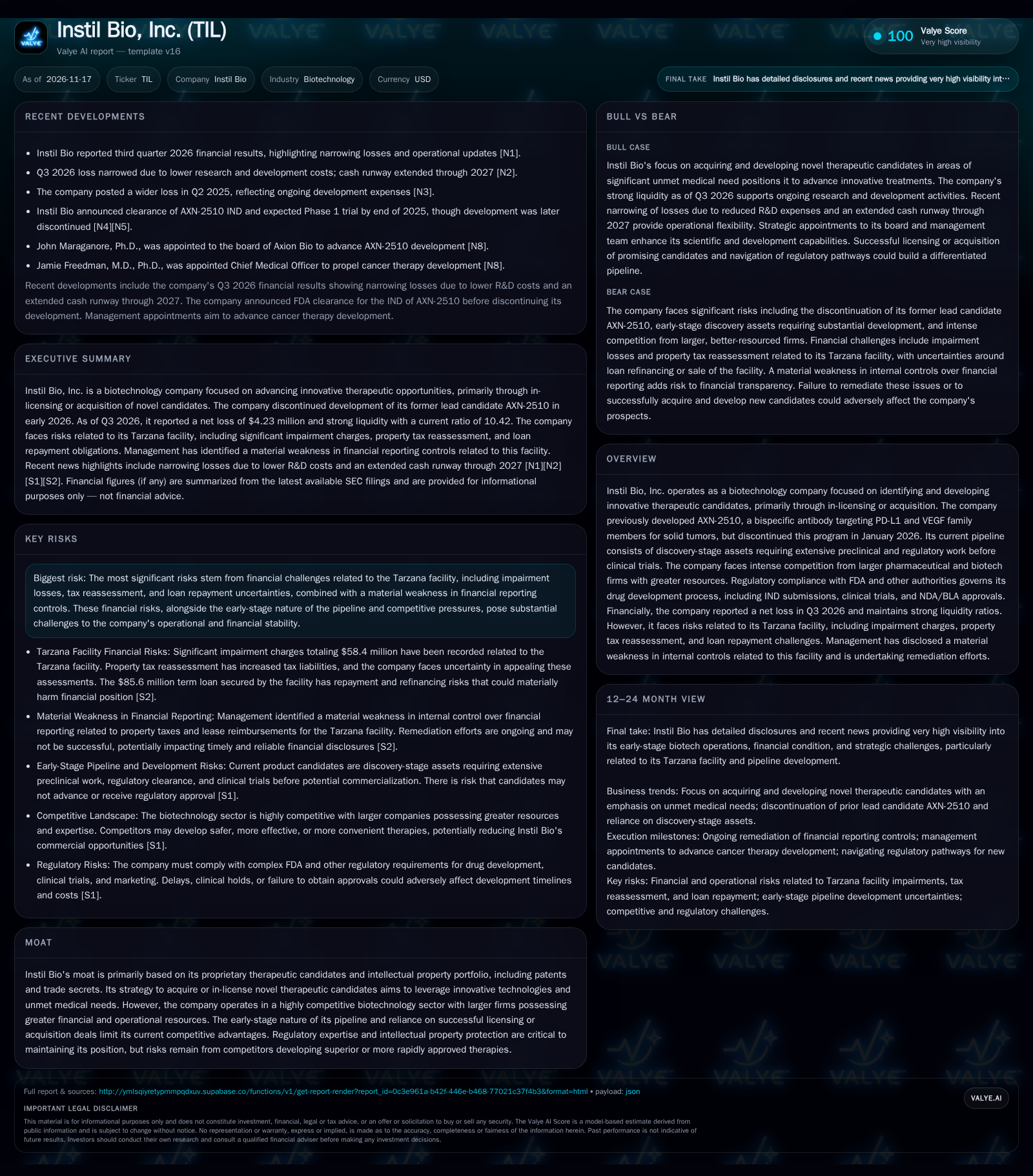
Instil Bio has exited its previous lead program, leaving it with only early-stage assets and no clinical candidates. Its prospects now depend on identifying and advancing new therapies, while addressing operational and financial reporting challenges.
Instil Bio’s business reset is marked by the discontinuation of its lead solid tumor therapy and the absence of any clinical-stage assets. While the company’s current ratio is high, this is overshadowed by significant impairment charges and a facility-linked term loan that could pose refinancing difficulties. Instil Bio’s business model now relies on its ability to identify, acquire, and advance new therapeutic assets—a strategy that carries both opportunity and execution risk. The urgency to resolve internal control issues and to convert its liquidity into a viable pipeline will define its next chapter.
Discontinued Lead Program, Early-Stage Pipeline, and Facility Financial Strain Shape the Outlook
Instil Bio discontinued development of its former lead product candidate, AXN-2510, a bispecific antibody for solid tumors, in January 2026 and terminated its licensing agreement with ImmuneOnco Biopharmaceuticals. As a result, the company’s current pipeline consists solely of discovery-stage assets, none of which have entered clinical development [S1].
The company reported a Q3 2026 net loss of $4.23 million, with strong current (10.42) and cash (22.85) ratios as of September 30, 2026 [S2]. However, this apparent liquidity is offset by $58.4 million in impairment charges and a lingering $85.6 million term loan secured by its Tarzana facility, which faces refinancing and sale risks [S2].
A material weakness in internal controls over financial reporting, specifically related to property taxes and lease reimbursements for the Tarzana facility, remains unresolved, with remediation expected to continue through 2027 [S2].
How Instil Bio’s Funding and Fixed Costs Drive Business Model Risk
Instil Bio’s economics are currently driven more by capital allocation and cost containment than by revenue generation, as it lacks commercialized products and all development assets are preclinical. The company’s operational expenses are dominated by R&D costs, G&A, and, notably, facility-related charges—including impairment losses and ongoing property taxes on the Tarzana facility [S2].
With no revenue and only discovery-stage assets, Instil Bio’s path to value creation depends on acquiring or in-licensing external assets, then advancing them through preclinical and clinical development. This model is inherently capital-intensive, requiring upfront payments, milestone obligations, and significant investment in IND-enabling studies and regulatory submissions before any commercial returns are likely.
The $85.6 million term loan associated with the Tarzana facility represents a large fixed liability, constraining cash flow flexibility. The company reported cash and liquidity metrics for the period; these figures do not by themselves establish operating runway, investment capacity, financial flexibility, or financing capacity. [S2]
Operating leverage is limited in the absence of revenue, while the discontinuation of AXN-2510 suggests that sunk costs in failed programs can be substantial. Instil Bio must manage its burn rate carefully while seeking credible assets that could justify further investment.
Competitive Realities: Small-Scale Innovator in a Field of Giants
Instil Bio operates in a highly competitive biotechnology sector, facing rivals ranging from large pharmaceutical companies to agile early-stage biotechs. Its core strategy—acquiring or in-licensing innovative therapeutic candidates in areas of unmet need—puts it in direct competition with better-resourced firms that often have established scouting, diligence, and deal-making infrastructures [S1].
Intellectual property protection is essential, but the company’s reliance on external innovation (rather than internal discovery) means it must win in competitive deal processes for attractive assets, often with higher upfront costs and less bargaining power.
The lack of clinical-stage assets reduces Instil Bio’s negotiating leverage, as licensors and partners may prefer buyers with proven development and commercialization track records. Furthermore, the early-stage status of its pipeline means that any scientific or regulatory advances by competitors could quickly erode the value of Instil’s acquired assets.
Substitution risk is high: in oncology and immunotherapy, multiple modalities (e.g., bispecifics, cell therapies, checkpoint inhibitors) compete for similar indications, and rapid advances elsewhere can make a recently acquired program obsolete before it reaches the clinic.
Transformative Acquisition or Licensing Deal Could Reset the Pipeline
The most optimistic scenario for Instil Bio is the successful identification and acquisition or in-licensing of a promising therapeutic candidate that can be advanced into clinical development within the next 12-24 months. If the company can leverage its cash reserves to secure a differentiated asset—particularly one with strong preclinical data and a clear regulatory path—it could regain relevance and attract follow-on capital or partnership interest.
Evidence that would confirm this scenario includes announcements of new deals for late-preclinical or IND-ready assets, disclosure of competitive licensing terms, and rapid progress toward IND submission or clinical trial initiation. Early validation from partners, key opinion leaders, or non-dilutive grant funding would further support the upside.
Conversely, failure to secure attractive assets or the acquisition of programs with only marginal differentiation would quickly falsify this scenario.
Slow Asset Sourcing, Ongoing Facility Drag, and Prolonged Early-Stage Status
The most plausible trajectory is that Instil Bio continues to search for in-licensing or acquisition opportunities but faces delays and competition for high-quality assets. During this time, cash burn will be driven by fixed facility costs, G&A, and the costs of evaluating new opportunities.
The company may eventually secure one or more early-stage assets, but these are likely to require extensive preclinical work and regulatory engagement before reaching the clinic, keeping Instil Bio in a prolonged preclinical phase. The Tarzana facility’s loan and impairment drag will remain a persistent burden, limiting potential financial flexibility for aggressive pipeline expansion.
Confirmation would come from continued updates about business development activities, incremental asset additions at the discovery or preclinical stage, and slow progress on resolving internal control weaknesses or the facility’s financial overhang. Falsification would require evidence of rapid, high-quality asset acquisition or successful monetization of the Tarzana facility.
Facility-Related Financial Stress and Inability to Replenish the Pipeline
The adverse scenario is one in which Instil Bio fails to secure new assets while the Tarzana facility’s financial challenges intensify. If the company cannot sell or refinance the facility, or if property tax reassessments worsen, the fixed costs could overwhelm available liquidity even with a reported current ratio today [S2].
If remediation of the material weakness in internal controls is delayed or unsuccessful, operational risk and market confidence could deteriorate, potentially complicating future fundraising or partnership efforts.
This scenario would be confirmed by rising facility-related expenses, inability to announce credible new pipeline assets, worsening financial reporting issues, or an acceleration of net losses. A default or forced sale of the Tarzana facility would be a clear signal of downside risk materializing.
Milestones That Will Determine Instil Bio’s Strategic Viability
Progress on new in-licensing or acquisition deals for therapeutic candidates, especially those at the IND-enabling or clinical-ready stage, would help test the company’s business development execution.
Updates on the remediation of internal control weaknesses, with specific milestones or audit committee statements, would indicate whether operational risk is being addressed.
Announcements regarding the sale, refinancing, or alternative monetization of the Tarzana facility would clarify the company’s ability to mitigate fixed-cost drag.
Disclosure of cash burn rates and R&D allocation, if provided, would show whether the company is maintaining financial discipline while searching for pipeline assets.
Details about the maturity schedule and any renegotiation of the $85.6 million term loan would signal whether debt overhang is being effectively managed.
Any evidence of partnerships, non-dilutive financing, or grants tied to new pipeline assets would indicate external validation and resource leverage.
Pipeline progression metrics—such as IND submissions, preclinical milestone achievements, or regulatory feedback—would provide tangible proof of asset advancement, if disclosed.
Disclaimer: This is research-only, informational analysis and not investment advice. It may include AI-generated interpretation and general industry context. Always verify important details using primary sources.

Comments