
DynaResource, Inc.: Mining Value Hinges on Gold Pricing, Operational Discipline, and Liquidity Pressure
The company’s economics are highly sensitive to commodity price swings and regulatory compliance, with competitive pressures and capital scarcity shaping both risk and upside.
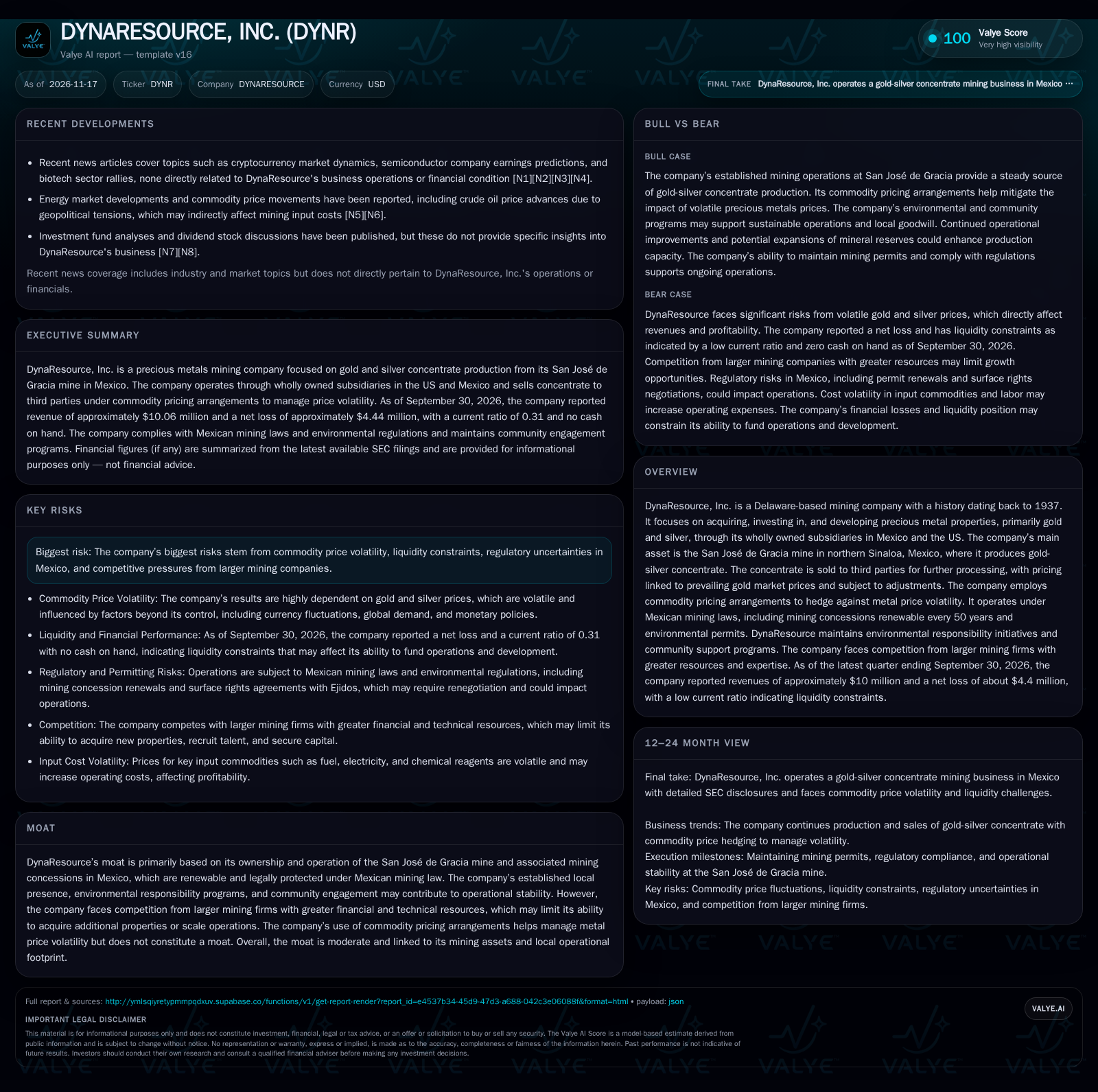
DynaResource’s gold-silver concentrate business is fundamentally exposed to volatile commodity prices and faces a severe liquidity shortfall, as evidenced by a current ratio of 0.31 and zero cash on hand as of September 2026. The company’s survival and value creation prospects depend on improving operational efficiency, maintaining regulatory compliance, and securing additional funding or a sustained rebound in gold prices. Absent a turnaround in cash generation or external capital, ongoing losses and competitive disadvantages could threaten the company’s ability to operate.
DynaResource, Inc. stands at a precarious inflection point. Despite generating over $10 million in quarterly revenue from its core San José de Gracia gold-silver concentrate operation, the company faces a severe liquidity crunch, reporting zero cash and a current ratio well below 1 as of September 2026. With net losses continuing and commodity prices dictating topline performance, DynaResource’s near-term future will be determined by its ability to secure funding, maintain regulatory approvals, and navigate both operational and competitive headwinds. The company’s value proposition is thus tightly linked to external gold price dynamics, internal cost discipline, and the ongoing challenge of capital scarcity.
Acute Liquidity Pressure and Ongoing Losses Shape the Present Outlook
As of September 30, 2026, DynaResource reported $10.06 million in revenue for the quarter, but a net loss of $4.44 million, translating to an EPS of -$0.15 [S2]. The company’s current assets stood at $14.99 million, dwarfed by current liabilities of $48.32 million, resulting in a current ratio of just 0.31 and zero cash or equivalents on hand [S2]. The company reported cash and liquidity metrics for the period; these figures do not by themselves establish operating runway, investment capacity, financial flexibility, or financing capacity. The company’s sole producing asset remains the San José de Gracia mine in Sinaloa, Mexico, with all revenue derived from gold-silver concentrate sales. These facts underscore the urgency of either improving operational cash generation, raising external capital, or benefiting from a sustained rise in gold prices to avoid operational disruption.
How DynaResource’s Revenue Model Amplifies Price and Cost Volatility
DynaResource generates revenue by producing gold-silver concentrate and selling it to third parties, with pricing tied to the gold content and prevailing market prices, subject to final settlement adjustments [S2]. This means topline results are highly sensitive to both output volume and fluctuations in global gold prices. The company employs commodity hedging strategies—including fixed price and min/max collars—to partially mitigate price swings, but the underlying exposure to spot and future gold prices remains significant.
The company’s cost structure is characterized by a mix of fixed overhead (mine maintenance, labor, administration) and variable costs (energy, reagents, consumables, and royalties), with input cost inflation—especially for fuel and chemicals—posing a margin risk. With net losses and no cash reserves, DynaResource lacks the potential financial flexibility to absorb sustained periods of unfavorable price or cost movements. Capital needs are ongoing, as mining operations require regular investment in equipment, exploration, and compliance. In the absence of robust free cash flow, the company appears reliant on either asset sales, external financing, or operational restructuring to bridge funding gaps.
Scale Disadvantage and Regulatory Complexity Limit Strategic Options
DynaResource’s competitive position is defined by its ownership of the San José de Gracia mining concessions and its local operational footprint in Mexico [S2]. While these assets provide a degree of operational stability, they do not confer a structural cost or scale advantage versus larger mining firms. Major competitors benefit from diversified asset portfolios, deeper technical expertise, and greater access to capital, enabling them to weather commodity price cycles and pursue growth acquisitions more aggressively.
The company’s ability to acquire new properties, attract and retain skilled personnel, and negotiate favorable terms with suppliers is thus constrained by its smaller scale and financial position. Regulatory complexity—particularly the need to renew mining concessions, maintain environmental permits, and negotiate surface rights with communal landowners (Ejidos)—adds further execution risk. While DynaResource’s environmental and community programs may help maintain local goodwill, they are unlikely to offset the broader disadvantages of limited capital and operational scale.
A Gold Price Rally and Operational Turnaround Could Unlock Value
The most plausible upside scenario for DynaResource hinges on a combination of external and internal improvements. A sustained rally in gold prices would directly boost revenue and cash flow, potentially turning current losses into profits even without significant operational change. If the company can simultaneously improve mining efficiency—through higher ore grades, better recovery rates, or successful cost containment—operating leverage could further amplify profit recovery.
This scenario would require evidence of: a meaningful and sustained rise in gold prices; a return to positive operating cash flow; improved gross and net margins; and the rebuilding of a reported cash balance. Additional upside could come from new resource discoveries, successful reserve expansions, or the ability to attract external capital on favorable terms. Confirmation would include increased production volumes, positive quarterly earnings, and reduced reliance on short-term liabilities.
Operational Resilience Tested Amid Persistent Capital Scarcity
The most probable near-term outcome is one in which DynaResource continues to operate under severe financial pressure, with periodic production and sales from San José de Gracia, but with little room for error. The company may need to pursue asset sales, joint ventures, or dilutive financing to meet immediate obligations. Regulatory compliance and community relations remain critical to avoid operational interruptions.
Evidence supporting this scenario would include continued modest revenue generation, recurring net losses, ongoing regulatory filings, and announcements of bridge financing or asset monetization efforts. Falsification would involve either a sudden cessation of operations (due to regulatory or financial default), or a dramatic improvement in profitability and liquidity not yet in evidence.
Liquidity Exhaustion or Regulatory Setback Could Force Disruption
The principal downside risk is that persistent losses and a lack of cash force DynaResource into operational suspension, asset fire sales, or even insolvency. With a current ratio well below 1, the company is exposed to any delay in concentrate sales, unanticipated expenses, or regulatory penalties. A material drop in gold prices, unexpected operational disruptions, or the inability to renew key permits or surface rights could rapidly escalate financial distress.
Early warning signs would include missed payments to suppliers or employees, regulatory citations or permit suspensions, or the disclosure of going-concern warnings in financial filings. If the company is unable to secure new funding or renegotiate liabilities, the risk of formal restructuring or liquidation would increase.
Metrics and Milestones to Clarify DynaResource’s Financial and Operational Trajectory
Quarterly operating cash flow, as reported, to track whether the company is generating or consuming cash from core mining operations.
Changes in current assets and liabilities—especially any rebuilding of cash balances or reduction in short-term obligations.
Gold and silver production volumes and grades, if disclosed, to evaluate operational performance and resource quality.
Unit production costs per ounce of gold equivalent, as a measure of cost discipline and margin sensitivity.
Updates on hedging positions and realized gold prices versus spot, to assess the effectiveness of commodity risk management.
Announcements regarding mining concession renewals, environmental permits, or surface rights negotiations, given the centrality of regulatory compliance.
Any disclosed financing arrangements, debt renegotiations, or asset sales to address liquidity gaps.
Evidence of new resource discoveries, reserve expansions, or exploration success, which could alter the long-term value proposition.
Disclaimer: This is research-only, informational analysis and not investment advice. It may include AI-generated interpretation and general industry context. Always verify important details using primary sources.

Comments