
Eloxx Pharmaceuticals: Clinical Ambition, Capital Reserves, and the Uncertain Road to Rare Disease Breakthroughs
Eloxx Pharmaceuticals advances exaluren through mid-stage kidney disease trials, buoyed by recent FDA clearance and a reported cash position. But with no revenue, widening losses, and regulatory outcomes years away, the company’s future hinges on clinical data and the viability of its rare-disease focus.
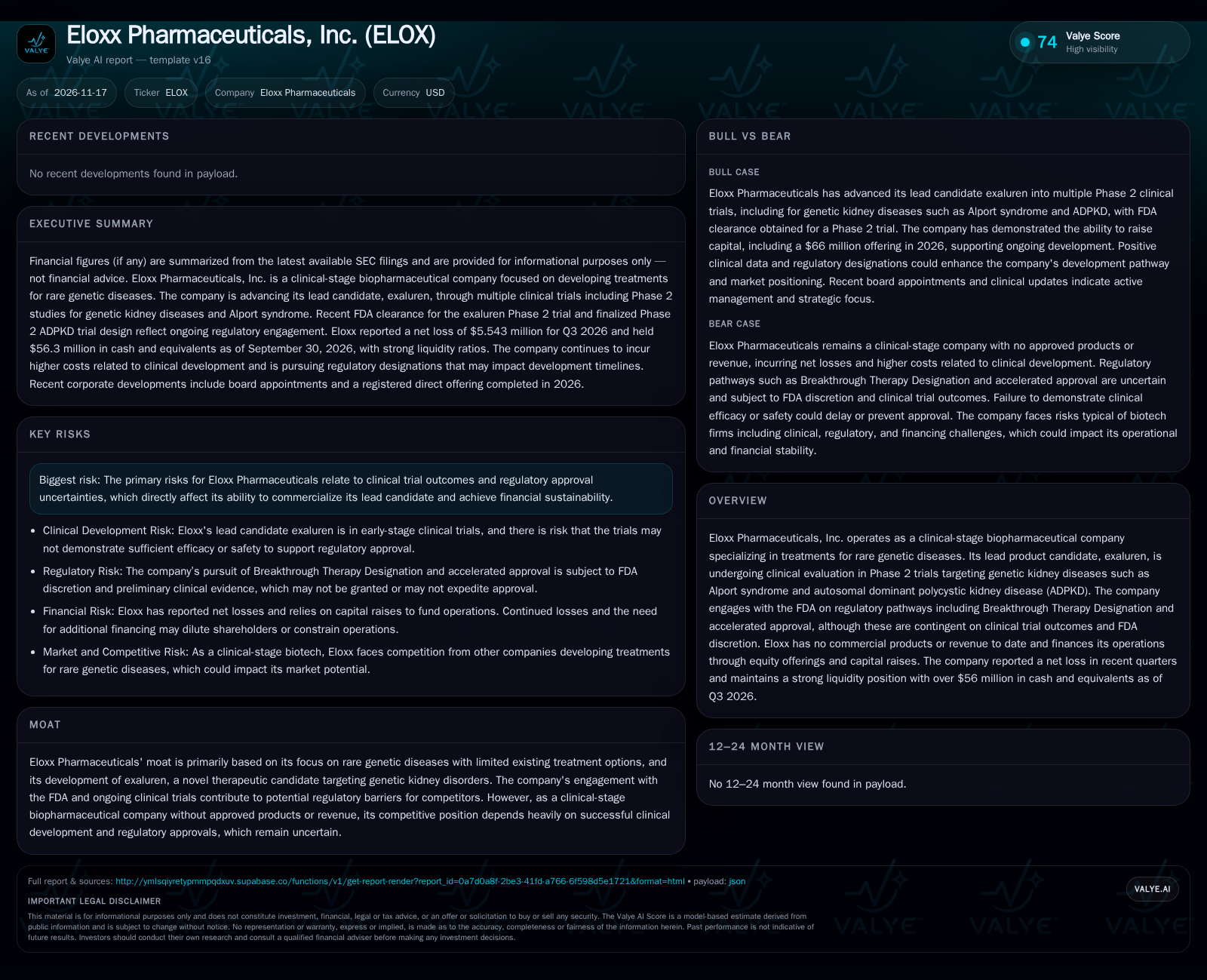
Eloxx Pharmaceuticals is a clinical-stage biotech developing exaluren for rare genetic kidney diseases. The company recently secured FDA clearance for a Phase 2 trial and completed a $66 million direct offering, resulting in over $56 million in cash as of Q3 2026. With no revenue and ongoing net losses, Eloxx’s prospects depend on positive mid-stage clinical results and regulatory progress, with key trial readouts not expected until mid-2027. The company’s rare-disease focus could offer competitive advantages if efficacy is proven, but faces familiar clinical and regulatory risks.
Eloxx Pharmaceuticals stands at a familiar crossroads for clinical-stage biotechs: it is well-capitalized and advancing a novel therapy, exaluren, through critical Phase 2 trials targeting rare genetic kidney diseases. Recent regulatory milestones—including FDA clearance for a new trial and a finalized protocol for ADPKD—underscore operational momentum. Yet with no commercial products, persistent net losses, and key clinical readouts not due until 2027, the company’s trajectory is highly sensitive to both trial outcomes and the evolving landscape of rare disease therapeutics.
Recent Milestones Define Eloxx’s Strategic Position
Eloxx Pharmaceuticals is actively conducting Phase 2 clinical trials for its lead candidate, exaluren, in genetic kidney diseases including Alport syndrome and autosomal dominant polycystic kidney disease (ADPKD). The company received FDA clearance for a Phase 2 trial in October 2026 and has finalized the design for its ADPKD study after regulatory feedback. These regulatory steps are crucial, as they enable Eloxx to advance its pipeline toward potential pivotal readouts, with Phase 2b Alport data expected in mid-2027 [N2] [N3].
Financially, Eloxx is operating with $56.3 million in cash and cash equivalents as of September 30, 2026, following a $66 million registered direct offering and an uplisting to Nasdaq earlier in the year. The company reported a Q3 2026 net loss of $5.54 million, reflecting increased clinical development costs. Eloxx remains pre-revenue, consistent with its status as a clinical-stage biotech [S2] [N1].
Economics of Rare Disease Drug Development: The Eloxx Model
Eloxx’s business model is typical of early-stage biopharma: significant upfront R&D investment, a multi-year clinical and regulatory timeline, and no operating revenue until product approval. The company’s current cost structure is dominated by fixed expenses related to clinical trials, regulatory engagement, and personnel, with variable costs likely to increase as trials expand or new indications are pursued.
Success in rare genetic diseases such as Alport syndrome and ADPKD could, in theory, could support premium pricing and strong gross margins if exaluren demonstrates clinical efficacy and secures regulatory approval. The rare-disease focus can also enable smaller, targeted commercial organizations and lessen reliance on mass-market sales channels. However, Eloxx will likely face high capital needs until pivotal data are available and may require additional financing before reaching a licensing event or commercialization. If exaluren advances, the company could opt for a partnership model, out-licensing, or a direct commercialization strategy—each with distinct economic implications.
A critical aspect of Eloxx's economic model involves managing the timing and scale of capital deployment relative to clinical milestones. The company reported cash and liquidity metrics for the period; these figures do not by themselves establish operating runway, investment capacity, financial flexibility, or financing capacity. This necessitates a careful balance between accelerating patient enrollment and controlling trial-related expenditures. Additionally, the choice between pursuing direct commercialization or partnering post-approval will significantly influence future cost structures and revenue recognition patterns. Each pathway entails different upfront investments in sales infrastructure versus potential royalty streams or milestone payments, thus impacting long-term profitability and capital efficiency.
Potential Moats and Threats in the Rare Disease Arena
Eloxx’s competitive argument rests on its focus on rare kidney disorders where existing therapies are limited or non-existent. This orphan drug orientation can confer advantages such as regulatory incentives, reduced competition, and potential pricing power if efficacy is established. The company’s engagement with the FDA and pursuit of designations like Breakthrough Therapy or accelerated approval could, if successful, create meaningful barriers to entry.
However, the competitive landscape for rare genetic diseases remains dynamic. Larger biopharma companies and other clinical-stage firms are also targeting these indications, and the possibility of alternative modalities—such as gene therapy or RNA-based treatments—represents a credible substitution risk. Eloxx’s position will depend heavily on the distinctiveness and robustness of exaluren’s clinical results. Without positive data, its orphan status alone offers limited protection.
The durability of Eloxx's competitive moat will also depend on the evolving regulatory environment and payer landscape for rare disease therapies. While orphan drug designations provide initial exclusivity and incentives, payers are increasingly scrutinizing clinical benefit relative to cost, especially for high-priced therapies targeting small populations. Consequently, Eloxx's ability to generate robust, clinically meaningful endpoints will be essential not only for regulatory approval but also for securing favorable reimbursement terms. Furthermore, the emergence of gene editing or other transformative technologies could alter treatment paradigms, requiring Eloxx to continuously assess its product's comparative effectiveness and adapt its development strategy accordingly.
How Favorable Data Could Transform Eloxx’s Prospects
The most constructive scenario for Eloxx involves exaluren demonstrating statistically and clinically meaningful benefits in ongoing Phase 2 trials for Alport syndrome and ADPKD. Positive mid-stage results, particularly those that address key endpoints relevant to the FDA, could unlock Breakthrough Therapy Designation or accelerated approval pathways. This would not only shorten the time to market but also enhance Eloxx’s negotiating leverage with potential partners or acquirers.
Confirmation of this scenario would come from strong interim or final data readouts (expected mid-2027), regulatory recognition of exaluren’s novelty and impact, and interest from larger pharmaceutical companies in licensing or acquisition discussions. Downstream, successful commercialization could validate the rare-disease strategy and could support premium pricing, leading to rapid revenue ramp and margin expansion.
In a scenario where exaluren demonstrates compelling efficacy, Eloxx could leverage regulatory incentives to expedite market entry and extend exclusivity periods, thereby maximizing revenue potential. Early designation as a Breakthrough Therapy or receipt of accelerated approval could also attract strategic partnerships, providing non-dilutive capital and access to established commercialization channels. This would enable Eloxx to focus resources on pipeline expansion or additional indications. Moreover, successful market penetration in rare kidney diseases could establish a platform for subsequent rare genetic disorders, creating a scalable business model with diversified revenue streams and enhanced investor confidence.
Clinical Progress Continues, but Uncertainty Remains the Norm
The most plausible near-term trajectory is that Eloxx continues to advance exaluren through Phase 2 trials, incurring ongoing net losses as it awaits critical data in 2027.
Plausible confirming evidence for this scenario includes steady clinical enrollment, incremental regulatory updates, and continued net operating losses. Falsification would come from unexpected early efficacy or safety signals (positive or negative), a significant partnership, or a major regulatory setback. In this scenario, Eloxx remains a speculative bet on future clinical outcomes, with its valuation driven by the probability-weighted value of exaluren’s pipeline.
Clinical or Regulatory Setbacks Could Trigger Dilution and Delay
Eloxx’s primary vulnerability is the risk of disappointing clinical data—either a failure to meet primary endpoints or emergence of safety concerns in the ongoing trials. Such outcomes would delay or derail regulatory approval, erode the perceived value of the company’s rare-disease focus, and force management to seek additional capital under adverse conditions, likely resulting in shareholder dilution.
This scenario would be confirmed by negative or inconclusive trial readouts, FDA feedback indicating insufficient evidence for accelerated pathways, or a collapse in partnership/acquisition interest. If cash burn continues without a clear path to value-creating events, Eloxx could face pressure to restructure, scale back operations, or pursue alternative development strategies.
Milestones and Metrics That Will Define Eloxx’s Next Chapter
Interim and final data from the Phase 2b Alport syndrome trial, expected mid-2027, will be the most direct test of exaluren’s efficacy [N2].
Updates on patient enrollment rates and retention in ongoing clinical trials would help gauge operational execution and timeline risk (if disclosed).
Regulatory feedback regarding Breakthrough Therapy or accelerated approval requests, including any formal designations granted by the FDA (if disclosed).
Changes in Eloxx’s cash burn rate and updated guidance on how long current liquidity is expected to last (if disclosed).
Any new partnership, licensing, or acquisition interest from larger pharmaceutical companies would signal external validation of exaluren’s potential (if disclosed).
Adverse safety signals or clinical holds in ongoing trials would represent material downside risk (if disclosed).
Additional equity offerings or other financing events, particularly if conducted under duress or at dilutive terms, would impact shareholder value.
Disclaimer: This is research-only, informational analysis and not investment advice. It may include AI-generated interpretation and general industry context. Always verify important details using primary sources.

Comments