
BeyondSpring’s Inflection Point: Asset Monetization, Clinical Ambition, and the Realities of Biotech Liquidity
While planning a Phase 3 trial for its lead asset Plinabulin in China, the company faces long-term operational restrictions through its Wanchunbulin subsidiary.
While planning a Phase 3 trial for its lead asset Plinabulin in China, the company faces long-term operational restrictions through its Wanchunbulin subsidiary. Success hinges on clinical outcomes, regulatory approvals, and the ability to secure capital or strategic partnerships before its limited cash is depleted. [S1] [S2] [N1]
The company’s future now pivots on the clinical and commercial trajectory of its lead oncology asset, Plinabulin, which is advancing into Phase 3 trials in China. However, government-imposed restrictions on its Wanchunbulin subsidiary, combined with high biopharma R&D costs and a lack of recurring operational cash flow, mean that BeyondSpring’s ability to secure additional capital or forge new partnerships will be decisive for its ongoing viability. [S1] [S2] [N1]
Monetizing Assets Buys Time, But reported cash balance Remains Thin
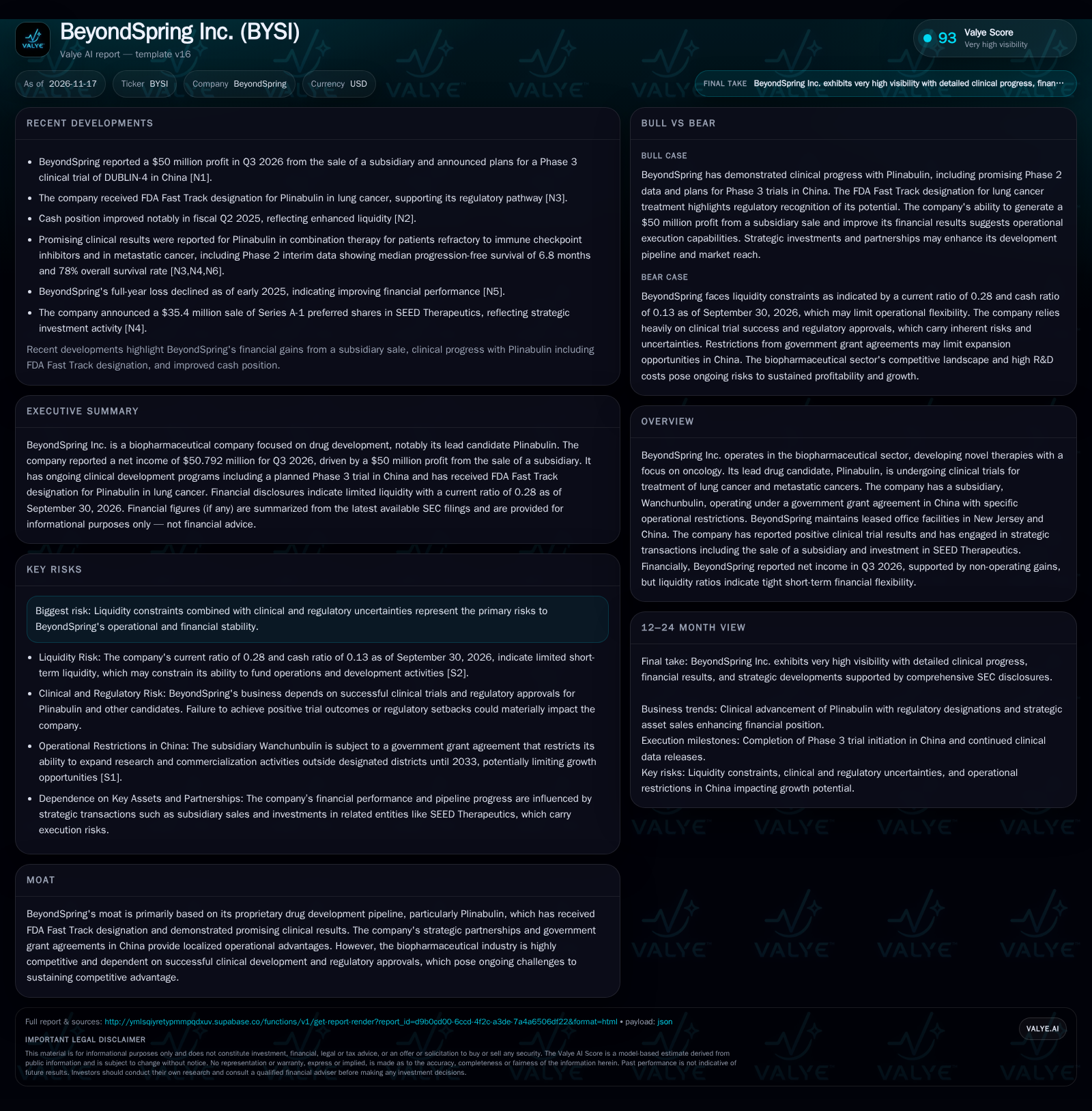
BeyondSpring reported net income of $50.792 million for Q3 2026, almost entirely attributable to a $50 million profit from the sale of a subsidiary [S2] [N1]. While this windfall provides a short-term boost, the underlying liquidity profile remains precarious: as of September 30, 2026, the company reported only $580,000 in cash and cash equivalents, with a current ratio of 0.28 and a cash ratio of 0.13 [S2]. The company’s lead drug, Plinabulin, is advancing into a Phase 3 trial in China, but the Wanchunbulin subsidiary that holds relevant Chinese rights is subject to a government grant agreement restricting geographic expansion until 2033 [S1] [N1]. These facts set the stage for a company highly leveraged to near-term clinical and capital-raising outcomes.
The monetization of non-core assets, while providing immediate liquidity, often reflects a strategic trade-off between short-term survival and long-term growth potential. This approach can temporarily alleviate cash constraints but may also reduce future revenue streams or strategic options if key assets are divested prematurely. In BeyondSpring’s context, the reliance on such asset sales underscores the absence of sustainable operational cash flow, which heightens the urgency to achieve clinical milestones or secure alternative funding.
How BeyondSpring’s Model Relies on Clinical Milestones and External Capital
BeyondSpring’s core business economics hinge on successfully advancing drug candidates through clinical trials to regulatory approval and commercialization. The company’s principal source of future value is Plinabulin, a late-stage oncology asset. If approved and commercialized, revenue would likely come from out-licensing, regional partnerships, or direct sales—each with different margin and cash-flow implications. However, the biopharmaceutical model is typically characterized by long cash burn periods, high fixed costs related to R&D and clinical trial execution, and lumpy, event-driven inflows (such as milestone payments or asset sales).
The Q3 2026 profit resulted from a non-recurring subsidiary sale, not from product revenue or recurring operations [S2] [N1]. The company’s accrual approach for research contract costs, which involves significant management judgment [S1], can make near-term expense forecasting difficult, adding uncertainty to cash runway estimates. In this context, operating leverage—where fixed R&D costs are high until, and unless, a drug is approved—means that the timing and outcome of clinical and regulatory milestones directly determine economic sustainability.
A critical dimension of BeyondSpring’s business model is the timing and predictability of milestone payments and licensing revenues, which are inherently uncertain and contingent on regulatory and clinical outcomes. The company’s ability to negotiate favorable terms in partnership agreements depends not only on clinical data but also on its current financial health and competitive positioning. If clinical milestones are delayed or unmet, the anticipated inflection points for revenue recognition may shift, compressing the runway and necessitating more aggressive capital raising.
Strategic Constraints and Competitive Pressures in Oncology Drug Development
BeyondSpring operates in one of the most competitive segments of biopharma: oncology therapeutics. Its lead candidate, Plinabulin, targets indications such as lung cancer and metastatic cancers, areas where large multinational pharmaceutical companies and numerous biotech peers are pursuing similar targets, often with greater financial resources. Competitive advantages in this space typically derive from unique mechanisms of action, differentiated clinical data, or first-mover regulatory status. However, the existence of a government grant agreement restricting Wanchunbulin’s expansion in China until 2033 [S1] could limit BeyondSpring’s ability to fully capitalize on positive trial results in the world’s second-largest pharmaceutical market.
While strategic partnerships or licensing deals could provide non-dilutive capital and commercialization leverage, the company’s current liquidity constraints may undermine its bargaining position. In addition, the high failure rate of late-stage oncology trials and the prevalence of alternative therapies (including immunotherapies and targeted agents) mean that even promising clinical results may not guarantee significant market share or pricing power.
BeyondSpring’s competitive positioning is further complicated by the structural constraints imposed by the government grant agreement on Wanchunbulin, which limits geographic expansion and potentially diminishes the commercial leverage of any successful clinical data within China. This restriction can affect the company’s valuation and attractiveness to global partners, who may perceive limited upside in a market with constrained operational freedom. Furthermore, the oncology landscape is characterized by rapid innovation cycles and evolving standards of care, meaning that delays in development or market entry could erode the therapeutic differentiation of Plinabulin. Therefore, the company’s strategic calculus must account for both regulatory and competitive timing risks, alongside the challenge of maintaining sufficient financial resources to navigate these dynamics.
Clinical Success and Strategic Partnership Could Transform the Trajectory
In a favorable scenario, Plinabulin’s Phase 3 trial in China delivers compelling efficacy and safety data, leading to regulatory approval and rapid uptake by oncologists. This could unlock substantial milestone payments from a commercial partner or allow BeyondSpring to license the asset on attractive terms, reducing the need for highly dilutive equity raises. Strong clinical data could also improve the company’s negotiating leverage, potentially attracting global pharmaceutical partners interested in co-development or commercialization outside of China.
Conversely, delays in trial enrollment, ambiguous data, or failure to secure a partner would undermine this upside thesis.
Incremental Progress but Persistent Funding Gaps Define the Near Term
The most plausible outcome is one of incremental clinical progress coupled with ongoing liquidity challenges. BeyondSpring could advance Plinabulin through the next phase of clinical development, but at a pace constrained by available resources. In this scenario, the company may need to pursue additional asset sales, licensing deals, or dilutive equity offerings to bridge its funding gap. The operational restrictions in China persist, and while positive clinical data may be reported, regulatory approval and commercial launch remain at least several quarters away.
Evidence confirming this scenario would include further small-scale financings, continued improvement in operational loss metrics, or the announcement of new but non-transformative partnerships. A failure to materially improve liquidity or secure a major commercial deal would reinforce this base case.
Liquidity Shortfall and Clinical Setbacks Amplify Existential Risk
If the Phase 3 trial is delayed, produces negative or inconclusive results, or encounters regulatory hurdles, the company could struggle to attract new capital or partners. With a current ratio of 0.28 and cash ratio of 0.13 as of September 2026 [S2], any adverse development could accelerate a liquidity crisis—potentially leading to asset fire sales, forced restructuring, or insolvency.
Signs of this scenario materializing would include missed clinical milestones, announced layoffs or program discontinuations, inability to close new financing, or public disclosure of going-concern doubts by auditors.
Milestones That Will Decide BeyondSpring’s Viability and Value
Progress and topline results from the Phase 3 Plinabulin trial in China: Timely enrollment, clear efficacy signals, and a positive readout would be critical.
Updates on regulatory interactions and pathway clarity for Plinabulin in key markets: Evidence of expedited review or acceptance of filings would be positive.
Evidence of partnership or licensing deals for Plinabulin or other pipeline assets: Terms, upfront payments, and retained economics would help clarify commercial potential.
Any changes to the Wanchunbulin subsidiary’s government grant restrictions or expansion of operational latitude in China.
Quarterly trends in operating loss and R&D expenses, especially if disclosed alongside cash burn rates.
Disclosure of going-concern language in filings, or auditor commentary regarding liquidity sufficiency.
A useful metric would be the projected cash runway under current and alternative funding scenarios, if disclosed.
Disclaimer: This is research-only, informational analysis and not investment advice. It may include AI-generated interpretation and general industry context. Always verify important details using primary sources.

Comments