
Foxx Development Holdings: Affordability Ambition Meets the Realities of Cost Pressure
Foxx Development’s build-to-order, affordability-focused device model targets budget-conscious US mobile users and leverages carrier and e-commerce channels.
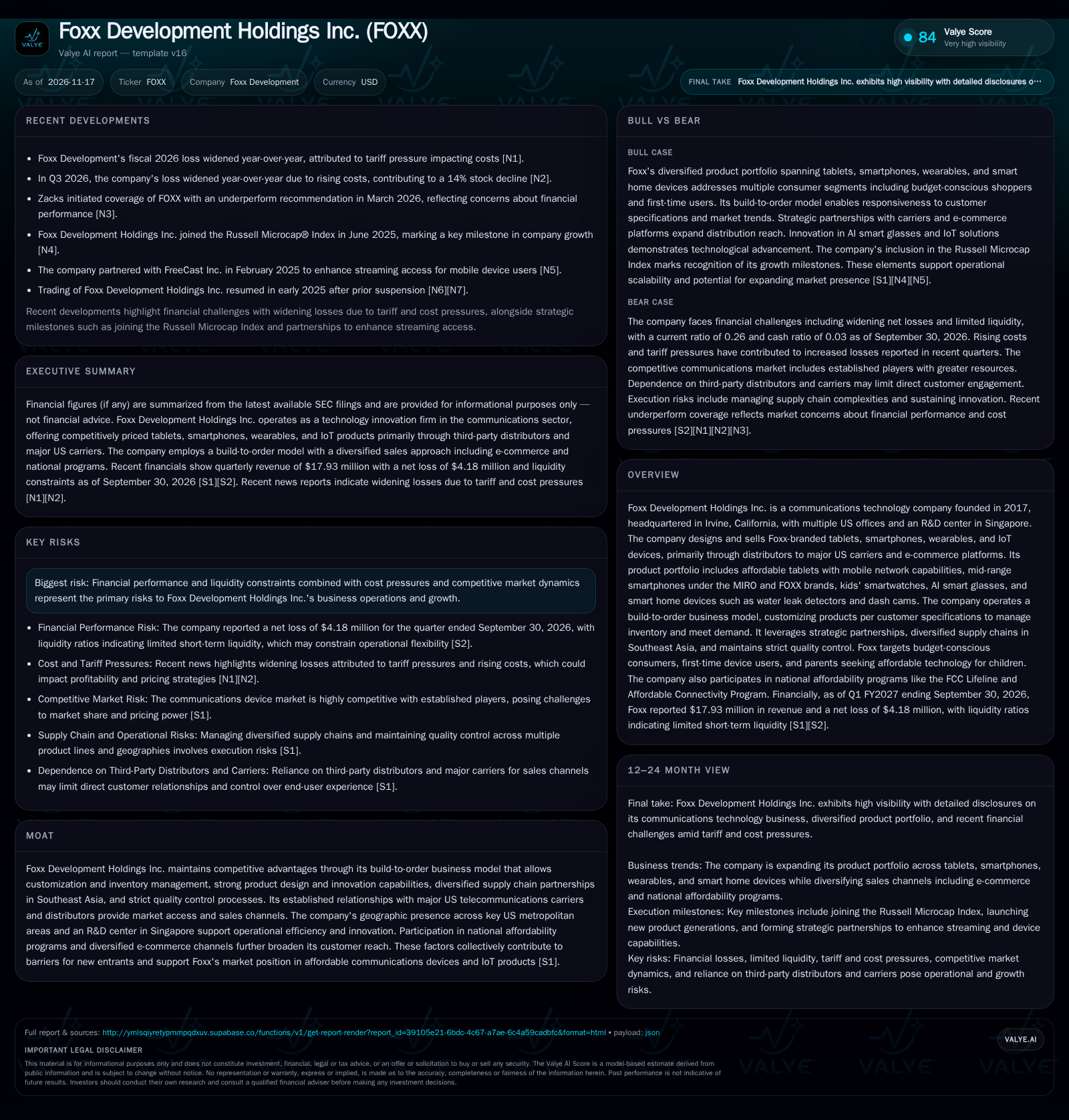
Foxx Development Holdings sells affordable smartphones, tablets, wearables, and IoT devices mainly through US carriers and online channels, with a build-to-order approach and diversified supply chain. Widening losses, rising costs, and tariff headwinds are driving operational risk, despite portfolio breadth and distribution reach. Success will hinge on margin management, supply chain execution, and the ability to differentiate in a crowded, cost-sensitive market. [S1] [S2] [N1] [N2]
Foxx Development Holdings has carved out a niche in the US communications device market by focusing on affordable, customizable smartphones, tablets, and wearables—sold through a web of carrier partnerships and online platforms.
Widening Losses and Liquidity Pressures Define the Operating Landscape
Foxx Development Holdings reported $17.93 million in revenue and a net loss of $4.18 million for the quarter ended September 30, 2026. Its current and cash ratios—0.26 and 0.03, respectively—underscore severe short-term liquidity constraints. These financial strains are not isolated: news coverage attributes the company’s widening losses to tariff pressures and rising input costs, with a notable 14% stock decline on the Q3 loss report. The company’s ongoing participation in national affordability programs and its broad product portfolio provide some insulation, but the acute cash and cost pressures now dominate the company’s near-term outlook. [S2] [N1] [N2]
Economics of Affordability: High Volume, Low Margin, and Build-to-Order Dynamics
Foxx’s business model centers on selling affordable communications devices—primarily smartphones (over 1.6 million units sold in FY2026), tablets, wearables, and IoT products—to US consumers via major carriers, MVNOs, and e-commerce. The build-to-order approach enables customization per carrier or program requirements, which can reduce inventory risk and allow for tailored feature sets. However, this model also means Foxx must manage tight manufacturing timelines, supplier coordination, and fluctuating input costs.
Pricing is inherently constrained by the company’s target demographic: budget-conscious and first-time users. As a result, revenue growth is likely to be volume-driven rather than margin-driven, with limited room for premium pricing or value-added upsell. Variable costs are dominated by component procurement, assembly, and logistics, with some fixed costs in R&D and compliance (e.g., FCC and GMSA certifications). Operating leverage is limited unless Foxx can drive significant volume gains or shift more sales to higher-margin wearables and IoT offerings. Capital needs are acute given the company’s low cash and high current liabilities, making working capital management and supplier terms critical to ongoing operations. [S1] [S2]
The build-to-order model, while advantageous in reducing inventory holding costs and enabling customization, inherently introduces complexity in supply chain coordination. Foxx must maintain a delicate balance between demand forecasting and supplier lead times, which can be challenging given the volatility in component availability and pricing. Any misalignment may result in production delays or excess inventory, both detrimental to cash flow and margin stability. Furthermore, the reliance on just-in-time procurement increases vulnerability to supply chain disruptions, emphasizing the need for robust supplier relationships and contingency planning.
From a cost structure perspective, the low-margin nature of Foxx’s products necessitates stringent control over variable and fixed expenses. The company’s ability to negotiate favorable terms with suppliers and logistics providers directly impacts gross margin resilience. Additionally, operational efficiencies in manufacturing and assembly processes can provide incremental margin relief. However, scaling these efficiencies requires volume growth, which is contingent on market acceptance and channel effectiveness. Without such scale, fixed costs related to R&D, compliance, and overhead may disproportionately weigh on profitability.
Can Foxx Sustain Differentiation in a Saturated Low-End Device Market?
Foxx’s primary competitive lever is affordability, supported by a build-to-order model and relationships with major US carriers. Its product design, Southeast Asian supply chain partnerships, and national program participation (e.g., FCC Lifeline, Affordable Connectivity Program) provide distribution reach and some defensibility against pure commodity competition.
However, the US communications device market is intensely competitive, with entrenched global brands (e.g., Samsung, Motorola, TCL) and a steady influx of low-cost Asian manufacturers. These rivals benefit from greater scale, supply chain bargaining power, and established brand recognition. Foxx’s reliance on distributors and carriers means it has limited direct influence over end-user experience or brand loyalty. Its recent innovations in wearables and AI smart glasses could provide a future differentiator, but these categories are nascent and may not offset margin pressure in the core smartphone/tablet business without material adoption or pricing power. [S1]
Foxx’s competitive positioning is also influenced by the evolving preferences of budget-conscious consumers, who increasingly expect not only affordability but also acceptable quality and feature sets. This dynamic pressures Foxx to innovate within tight cost constraints, balancing component quality and feature inclusion. The company’s participation in national affordability programs offers a strategic advantage by securing volume sales, but these programs often impose strict pricing and feature requirements, limiting flexibility. Moreover, Foxx’s indirect sales model through carriers and distributors may constrain its ability to gather direct consumer feedback and rapidly iterate on product improvements, potentially slowing responsiveness to market shifts.
In addition, the competitive landscape’s fragmentation and the presence of numerous low-cost Asian manufacturers create a continuous threat of price erosion. Foxx’s ability to differentiate through product innovation, such as AI-enabled wearables, hinges on achieving meaningful adoption and demonstrating clear value to end-users. Without sufficient scale or brand recognition, these newer categories may struggle to offset margin pressures from the core smartphone and tablet segments. Therefore, Foxx’s strategic emphasis on channel partnerships and affordability programs must be complemented by a clear pathway to building brand equity and customer loyalty to sustain long-term competitiveness.
Margin Recovery and Volume Expansion through Cost Discipline and Channel Leverage
A positive scenario would see Foxx stabilizing its cost base—potentially through renegotiated supplier terms, geographic sourcing shifts, or operational efficiencies—thereby protecting gross margins even as tariffs and input costs remain volatile. Success in channel partnerships (particularly with major carriers and through national affordability programs) could drive higher device volumes, especially if the company’s latest devices (e.g., MIRO C69M Pro, AI wearables) resonate with target demographics.
Evidence for this scenario would include sequential improvement in gross margin, sustained or increased sales volumes (especially in wearables/IoT), and a narrowing of net losses. Additional signs would be new carrier or national program wins, positive product reviews, or successful launches on e-commerce platforms. Falsification would be continued margin erosion, further liquidity deterioration, or a loss of key distribution relationships.
Squeezed Between Cost Pressures and Price Sensitivity: The Most Likely Trajectory
The most plausible outcome for Foxx is a continuation of high-volume, low-margin operations, with persistent net losses unless the company can materially improve its cost structure or realize unexpected volume gains. Tariff and input cost pressures are likely to persist, and Foxx’s ability to pass these costs onto price-sensitive consumers is limited. The company may eke out modest growth through new product launches and incremental channel expansion, but liquidity strain will continue to constrain its strategic flexibility.
Confirmation of this scenario would be stable or slightly growing revenue, ongoing net losses, and little improvement in liquidity metrics. Falsification would require either a step-change in gross margin (through cost or mix improvement) or a significant new capital infusion that alters the operating runway.
Liquidity Crunch and Supply Chain Disruption Threaten Business Continuity
In the most adverse scenario, Foxx’s acute liquidity constraints worsen, leading to delayed supplier payments, production bottlenecks, or inability to fulfill distributor/carrier orders. This could result in lost shelf space, carrier delistings, or reputational damage. If tariff or cost pressures intensify further, gross margins may turn negative, accelerating cash burn. The company’s reliance on external partners for both sales and supply could amplify the impact of any operational hiccup.
Evidence supporting this scenario would include further deterioration in current/cash ratios, reports of shipment delays or supply chain disputes, and loss of key carrier or distributor relationships. Falsification would require a rapid improvement in working capital, a successful capital raise, or clear evidence of cost structure stabilization.
What Could Shift the Foxx Thesis in the Next Year?
Gross margin trends by product category—especially if disclosed quarterly—to gauge whether cost management is offsetting tariff/headwind pressure.
Sales volumes for wearables and IoT devices, which would indicate whether Foxx is successfully diversifying beyond low-margin smartphones and tablets.
New or renewed carrier distribution deals, especially with Tier 1 US carriers, as confirmation of channel strength and volume visibility.
Working capital and supplier payment terms, as further tightening could signal operational distress or risk to the build-to-order model.
Product launch cadence and consumer uptake for new devices (e.g., AI wearables, smart home products), as a proxy for innovation-driven growth.
Participation volumes and contract terms within national affordability programs, as these programs can drive high-volume, low-risk sales.
If disclosed, direct-to-consumer e-commerce traction (repeat rates, basket size) to assess Foxx’s ability to build brand equity and margin outside traditional carrier channels.
Disclaimer: This is research-only, informational analysis and not investment advice. It may include AI-generated interpretation and general industry context. Always verify important details using primary sources.

Comments