
Western Uranium & Vanadium: Technology Bet and Processing Ambition Define a High-Risk, High-Reward Mining Thesis
With a proprietary separation technology and fully permitted U.S. mines, Western Uranium & Vanadium is building the infrastructure for vertically integrated uranium and vanadium production. The company’s progress hinges on commercializing its Kinetic Separation process and successfully transitioning from an exploration-stage entity to a cost-advantaged producer in volatile commodity markets.
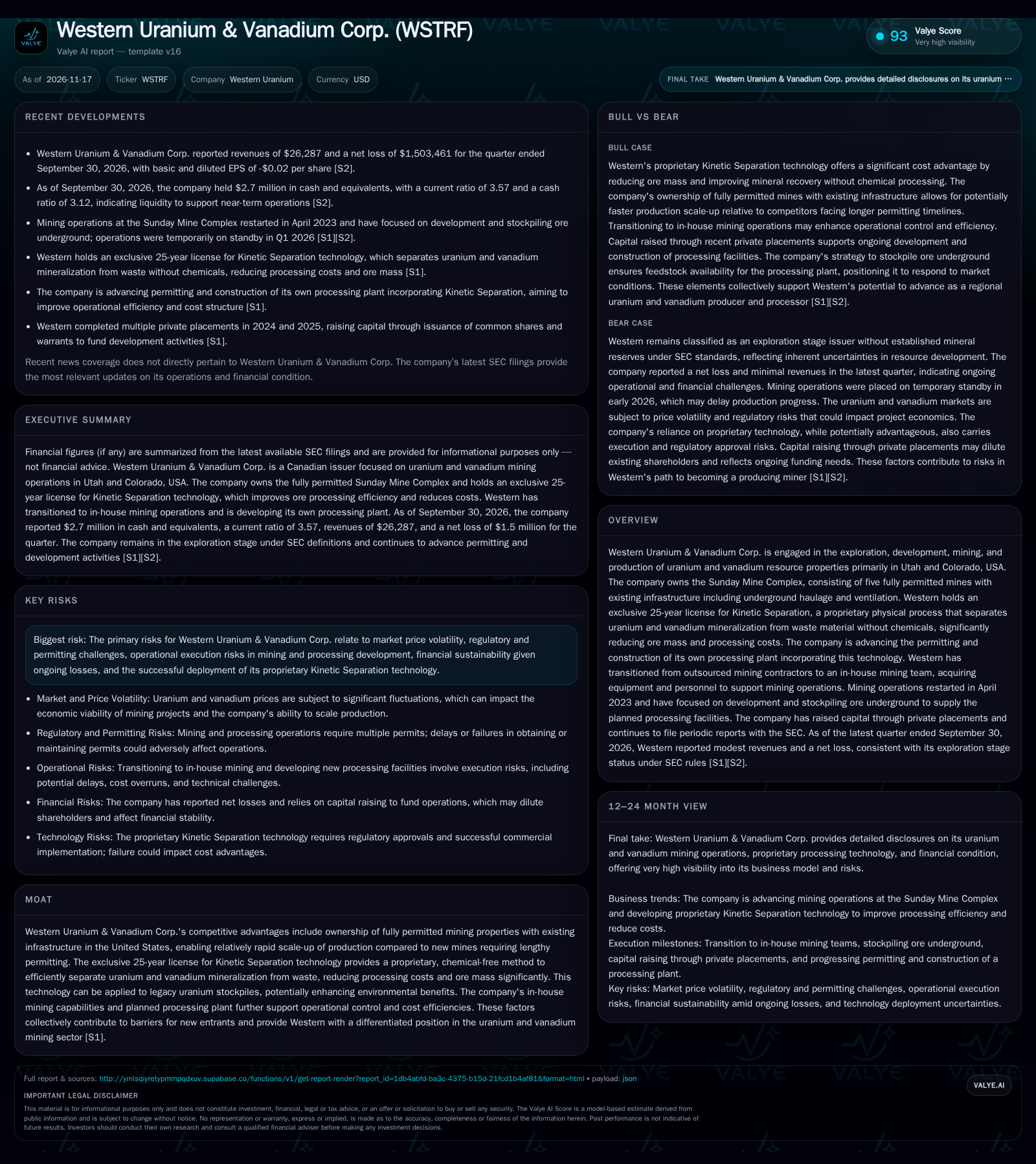
Western Uranium & Vanadium owns fully permitted mines in Colorado, holds an exclusive license for a proprietary ore separation technology, and is developing its own processing plant. The company remains at the exploration stage, reporting minimal revenues and continuing net losses, but aims to leverage technology and infrastructure for a cost advantage if it can scale production and secure favorable uranium and vanadium prices. Execution, regulatory, and market risks remain high. [S1] [S2]
Western Uranium & Vanadium Corp. represents a distinctive but high-risk bet within junior mining: it pairs fully permitted U.S. uranium and vanadium mines with exclusive rights to a proprietary ore processing technology. While the company’s Kinetic Separation process promises substantial reductions in processing costs and chemical usage, Western remains an exploration-stage issuer, reporting minimal revenue and ongoing losses as it builds out the infrastructure for vertical integration. The company’s future hinges on converting technical and permitting milestones into commercial production at scale—an ambition complicated by volatile commodity prices, execution risks, and the realities of early-stage mining economics. [S1] [S2]
Recent Developments Reshape Western’s Short-Term Trajectory
Western Uranium & Vanadium has continued to operate as an exploration-stage company, reporting just $26,287 in revenue and a net loss of $1,503,461 for the quarter ended September 30, 2026. The company’s cash and equivalents stood at $2.7 million, with a current ratio of 3.57 and a cash ratio of 3.12 at quarter end. These figures indicate that while Western has some liquidity for near-term operations, it is not yet generating cash flow from mining or processing activities. Mining operations at the Sunday Mine Complex, Western’s flagship asset, were restarted in April 2023 but are on temporary standby as of Q1 2026, with the company focusing on stockpiling ore for future processing. The major operational pivot is Western’s ongoing permitting and design of a proprietary processing plant in Utah and Colorado, intended to leverage its exclusive 25-year license for Kinetic Separation technology—a process management claims can reduce production costs by 44-53% and recover 85-90% of uranium from legacy stockpiles. [S1] [S2]
Processing Plant Economics and Technology Drive Future Profit Potential
Western’s business model aspires to vertically integrate mining and processing of uranium and vanadium, extracting value both from ore and from process innovation. The company’s cost structure is currently dominated by development, permitting, and care-and-maintenance expenses, with minimal offsetting revenue while operations are on standby. The planned processing plant, if constructed and permitted, could fundamentally alter unit economics: Kinetic Separation is designed to reduce the volume of waste processed, lower chemical and energy inputs, and potentially enable processing of lower-grade ores or legacy stockpiles that would otherwise be uneconomical. This could allow Western to capture a margin advantage, provided the technology performs at commercial scale and market prices support production. However, as an exploration-stage issuer without established mineral reserves, Western must still prove up its resource base to justify capital investment and secure offtake agreements.
Fixed costs are likely to be high in the near term, given plant construction, permitting, and in-house team buildout. Variable costs could be meaningfully lower than conventional mining if Kinetic Separation delivers as advertised. The capital intensity of building a new mill and supporting infrastructure remains a significant hurdle, and ongoing net losses suggest further external funding will be required until commercial operations begin. Operating leverage could be substantial if throughput ramps up and commodity prices are favorable, but downside exposure is high if delays, cost overruns, or technical failures occur.
Proprietary Technology and Permitted Mines Offer Differentiation—If Commercialized
Western’s main competitive levers are its exclusive 25-year license for Kinetic Separation and ownership of fully permitted U.S. mining assets. In theory, this positions the company ahead of junior peers still navigating lengthy regulatory processes or lacking technology differentiation. The U.S. location is strategic, given heightened interest in domestic uranium supply chains for energy security. If Kinetic Separation works at scale, Western could process ore with lower costs and environmental impact than conventional acid-leach or solvent extraction methods, potentially capturing contracts from utilities or legacy stockpile holders.
However, these advantages are not yet proven in commercial production. Western competes with other junior uranium and vanadium miners, established North American producers, and companies pursuing alternative processing or extraction technologies. The sector is also exposed to substitution risk from secondary uranium supply, recycling, and, over the long term, alternative energy sources. The company’s ability to maintain a moat will be tested by its execution on plant construction, demonstration of technology efficacy, and ability to scale operations before competitors can replicate or leapfrog its approach.
Cost Disruption and Vertical Integration Could Unlock Material Value
If Western successfully permits, builds, and commissions its processing plant on schedule, and Kinetic Separation delivers the promised cost and recovery advantages at commercial scale, the company could rapidly transition from exploration-stage to profitable production. This would allow Western to monetize its stockpiled ore, process legacy uranium and vanadium resources, and potentially offer tolling or technology-licensing services to other miners. Upside could be amplified by a strong uranium price environment, driven by renewed interest in nuclear power and supply constraints in other regions.
Evidence supporting this scenario would include timely completion of plant permitting and construction, successful demonstration of Kinetic Separation on commercial ore, third-party validation of cost savings and recovery rates, and the signing of offtake or tolling agreements. Falsification would come from delays, technical setbacks, or failure to achieve stated cost reductions.
Incremental Progress and Ongoing Losses Define a Transitional Phase
The most plausible near-term trajectory is that Western continues to advance permitting and initial construction of its processing plant while maintaining its mines in standby or limited development mode. Modest capital raises—likely through further private placements—would bridge funding gaps but dilute equity holders. Operating losses persist, with only minor revenue from incidental ore sales or development activities. The company’s valuation remains tied to optionality around future production and technology value, rather than current cash flows.
Confirmation of this scenario would be the gradual achievement of permitting milestones, continued SEC reporting as an exploration-stage company, and periodic capital raises. Setbacks could include regulatory delays, cost overruns, or adverse commodity price movements, but not necessarily outright failure unless funding dries up or technology underperforms.
Permit Delays, Execution Failures, and Commodity Weakness Could Force Strategic Reset
In the adverse case, Western could face prolonged permitting delays, technical failures in scaling Kinetic Separation, or sustained weakness in uranium and vanadium prices. These outcomes could exhaust available liquidity before commercial operations commence, forcing the company to halt development, seek distressed financing, or pursue asset sales. Shareholder dilution could accelerate, and the company’s technology advantage could erode if competitors leapfrog with new methods or if regulatory changes undercut the economics of domestic uranium mining.
Evidence for this downside would include missed permitting or construction milestones, rising net losses without corresponding progress, inability to raise new capital on reasonable terms, or public disclosure of technical or regulatory setbacks.
Milestones and Metrics That Will Clarify Western’s Transition from Explorer to Producer
Progress on permitting and construction of the Utah and Colorado processing plants—official permit approvals, construction contracts awarded, and timeline disclosures.
Demonstrated commercial-scale performance of Kinetic Separation, including third-party validation of cost savings and recovery rates—if disclosed.
Ore throughput and stockpile volume metrics at the Sunday Mine Complex, which would indicate operational readiness for plant commissioning.
Updates on offtake agreements, tolling contracts, or technology-licensing deals with third parties, signaling external validation and future revenue streams.
Quarterly cash burn, capital raise activity, andreported liquidity position, particularly as development costs ramp ahead of meaningful revenue.
Regulatory or legislative changes impacting U.S. uranium and vanadium mining economics, such as new incentives, tariffs, or supply mandates.
Commodity price trends for uranium and vanadium, as realized pricing will determine project economics and capital access.
If disclosed, progress toward establishing mineral reserves under SEC S-K 1300, which would support a transition from exploration-stage to development-stage reporting.
Disclaimer: This is research-only, informational analysis and not investment advice. It may include AI-generated interpretation and general industry context. Always verify important details using primary sources.

Comments