
iSpecimen’s Marketplace Transformation: Technology Gains Meet Revenue Realities in the Biospecimen Sector
Despite significant investments in platform modernization and operational efficiency, iSpecimen faces a sharp revenue contraction and mounting doubts about its financial sustainability. The company must bridge the gap between a differentiated marketplace model and the commercial traction required to survive in a fragmented, compliance-intensive industry.
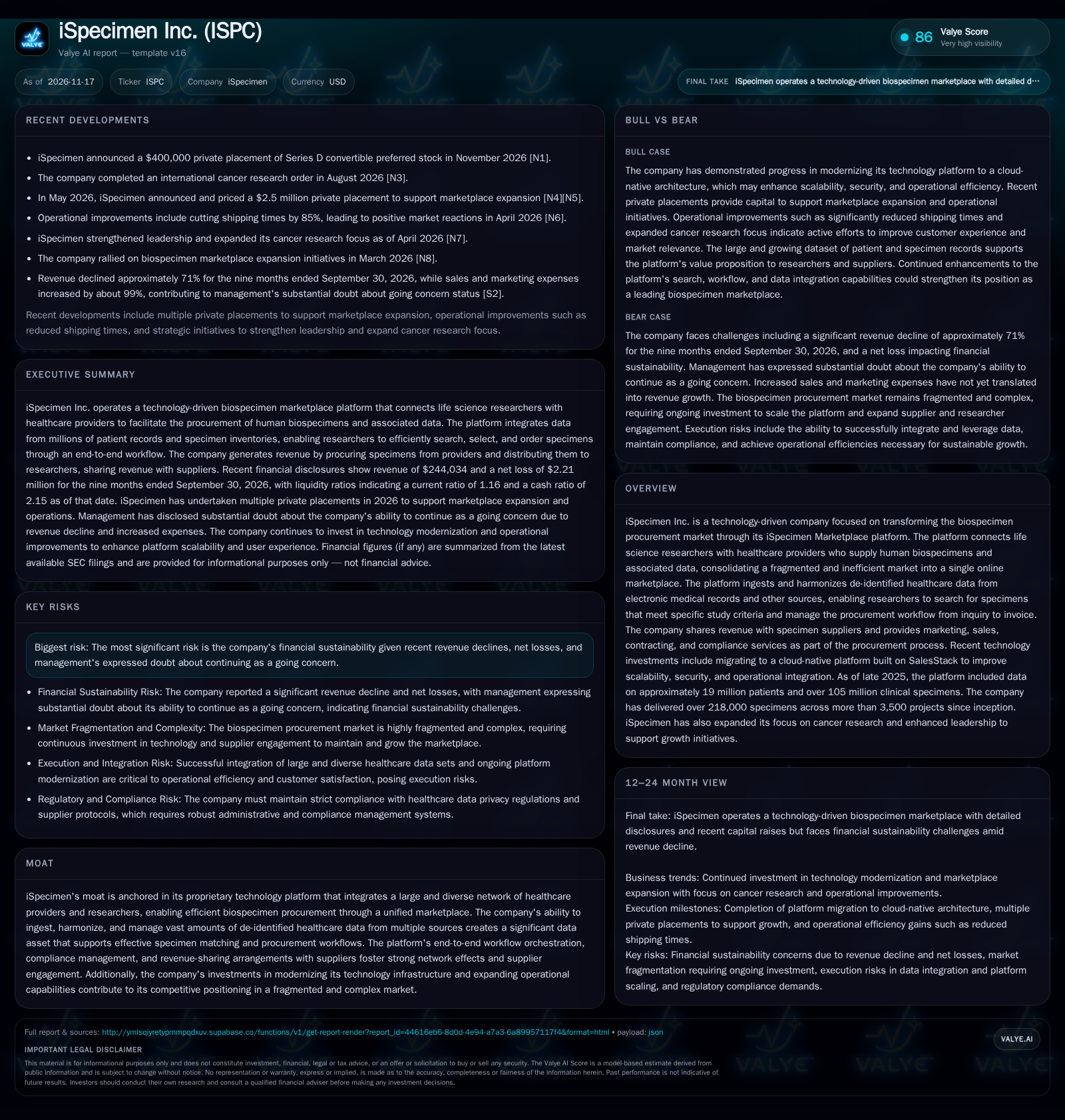
iSpecimen has modernized its cloud-native biospecimen marketplace and cut shipping times substantially, but revenue has dropped 71% year-over-year as of Q3 2026 and management has expressed substantial doubt about its ability to continue as a going concern. Recent capital raises have supported operations, but the company is under acute pressure to convert platform and operational improvements into sustainable revenue growth [S2] [N1] [N4] [N6].
iSpecimen sits at the intersection of healthcare data, technology, and life sciences research, aiming to solve the longstanding fragmentation of biospecimen procurement. Its marketplace platform, now cloud-native and boasting vast clinical data integration, offers a compelling value proposition for researchers and specimen suppliers alike. However, a dramatic revenue decline, rising expenses, and management’s explicit warning about its ability to continue as a going concern make the company’s future highly uncertain. The next phase will test whether operational and strategic improvements can translate into commercial relevance before financial runway runs out.
Sharp Revenue Contraction and Financial Warning Define the Current State
For the nine months ended September 30, 2026, iSpecimen reported revenue of $244,034—a year-over-year decline of approximately 71%—and a net loss of $2.21 million. Sales and marketing expenses increased by about 99% over the same period, further compounding financial strain [S2].
Management has explicitly stated substantial doubt about the company’s ability to continue as a going concern, citing persistent revenue decline and rising costs [S2].
Liquidity remains tight: as of September 30, 2026, the company held $5.56 million in cash and cash equivalents against $5.47 million in current liabilities, with a current ratio of 1.16 and a cash ratio of 2.15 [S2].
Multiple private placements, including a $2.5 million raise in May 2026 and a $400,000 Series D preferred placement in November, have provided incremental capital, but the company’s cash reserves remain closely matched to its short-term obligations [N1] [N4].
Marketplace Model, Revenue Sharing, and the Challenge of Scaling Profitability
iSpecimen’s core business is a digital marketplace connecting researchers with healthcare providers offering human biospecimens and associated clinical data. The platform ingests and harmonizes de-identified data from electronic health records, providing end-to-end workflow management from search to compliance [S1].
Revenue is generated by sourcing specimens from providers and distributing them to researchers, with suppliers typically receiving 20% to 50% of gross proceeds [S1]. This margin structure means gross profitability is sensitive to both transaction volume and the average revenue per specimen.
The model is inherently variable-cost intensive: as the intermediary, iSpecimen’s cost of goods sold scales directly with specimen procurement, shipping, and handling. Fixed costs are dominated by technology infrastructure, compliance systems, and sales/marketing—a mix that offers operating leverage if volume can be scaled, but exposes the company to losses when volumes fall, as seen in 2026.
Recent investments in a cloud-native platform (built on SalesStack) aim to improve scalability, integration, and security, which could reduce per-transaction overhead and support higher throughput in the long term [S1]. However, ongoing capital is required for platform development, supplier onboarding, and compliance, especially in a highly regulated sector.
Fragmented Supply, Complex Compliance, and the Race for Network Effects
iSpecimen operates in a highly fragmented market where biospecimen procurement is traditionally manual, slow, and often relationship-driven. The company’s technology platform seeks to aggregate and standardize access, offering a centralized solution for both researchers and providers [S1].
The principal competitive advantage is the breadth and depth of integrated clinical and specimen data—19 million patient records and over 105 million specimen records—which enhances matching accuracy and workflow efficiency. The end-to-end compliance and procurement orchestration further differentiates the offering.
However, network effects in this domain are not as self-reinforcing as in pure software marketplaces: supplier loyalty is contingent on revenue-sharing economics, while researcher adoption depends on data quality, procurement speed, and regulatory assurance. Both sides have alternatives, including direct sourcing from biobanks, academic medical centers, or specialized procurement firms.
Barriers to entry include technology investment, compliance infrastructure, and data harmonization capabilities, but switching costs are limited unless iSpecimen can deliver persistent advantages in speed, breadth, or regulatory assurance. Recent operational improvements—such as an 85% reduction in shipping times—may improve competitive positioning if sustained [N6].
Unlocking Volume Through Platform Efficiency and Cancer Research Focus
The most plausible upside scenario is that recent investments in technology, operational efficiency, and a sharpened focus on cancer research translate into renewed customer demand and transaction volume.
Operational improvements—most notably the 85% cut in shipping times—could drive higher satisfaction and repeat business among both researchers and suppliers, making the marketplace a preferred channel [N6]. Expansion in cancer research, a high-growth and specimen-intensive domain, could attract new institutional customers and increase average order values [N7].
Confirmation would come from a meaningful rebound in quarterly revenue, improved gross margin (suggesting better pricing or cost discipline), and evidence of new large-scale research contracts or strategic partnerships. A sustained increase in project counts or specimen throughput would also validate the thesis.
Falsification would be signaled by persistently flat or declining revenues despite operational improvements, suggesting that either market demand is weak or competitive alternatives remain preferable.
Struggling for Traction: Platform Improvements Meet Slow Commercial Uptake
The most likely near-term scenario is that iSpecimen’s technology and operational enhancements yield only incremental revenue gains, insufficient to offset the sharp 2026 contraction and fixed cost base.
Sales and marketing spend may continue to outpace revenue growth as the company works to re-engage lapsed customers and onboard new suppliers, particularly in cancer research. Platform improvements may reduce customer churn and improve satisfaction but are unlikely to drive a rapid inflection in demand without a broader market tailwind.
Evidence supporting this scenario would be a modest stabilization of revenue (even if not returning to prior levels), ongoing net losses, and continued reliance on external capital to fund operations. The current ratio and cash position would remain tight, with further private placements or cost-cutting likely required.
A shift to positive operating cash flow or a clear inflection in customer acquisition would contradict this scenario, while another sharp revenue decline or inability to raise capital would reinforce it.
Acute Financial Distress and Potential Platform Wind-Down
If operational improvements and increased commercial focus fail to drive a revenue rebound, iSpecimen may face acute financial distress within the next 12 months, given management’s expressed going concern doubts and the close match between cash reserves and current liabilities [S2].
In this scenario, the company could exhaust its cash runway without achieving self-sustaining transaction volumes, forcing a restructuring, asset sale, or platform wind-down.
Confirmation would come from continued revenue declines, an inability to raise additional funds, or a further increase in net losses. Disclosure of workforce reductions, asset impairment, or strategic reviews would also signal distress.
Falsification would require a clear and sustained recovery in revenue and gross profit, new strategic partnerships with significant upfront payments, or a major external investment that meaningfully extends the company’s runway.
Milestones That Will Define iSpecimen’s Market Relevance and Survival
Quarterly revenue growth or stabilization: A sustained rebound or even stabilization in top-line revenue would be a critical signal that operational improvements and commercial initiatives are gaining traction.
Gross margin trends: Improvement in gross margin would indicate better procurement economics, pricing discipline, or cost control—key for platform viability.
Customer acquisition and retention rates: If disclosed, metrics on new researcher sign-ups, repeat order rates, and supplier churn would provide early evidence of network effects and marketplace stickiness.
Average order value and specimen throughput: A rising average order size or total specimens fulfilled per quarter would suggest deeper customer engagement and higher platform utility.
Execution in cancer research vertical: Announcements of large-scale cancer research contracts or partnerships would validate the sector focus and potentially unlock higher-margin growth.
Platform development milestones: Completion of further technology upgrades or integration of new data sources would strengthen the infrastructure for future growth.
Regulatory or compliance developments: Any new compliance disclosures or enforcement actions would directly impact platform credibility and customer willingness to engage.
Disclaimer: This is research-only, informational analysis and not investment advice. It may include AI-generated interpretation and general industry context. Always verify important details using primary sources.

Comments