
Oaktree Specialty Lending: Navigating Middle-Market Credit Amid Macroeconomic Volatility and Leverage Risk
Oaktree Specialty Lending Corp’s latest results highlight resilient income generation and disciplined portfolio practices, but persistent macro headwinds, portfolio risk concentration, and leverage exposures shape future outcomes. The interplay between credit quality, valuation discipline, and funding costs will determine whether OCSL can sustain returns for shareholders in a shifting credit landscape.
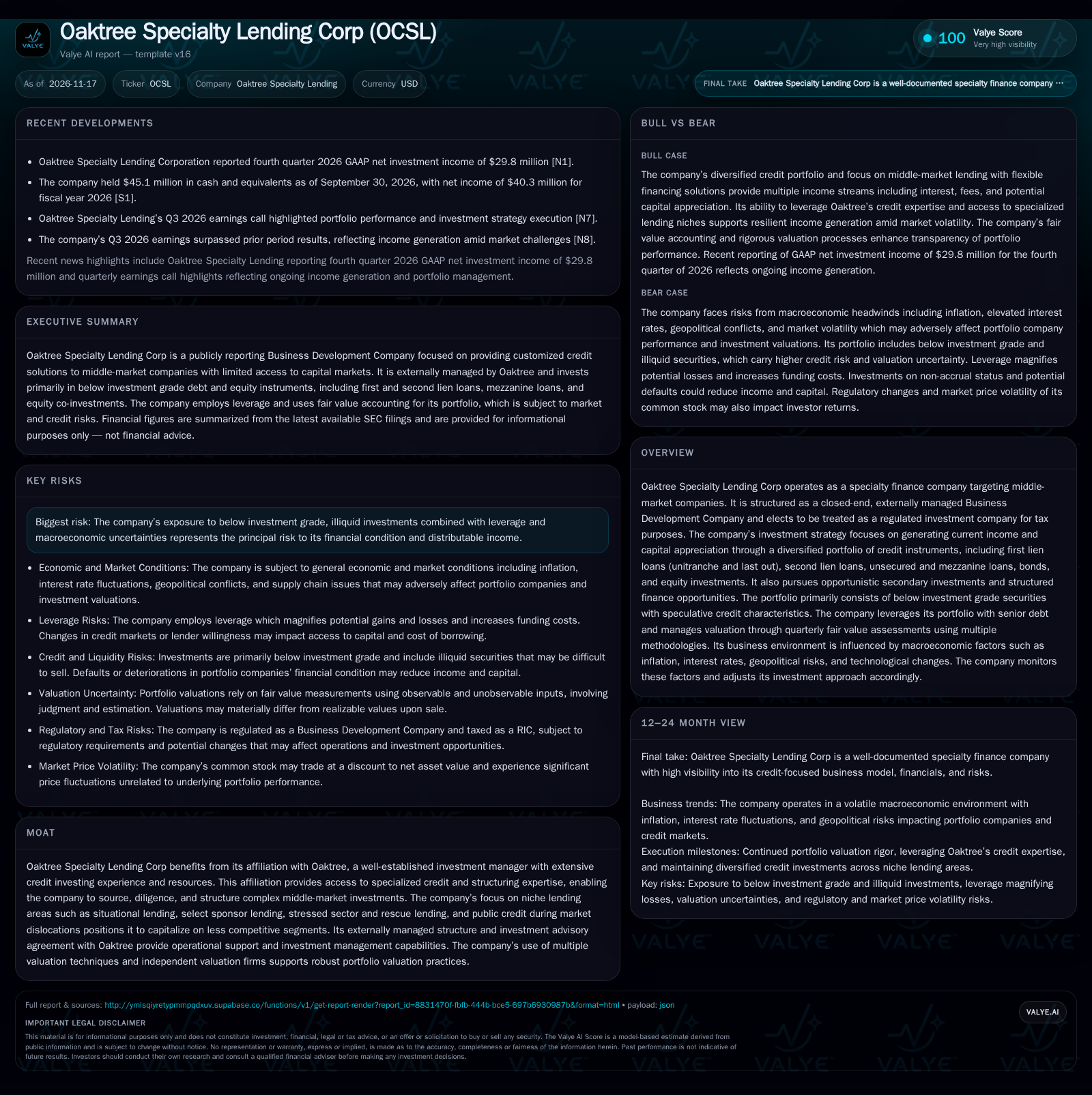
Oaktree Specialty Lending Corp reported $29.8 million in GAAP net investment income for Q4 2026 and closed the fiscal year with $40.3 million of net income, but net asset value per share declined year-on-year. The company’s leveraged, below-investment-grade portfolio faces elevated macroeconomic and credit risks. OCSL’s affiliation with Oaktree provides sourcing and structuring advantages, yet the sustainability of income and asset values will depend on credit cycle dynamics, non-accrual resolutions, and continued access to attractively priced funding. [S1] [N1]
Oaktree Specialty Lending Corp (OCSL) is a major player in the U.S. middle-market lending space, structuring flexible credit solutions for companies that often lack access to traditional capital markets. Its model—anchored by Oaktree’s credit expertise—has produced robust net investment income and maintained a diversified portfolio across loan and equity types. However, the 2026 fiscal year saw a decline in net asset value per share, and a portion of the book remains on non-accrual, signaling persistent credit stress. As OCSL leans on leverage to drive returns, the sustainability of its performance will hinge on its ability to manage credit deterioration, portfolio valuation discipline, and funding costs in a volatile macroeconomic environment. [S1] [N1]
Recent Portfolio Performance and Credit Quality Trends
Oaktree Specialty Lending Corp reported GAAP net investment income of $29.8 million for Q4 2026, with full-year net income of $40.3 million and EPS of $0.46. While these figures underscore the company’s continued ability to generate distributable income, net asset value (NAV) per share declined from $16.64 to $15.63 over the fiscal year, suggesting that credit markdowns or realized losses outpaced income generation. As of September 30, 2026, OCSL held $45.1 million in cash and equivalents and maintained $1.416 billion in senior securities at a 6.2% weighted average interest rate. Non-accrual debt investments—where borrowers are not making contractual payments—accounted for 4.2% of the portfolio at cost as of June 30, 2026, highlighting ongoing credit risk within the book. [S1] [N1]
How OCSL Generates Income—and Where Risk Accumulates
OCSL’s business model is built on generating current income through a blend of interest, fees, and, occasionally, capital appreciation from a portfolio of predominantly below investment grade loans and equity co-investments. The company’s use of leverage is intended to enhance returns on equity, with the spread between asset yields and funding costs driving net investment income. However, this model also amplifies credit and liquidity risks, particularly when macroeconomic volatility leads to higher funding costs and asset impairments. Because OCSL’s investments are often illiquid and speculative, realized losses or payment defaults can quickly erode NAV and reduce distributable earnings. The company’s externally managed structure means management fees and administrative expenses are a fixed cost burden, so scale and portfolio yield are critical for maintaining operating leverage. In periods of market stress, the fair value accounting required for BDCs can accelerate reported losses even before actual defaults, pressuring both reported income and capital ratios.
Oaktree Affiliation: Sourcing Edge or Structural Limitation?
Oaktree Specialty Lending’s competitive positioning is anchored by its relationship with Oaktree—a global credit investor known for deep expertise in distressed and special situations. This affiliation provides OCSL with access to proprietary deal flow, credit underwriting resources, and structuring capabilities that many standalone BDCs lack. It also enables the company to pursue niche lending opportunities, such as rescue finance, non-sponsor direct lending, and opportunistic secondary purchases during market dislocation. However, the market for middle-market lending remains highly competitive, with direct lenders, private credit funds, and other BDCs all seeking yield in a low-growth environment. Oaktree’s scale and reputation may help in sourcing and executing complex deals, but the company’s externally managed structure can create potential conflicts of interest—particularly around fee arrangements and risk appetite. Furthermore, the focus on below investment grade credits means OCSL is structurally exposed to higher loss rates and periods of market illiquidity, limiting its ability to meaningfully differentiate based solely on sourcing or credit expertise.
If Credit Conditions Stabilize, Leverage Could Amplify Returns
In a scenario where inflation moderates and credit markets stabilize, OCSL could benefit from a narrowing of credit spreads, lower default rates, and improved recovery values on distressed assets. The company’s portfolio yield could remain elevated relative to funding costs, supporting robust net investment income and potential NAV recovery. If Oaktree’s sourcing advantage allows OCSL to selectively add high-return, low-default assets—especially in market dislocations—portfolio quality and income generation could improve further. Confirmation would come from a reduction in non-accrual rates, a rebound in NAV per share, and sustained or growing net investment income quarter-over-quarter. Falsification would be evidenced by continued NAV erosion, rising non-accruals, or a spike in realized credit losses despite stable or improving macro conditions.
Sustaining Income in a Cautious Credit Environment
The most plausible outcome is that OCSL maintains its current level of net investment income, with modest portfolio turnover and continued vigilance on credit risk. Macroeconomic conditions—while volatile—do not deteriorate significantly, and OCSL’s management team is able to offset credit losses with new originations and opportunistic purchases. Leverage remains broadly stable, and funding costs do not spike materially higher. Portfolio valuation remains disciplined, but NAV per share may continue to drift lower if realized losses persist or if new investments are made at wider discounts to par. Confirmation would include stable or slightly improving net investment income, a steady non-accrual ratio, and relatively flat NAV per share. Falsification would be indicated by a sharp uptick in non-accruals, a material drop in net investment income, or an adverse funding event that restricts new investment activity.
Leverage Amplifies Losses if Credit Deterioration Accelerates
Should macroeconomic conditions worsen—such as a recession, persistent inflation, or a spike in borrower defaults—OCSL could experience a sharp increase in non-accruals and realized credit losses. Because the portfolio is highly leveraged and concentrated in below investment grade assets, losses could quickly outpace income generation, leading to further NAV erosion and potential breaches of regulatory asset coverage ratios. Funding costs may rise if capital markets tighten, and the company could be forced to sell assets at a discount or limit new originations. Confirmation of this scenario would include a surge in non-accrual investments, a steep decline in NAV per share, and potentially a reduction or suspension of dividends. Falsification would require evidence of resilience in both portfolio quality and funding access despite adverse macro headlines.
What Will Determine OCSL’s Resilience in the Next Credit Cycle?
Quarterly trend in non-accrual investments as a percentage of total debt at cost—rising or stabilizing rates would provide an early signal of portfolio stress or recovery, respectively, if disclosed.
Quarterly net asset value (NAV) per share movement, which reflects the combined impact of credit losses, asset valuations, and portfolio income.
Net investment income and its ratio to average net assets, as an indicator of ongoing earning power versus cost of capital.
Weighted average yield on new originations compared to weighted average cost of debt, to assess whether the spread is widening or compressing.
Changes in the mix of first lien, second lien, and equity investments, which would illustrate risk appetite and portfolio repositioning.
Leverage ratio (total debt to equity or regulatory asset coverage), as rising leverage in a deteriorating credit environment could signal increased risk.
Portfolio turnover rate and realized gains/losses on exits or restructurings—high turnover with realized losses could indicate credit stress.
Funding cost trends and access to new capital, especially if market volatility increases and refinancing conditions tighten.
Disclaimer: This is research-only, informational analysis and not investment advice. It may include AI-generated interpretation and general industry context. Always verify important details using primary sources.

Comments