
Tetra Tech’s Diversification Strategy Faces U.S. Federal Headwinds, but International and Commercial Gains Shift the Center of Gravity
Tetra Tech’s fiscal 2026 results underscore a sharp decline in U.S. federal revenue, even as international and commercial segments advance. The company’s acquisition-driven model and specialized services in water and sustainability are recalibrating its risk profile—but the question is whether international and commercial momentum can offset shrinking U.S. government demand.
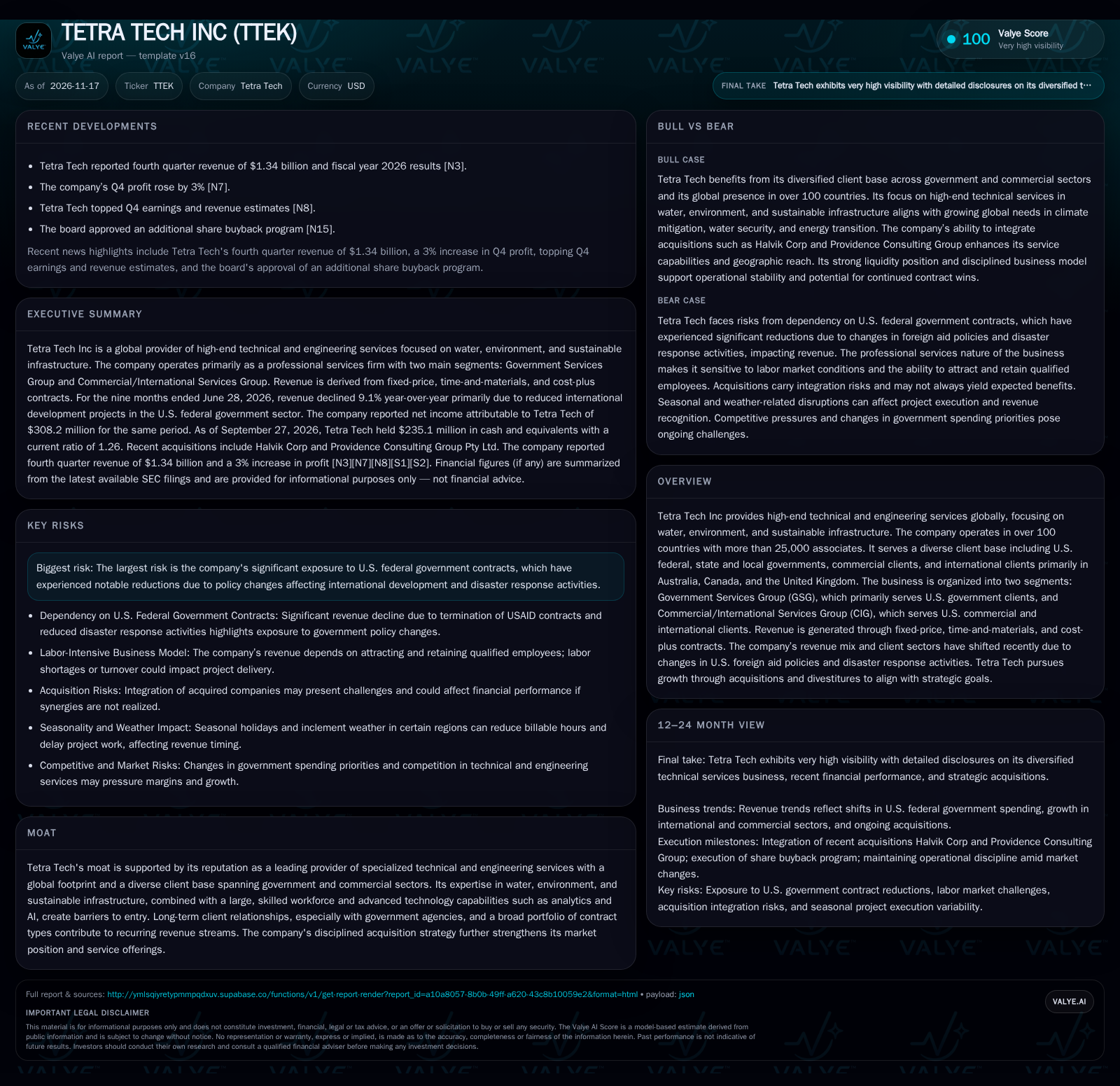
Tetra Tech’s 2026 revenue fell 9.1% year-over-year, mainly due to a 32.5% drop in U.S. federal government business. However, international revenue grew nearly 10%, and commercial revenue held steady. Recent acquisitions aim to diversify exposure and build out advisory capabilities, but the firm remains exposed to U.S. policy shifts. The core thesis now hinges on the company’s ability to execute internationally and leverage technical differentiation in a more fragmented, competitive global market. [S2] [N3] [N7] [N8]
Tetra Tech’s 2026 performance illustrates the risks and rewards of a diversified, global engineering and consulting model. The firm suffered a material setback in U.S. federal revenue as government priorities shifted—yet continued growth in international markets and stable commercial demand suggest a pivot in the company’s revenue base. Recent acquisitions highlight a push toward higher-value advisory and digital services, but also present integration and execution risks. As Tetra Tech rebalances its portfolio, the company’s ability to win and deliver complex projects across geographies will likely determine whether it can sustain growth and margin resilience in a changing market landscape.
Recent Revenue Shifts Reshape Tetra Tech’s Exposure
For the nine months ended June 28, 2026, Tetra Tech reported a 9.1% year-over-year revenue decline, mainly attributed to a sharp 32.5% drop in U.S. federal government revenue. This was driven by the termination of USAID contracts and a pullback in disaster response activities. In contrast, international revenue grew 9.9%, buoyed by increased demand from water utilities and digital water projects, and commercial revenue was stable with a slight 0.2% increase. The fourth quarter saw revenue of $1.34 billion and a 3% profit increase, with both earnings and revenue surpassing consensus estimates [S2] [N3] [N7] [N8].
Recent acquisitions, including Halvik Corp (U.S. federal defense/civilian advisory) and Providence Consulting Group in Australia, reflect Tetra Tech’s strategy to diversify its client base and strengthen its advisory/project management offerings [S2].
As of September 2026, Tetra Tech’s cash and equivalents were $235.1 million, with a current ratio of 1.26—typical for a labor-intensive services firm [S1].
How Tetra Tech Monetizes Expertise in a Fluid Market
Tetra Tech’s business model is fundamentally labor-driven: the company earns revenue by deploying technical experts to solve complex water, environmental, and infrastructure challenges for government and commercial clients. Revenue is split among fixed-price (48%), time-and-materials (43.2%), and cost-plus (8.8%) contracts, each with distinct risk/reward profiles [S2]. Fixed-price contracts can yield higher margins if executed efficiently but expose Tetra Tech to cost overruns, while time-and-materials contracts offer more predictable returns but limit upside. Cost-plus contracts provide a safety net but are less common.
The firm’s cost structure is largely variable, linked to direct labor and subcontractor expenses, with relatively low capital requirements for equipment or facilities. This gives Tetra Tech some flexibility to scale up or down with demand, but also means gross margins are highly sensitive to project mix, utilization rates, and the ability to attract and retain specialized talent. Operating leverage is modest in this model, with incremental margin gains possible through higher utilization or successful integration of higher-value advisory services.
Acquisitions represent a key capital allocation lever—enabling bolt-on growth and access to new markets or capabilities. However, integration costs and the risk of cultural misalignment can dilute synergies, especially in international settings.
Specialization, Scale, and Relationships Define Market Standing
Tetra Tech competes in a fragmented global market for engineering and technical services, where scale, technical depth, and client relationships are critical. The company’s reputation in water and environmental consulting, combined with a large global workforce, supports competitive positioning—especially for complex, multidisciplinary projects that require regulatory expertise and local delivery.
Long-term relationships with government agencies and commercial clients can provide some revenue visibility, but contract-based work is inherently competitive and exposed to periodic rebidding. In the U.S., Tetra Tech faces competition from other large engineering firms and niche consultancies, while internationally, local players and global peers vie for infrastructure and sustainability contracts.
Technology adoption—such as digital water solutions, advanced analytics, and AI-enabled project management—could enhance differentiation and pricing power if Tetra Tech can scale these offerings. However, many competitors are also investing in digital and sustainability services, so sustained leadership will depend on both technical execution and customer trust.
International Expansion and Advisory Integration Drive a New Growth Phase
A bullish scenario sees Tetra Tech successfully leveraging its recent acquisitions to deepen advisory and digital service offerings, particularly in international markets where infrastructure investment is accelerating. If the company can cross-sell high-value consulting and project management to new and existing clients—especially in regions like Australia, Canada, and the UK—revenue mix could continue to shift away from volatile U.S. federal streams.
Confirmation would come from sustained double-digit international revenue growth, rising margins from higher-value services, and evidence that acquired businesses contribute meaningfully to both top- and bottom-line results. Signs of successful talent retention, new contract wins in digital water and sustainability, and a growing portfolio of multi-year client engagements would further support this scenario.
Falsification would be indicated by stalled international growth, persistent integration costs, or failure to win new advisory mandates outside the U.S.
Portfolio Rebalancing Offsets U.S. Federal Weakness, but Growth Stays Modest
The most plausible path is one where Tetra Tech gradually reduces its exposure to U.S. federal government volatility by growing international and commercial business, while overall growth remains tempered by ongoing headwinds in its legacy U.S. segments. The company’s ability to maintain stable commercial revenue and achieve mid-single-digit growth in international markets could offset further declines or stagnation in federal work.
This scenario would be confirmed by a stable or rising proportion of revenue from the Commercial/International Services Group, steady margins, and continued bolt-on acquisitions that are absorbed without major disruption. Periodic softness in U.S. government contracting or project delays could periodically weigh on results, but not derail the broader shift.
Falsification would occur if international or commercial wins fail to materialize, or if integration issues from recent acquisitions erode profitability and distract management attention.
Concentration Risk and Integration Hurdles Undermine Recovery Prospects
A negative outcome could emerge if U.S. federal revenue continues to deteriorate and is not offset by international or commercial gains. Integration challenges from recent acquisitions could create operational drag, resulting in higher costs, client attrition, or missed project milestones. Additionally, if global economic or political instability reduces infrastructure spending in key international markets, Tetra Tech could face a broader demand shortfall.
Confirmation of this scenario would include further sharp declines in federal and state/local revenue, earnings misses, rising project write-downs, or evidence that integration costs are exceeding expectations. A spike in turnover among key technical staff or a failure to secure new international contracts would exacerbate downside risk.
This scenario could be falsified if the company stabilizes U.S. government work or demonstrates rapid integration and revenue synergies from recent acquisitions.
Testing the Thesis: What Will Reveal Tetra Tech’s Trajectory
International revenue growth rates, especially in water and digital infrastructure, as a signal of successful geographic diversification.
Revenue and margin contribution from recent acquisitions (Halvik Corp, Providence Consulting Group)—if disclosed—would clarify integration effectiveness.
Contract win rates and backlog composition by geography and sector, to measure resilience against U.S. federal volatility.
Utilization rates and employee turnover, since talent retention is critical for project delivery and margin protection.
Shifts in contract mix (fixed-price vs. time-and-materials), which affect risk exposure and margin variability.
Any material changes in U.S. government policy or infrastructure funding that could further impact federal business.
Project write-downs or cost overruns, which would signal execution or integration challenges.
Evidence of client renewals or multi-year engagement wins in new advisory/digital service areas, supporting the transition to higher-value offerings.
Disclaimer: This is research-only, informational analysis and not investment advice. It may include AI-generated interpretation and general industry context. Always verify important details using primary sources.

Comments