
Disney’s Strategic Pivot: Streaming Growth, Content Value, and the Quest for Sustainable Profit
As Disney navigates a leadership transition and the continued evolution of its multi-platform entertainment empire, the company’s ability to monetize its vast content library across streaming and traditional channels faces mounting pressures from shifting consumer behavior, rising costs, and intensifying competition.
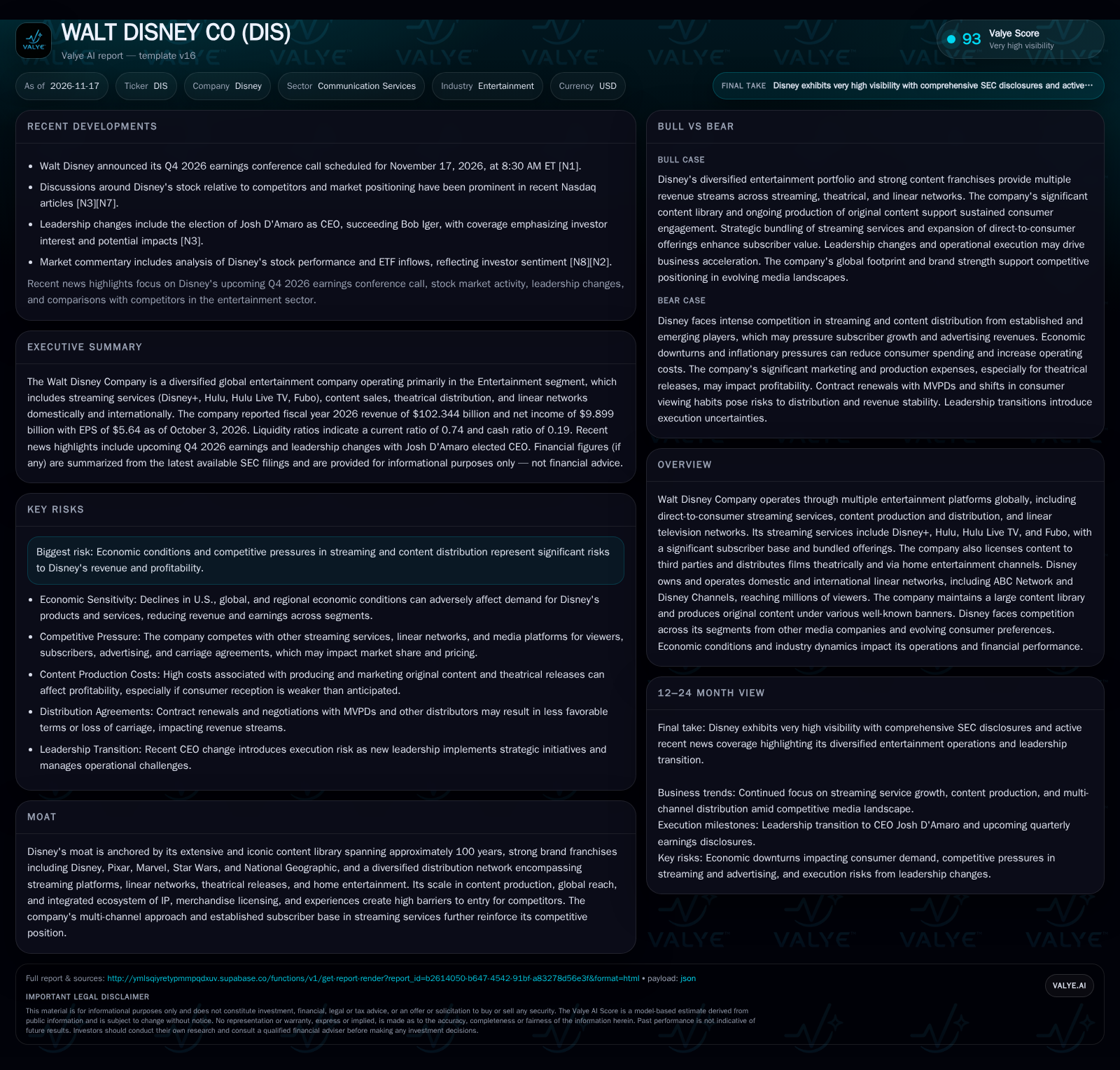
Disney reported $102.3 billion in revenue and $9.9 billion in net income for fiscal 2026, but faces a liquidity profile with a current ratio of 0.74 and a cash ratio of 0.19. The company’s strategic focus remains on streaming growth and content production amid a CEO transition. Execution risk, high content costs, and competitive intensity in media distribution shape the forward thesis. Disney’s moat, built on IP and global reach, is tested by industry disruption and the need to sustain profitability while scaling newer digital businesses. [S1] [N3]
The Walt Disney Company stands at a pivotal juncture as it transitions leadership to Josh D’Amaro and continues to recalibrate its business model for a digital-first entertainment landscape. While Disney’s fiscal 2026 results reflect formidable scale and brand power, the company faces a complex mix of opportunities and threats: streaming growth remains central but increasingly costly, traditional networks face secular headwinds, and the ability to convert IP into sustainable profit is under stress. Navigating these dynamics will test the resilience of Disney’s moat and the agility of its new management team.
Financial and Strategic Moves That Are Reshaping Disney’s Outlook
Disney reported fiscal 2026 revenue of $102.344 billion and net income of $9.899 billion, with basic EPS of $5.64 and diluted EPS of $5.63 as of October 3, 2026. The company reported cash and liquidity metrics for the period; these figures do not by themselves establish operating runway, investment capacity, financial flexibility, or financing capacity. [S1]
The recent election of Josh D’Amaro as CEO marks a pivotal leadership transition, raising questions about continuity versus change in strategic direction, especially as the company’s Q4 2026 earnings call approaches. This transition is being closely watched by investors, who are weighing the implications for operational execution and future capital allocation. [N3]
The Mechanics of Disney’s IP Monetization and Emerging Operational Challenges
Disney’s economics hinge on monetizing its extensive content library and new productions across multiple channels: direct-to-consumer (DTC) streaming (Disney+, Hulu, Hulu Live TV, Fubo), linear networks, theatrical releases, and licensing to third parties. Revenue from streaming is primarily driven by subscription fees and advertising, while linear networks derive income from carriage fees and traditional advertising. Content sales add another layer through licensing and home entertainment distribution. [S1]
While streaming offers global reach and direct customer relationships, it is capital- and content-intensive, with high fixed costs for original production and technology infrastructure. Margins are pressured by ongoing content spending, marketing outlays for theatrical releases, and the need to maintain or grow subscriber bases in the face of churn and competition. Linear networks, historically high-margin, are experiencing secular decline in subscribers and advertising rates, offsetting some digital gains.
Disney’s very low current and cash ratios highlight the importance of cash flow discipline and working capital optimization. The company’s ability to generate operating leverage depends on scaling streaming profitability faster than the decline in legacy businesses and managing content amortization efficiently. If streaming ARPU and retention improve, incremental margins could expand; if not, the economics risk further dilution.
Assessing Disney’s Competitive Edge Through Its IP Portfolio and Global Footprint
Disney’s competitive moat rests on its 100-year content library, iconic franchises (Disney, Pixar, Marvel, Star Wars, National Geographic), and global multi-channel distribution. These assets create high barriers to entry for new competitors and enable Disney to cross-monetize IP through media, merchandise, theme parks, and experiences.
However, the rise of rival streaming platforms, the fragmentation of consumer attention, and digital-native competitors with advanced targeting technologies have eroded the exclusivity of content as a moat. Pricing power is now contested, with bundling and discounting strategies required to sustain subscriber growth. The risk is that as more content becomes commoditized and consumers grow more price-sensitive, the ability to extract premium economics from IP may diminish.
Disney’s global scale and integrated ecosystem still provide unique advantages in cross-promotion and customer lifecycle value, but sustaining these in the face of rapid industry change requires continued innovation in content, distribution, and user experience.
Potential for Streaming Integration and Content Leverage to Enhance Margins
A favorable scenario for Disney would involve successful execution on several fronts: continued subscriber growth and improved ARPU for Disney+ and Hulu, effective bundling with ESPN and third-party DTC services, and stabilization of linear network declines through targeted advertising and selective carriage renegotiations. If new leadership accelerates operational efficiency, rationalizes content spend, and leverages data-driven personalization to reduce churn, streaming margins could inflect higher.
Content monetization could further benefit from new distribution partnerships and increased licensing to third parties, especially as global demand for premium IP remains robust. Realization of synergies across Disney’s ecosystem—merchandise, experiences, and parks—would amplify returns from core franchises.
Confirmation would come from: reported improvement in streaming segment profitability, sequential ARPU growth, lower content amortization as a percentage of revenue, and evidence of stabilized or growing free cash flow. Falsification would be indicated by persistent streaming losses, subscriber stagnation, or margin erosion despite revenue growth.
Balancing Digital Expansion Against Traditional Media Declines
The most plausible near-term path is one of continued streaming expansion offsetting gradual linear network decline, with aggregate revenue growth moderating and profitability pressured by high content and marketing costs. Disney maintains its leadership in family and franchise entertainment, but competition for digital subscribers and advertising dollars keeps pricing and margins under pressure.
Leadership transition brings incremental execution risk, but the strength of Disney’s IP and ability to cross-promote across platforms support ongoing engagement. Incremental improvements in streaming unit economics—if achieved—can stabilize margins, but full-scale margin recovery likely requires either a shakeout among streaming competitors or a step-change in ARPU and retention.
Evidence for this scenario includes stable or slightly growing DTC revenues, continued reduction in linear network reach, and relatively flat operating margins. Signs of deviation would include either an abrupt streaming inflection (positive or negative) or unexpected cost escalation.
Risks from Rising Content Expenses, Subscriber Turnover, and Economic Pressures
A negative outcome would be driven by persistent inflation in content and marketing costs, inability to raise streaming prices or sustain subscriber growth amid intense competition, and further acceleration in the decline of linear networks. If Disney is forced to discount aggressively or invest unsustainably in content to defend market share, margins could deteriorate further.
External shocks—such as a global economic downturn or advertising recession—could further reduce consumer spending on subscriptions and experiences, compounding the challenge. Leadership missteps or strategic drift during the CEO transition could exacerbate execution risk, leading to missed targets or asset impairment.
This scenario would be confirmed by sequential declines in streaming subscribers and ARPU, widening operating losses in DTC, negative free cash flow, and/or write-downs of content investments. Falsification would require evidence of cost discipline, resilient subscriber trends, or successful reallocation of capital to higher-return areas.
Factors Influencing Disney’s Future Performance Trajectory
Streaming subscriber counts and ARPU trends for Disney+, Hulu, and Fubo—especially post-bundle and DTC integration—would help test the thesis.
Segment profitability and margin trajectory for direct-to-consumer businesses, if disclosed, are critical for assessing operating leverage.
Churn rates and retention metrics for streaming platforms would indicate the sustainability of subscriber growth and lifetime value.
Linear network subscriber and advertising revenue trends, particularly for ABC and international channels, will show how legacy businesses are offsetting or compounding digital pressures.
Content amortization and marketing expense as a percentage of revenue, if disclosed, are important to track cost discipline and ROI on content investment.
Updates on leadership strategy and execution milestones from CEO Josh D’Amaro, including capital allocation decisions and operational priorities, could signal directional shifts.
Evidence of new licensing agreements or cross-platform IP monetization would help assess the company’s ability to extract incremental value from its content library.
Disclaimer: This is research-only, informational analysis and not investment advice. It may include AI-generated interpretation and general industry context. Always verify important details using primary sources.

Comments