
ACP Holdings Acquisition Corp.: Merger Execution Risk and Value Creation Potential in the May Mobility Deal
ACP Holdings Acquisition Corp. (ACGC), a SPAC, has entered into a definitive merger agreement with autonomous vehicle startup May Mobility. The outcome now hinges on the completion and terms of this business combination, with material upside if the transaction closes and May Mobility can leverage public capital, but real risks remain around deal execution, market reception, and sector headwinds.
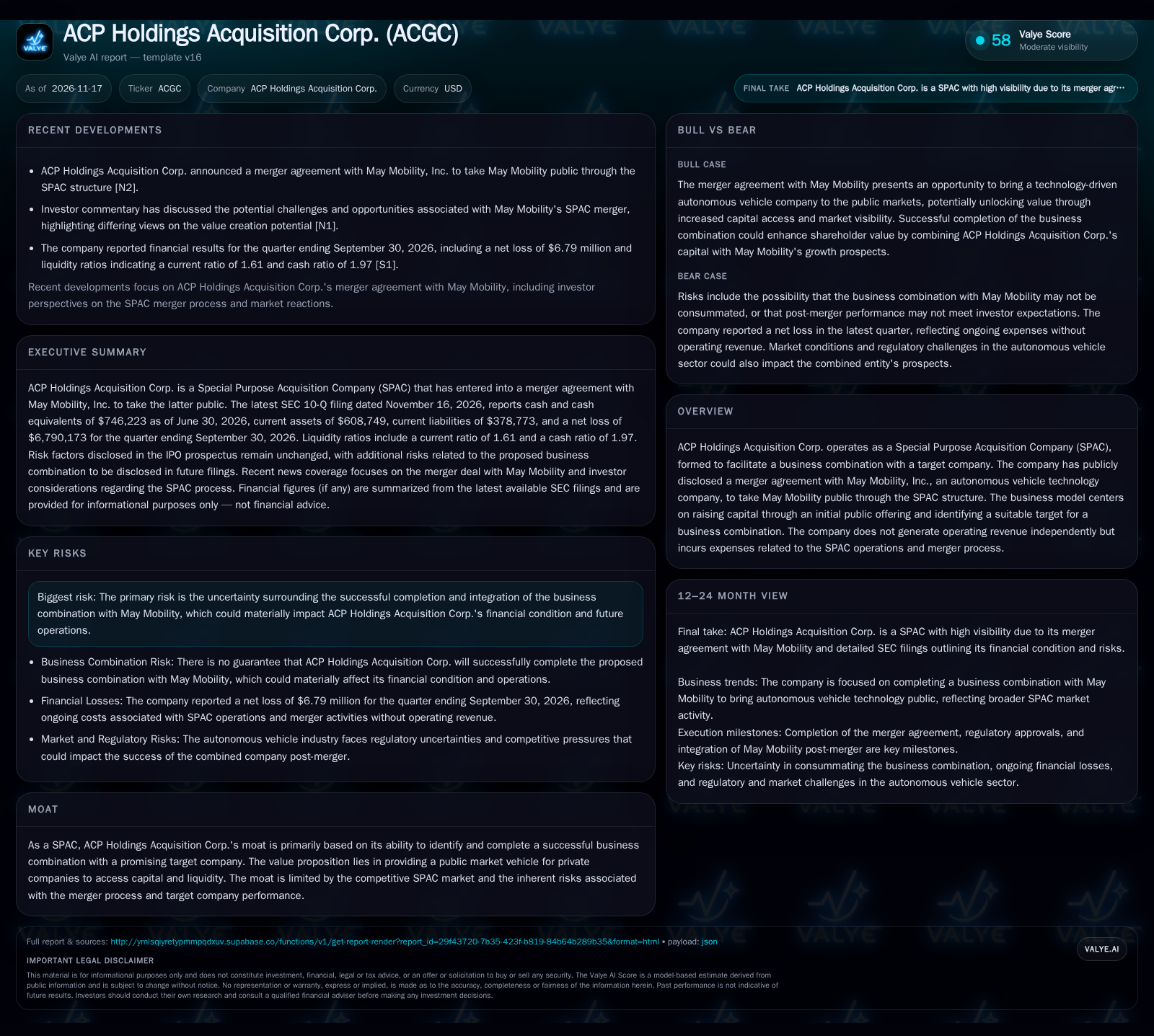
ACP Holdings Acquisition Corp. is a newly formed SPAC with no operating revenue, currently in the process of merging with May Mobility, an autonomous vehicle technology company. The company reported a net loss of $6.79 million for Q3 2026 and reported cash balance. The merger, if completed, could unlock public capital for May Mobility, but the transaction faces execution risk and future performance uncertainty in a sector known for capital intensity and regulatory hurdles. The thesis now hinges entirely on the merger's completion and the combined entity's ability to execute in a competitive, nascent market. [S1]
ACP Holdings Acquisition Corp. (ACGC) exemplifies the high-stakes, binary nature of the SPAC model: it exists solely to identify, acquire, and bring a private company public, and its entire value proposition now rests on its pending merger with May Mobility, an autonomous vehicle technology startup. With no operating revenues and a net loss of $6.79 million for the latest quarter, ACGC’s financial condition reflects the costs and risks inherent in the SPAC process. The proposed business combination, if consummated, would enable May Mobility to access public capital and visibility, potentially accelerating its growth in the capital-intensive autonomous vehicle sector. However, execution risk is high, and the ultimate outcome will be determined by both the ability to close the deal and the combined entity’s post-merger performance in a challenging and fast-evolving market. [S1]
Merger with May Mobility Sets the Stage, but Execution Remains Uncertain
ACP Holdings Acquisition Corp. is a newly formed SPAC that has entered into a definitive merger agreement with May Mobility, an autonomous vehicle technology company. The transaction, announced in September 2026, is scheduled to close by May 2027, subject to shareholder and regulatory approvals. As of September 30, 2026, ACGC reported a net loss of $6.79 million for the quarter, cash and cash equivalents of $746,223, current assets of $608,749, and current liabilities of $378,773, resulting in a current ratio of 1.61. These figures reflect ongoing expenses related to the merger process and typical SPAC operations, with no operating revenue reported. The company’s financial condition and future prospects are now entirely contingent on the successful completion of the May Mobility deal and the subsequent performance of the combined entity. [S1]
SPAC Economics: Cash Burn, Fee Structure, and the Leverage of Public Capital
As a SPAC, ACGC’s economics are fundamentally different from those of operating companies. The business model involves raising capital through an initial public offering, holding those funds in trust, and seeking a business combination within a defined timeframe. Until a merger is consummated, the SPAC generates no operating revenue and incurs costs related to legal, advisory, and administrative expenses—resulting in ongoing net losses, as seen in the latest quarter. SPAC sponsors typically receive a promote (often 20% of post-merger equity) and private placement warrants, aligning their incentives with deal consummation but potentially diluting public shareholders if the merger goes through.
Post-merger, the newly combined entity—here, May Mobility—would gain access to public-market capital, which could be critical in the capital-intensive autonomous vehicle sector. However, the ability to raise additional funds, manage dilution, and control operating leverage will depend on investor appetite and the credibility of May Mobility’s growth prospects. Until the merger closes, ACGC’s economics are entirely a function of its cash burn and the ticking clock on its SPAC lifecycle. [S1]
SPACs Face Crowded Field, but May Mobility’s Prospects Will Define Post-Merger Differentiation
ACP Holdings Acquisition Corp. does not possess a competitive moat in the traditional sense; its value is derived from its ability to identify, negotiate, and close a business combination with a promising target. The SPAC market has become highly competitive, with numerous blank-check companies vying for attractive targets, often leading to compressed timelines and higher valuations. The success of ACGC’s merger with May Mobility—and the combined company’s competitive position—will depend on May Mobility’s technology, partnerships, and ability to scale in the autonomous vehicle sector.
The autonomous vehicle market is characterized by deep-pocketed technology and automotive incumbents, high regulatory barriers, and rapid innovation cycles. For May Mobility to emerge as a differentiated player post-merger, it will need to demonstrate not only technical progress but also commercial traction, regulatory acceptance, and capital discipline. The SPAC’s role in this equation is to provide the initial public market entry point, but long-term differentiation will be determined by May Mobility’s execution and sector positioning.
If the Deal Closes and May Mobility Executes, Public Capital Could Catalyze Growth
A favorable outcome for ACGC shareholders requires the successful completion of the merger and a robust post-merger trajectory for May Mobility. In this scenario, the transaction closes on time, May Mobility leverages the SPAC proceeds and public market access to accelerate R&D, expand partnerships, and gain regulatory approvals. If the company can demonstrate commercial deployments, secure additional funding at attractive terms, and show credible paths to revenue growth, the public listing could drive valuation expansion.
Evidence supporting this upside would include timely deal closure, strong PIPE (private investment in public equity) participation, positive post-merger trading, and early commercial wins or contract announcements by May Mobility. Falsification would occur if the deal terms are revised unfavorably, the merger fails to close, or May Mobility struggles to raise further capital or gain commercial traction post-listing.
Most Likely: Deal Closes, but Sector and Execution Risks Remain Prominent
The most plausible scenario is that the merger with May Mobility proceeds, given the definitive agreement and typical SPAC timelines. However, even after closing, the combined entity will face substantial challenges: autonomous vehicle commercialization remains slow, capital requirements are high, and regulatory hurdles persist. May Mobility may access public capital, but will likely need to raise additional funds, manage dilution, and prove its business model in a market crowded with better-capitalized competitors.
Confirmation of this base scenario would be a completed transaction, initial trading in line with SPAC norms, and incremental progress on May Mobility’s commercial milestones—offset by continued cash burn and reliance on further financing. Falsification would come from material delays, failure to close the deal, or immediate post-merger financial or operational setbacks.
Deal Failure or Weak Post-Merger Performance Could Erase Shareholder Value
In the adverse scenario, the merger with May Mobility is delayed, renegotiated, or terminated, leaving ACGC with limited time and resources to identify an alternative target. Even if the deal closes, May Mobility could underperform due to market, regulatory, or execution risks—resulting in sustained losses, dilution, and weak public market support. The SPAC structure provides no operating business to fall back on, so a failed or disappointing combination would likely lead to sharp value erosion for shareholders.
Signals confirming this scenario would include missed transaction milestones, adverse regulatory developments, lack of PIPE or investor support, or early post-merger financial distress. Falsification would require evidence of a robust, well-supported transaction and tangible commercial wins by May Mobility as a public company.
Milestones and External Factors That Will Determine the ACP Holdings–May Mobility Outcome
Progress toward securing required shareholder and regulatory approvals for the proposed merger.
Filing and public disclosure of the definitive proxy/prospectus, including updated risk factors and deal terms.
PIPE investor participation, deal structure revisions, or changes to the capital raised in conjunction with the transaction.
Timing and certainty of closing the business combination relative to the stated May 2027 target.
Initial public market valuation and trading performance of the combined entity post-merger.
May Mobility’s ability to announce new commercial contracts, partnerships, or pilot deployments post-listing, if disclosed.
Cash burn and capital-raising activity by the combined entity in the first two to four quarters after the merger, if disclosed.
Sector-wide regulatory shifts or competitive developments that could impact the autonomous vehicle commercialization timeline.
Disclaimer: This is research-only, informational analysis and not investment advice. It may include AI-generated interpretation and general industry context. Always verify important details using primary sources.

Comments