
Armlogi Holding Corp.: E-Commerce Logistics Expansion Meets Acute Liquidity and Margin Pressures
Armlogi Holding Corp.
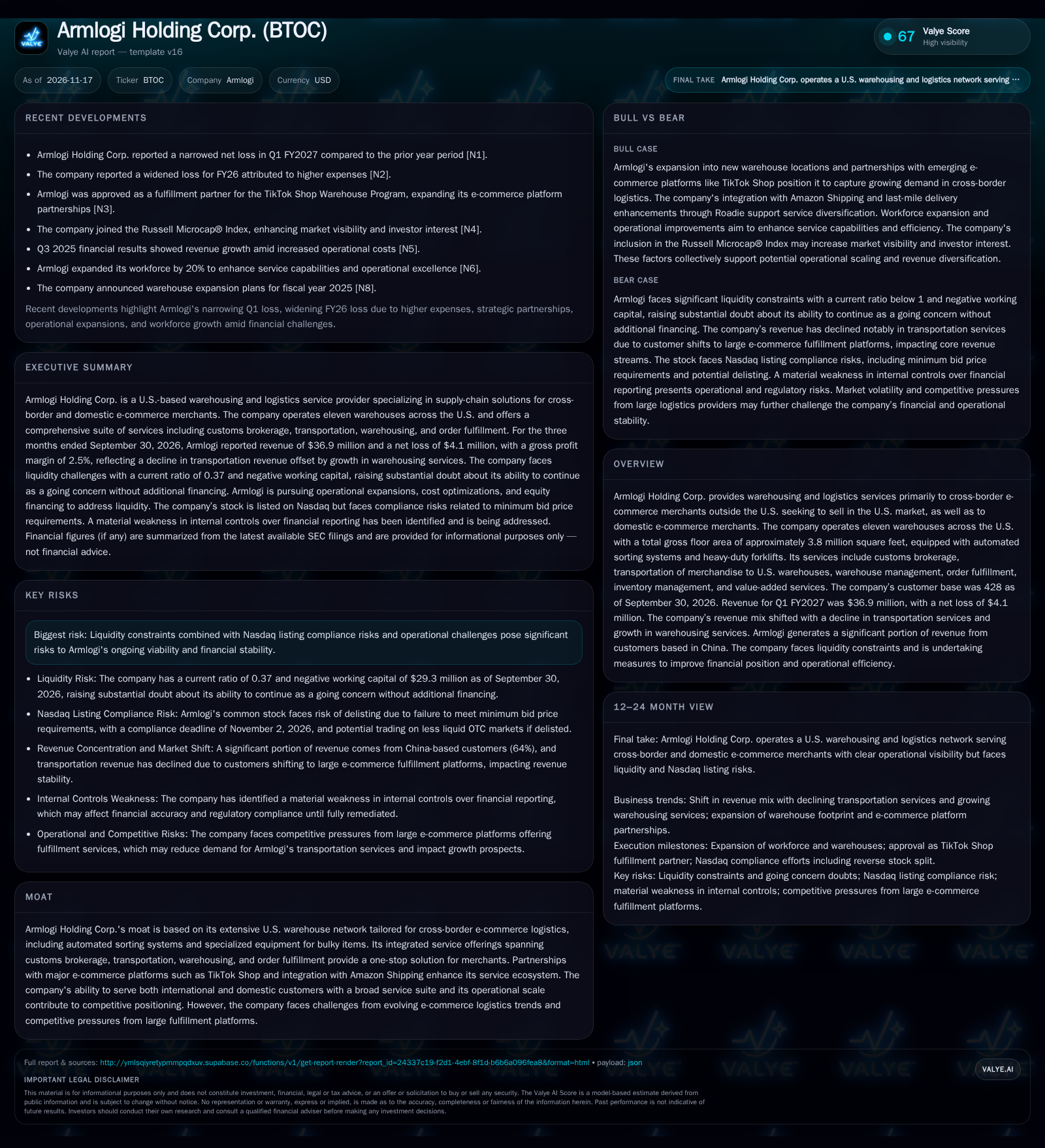
Armlogi Holding Corp. operates an 11-warehouse logistics network serving cross-border e-commerce, with recent revenue mix shifting toward warehousing and away from transportation. While partnerships with major platforms like TikTok Shop expand its reach, the company remains deeply unprofitable, posting a Q1 FY2027 net loss of $4.1M on $36.9M in revenue and a gross margin of just 2.5%. Liquidity is acute, with a current ratio of 0.37 and negative working capital, raising going concern doubts. Strategic execution now hinges on cost discipline, successful capital raises, and the ability to stabilize or grow higher-margin warehousing services.[S2] [N1] [N2] [N3]
Armlogi Holding Corp. stands at a critical juncture: its expanding U.S. warehouse footprint and deepening ties with fast-growing e-commerce platforms like TikTok Shop could position it as a specialized gateway for global merchants targeting U.S. consumers. Yet, this operational promise is shadowed by mounting losses, severe liquidity shortfalls, and a business model under pressure from both rising costs and powerful, integrated logistics giants. Whether Armlogi can convert scale and partnerships into sustainable margins—or will be forced to retrench under financial and competitive strain—will define its trajectory in the coming quarters.
Financial Realities: Margin Compression and Liquidity Peril Define the Moment
Armlogi’s Q1 FY2027 revenue reached $36.9 million, but the company posted a net loss of $4.1 million and a meager gross margin of 2.5%.[S2] [N1] This reflects an ongoing struggle with cost control and pricing power. The liquidity situation is acute: a current ratio of 0.37 and negative working capital of $29.3 million as of September 30, 2026, raise substantial doubt about Armlogi’s ability to continue as a going concern without fresh capital.[S2] Meanwhile, the company’s revenue composition is shifting, with transportation services declining and warehousing services growing—a response to customer migration toward larger e-commerce fulfillment platforms. Approval as a TikTok Shop fulfillment partner and inclusion in the Russell Microcap® Index are recent strategic milestones, but do not directly resolve the underlying financial fragility.[N3] [N4]
How Armlogi’s Model Generates Revenue—and Where the Economics Break Down
Armlogi’s business is built on providing end-to-end logistics services—customs brokerage, transportation to U.S. warehouses, inventory management, and order fulfillment—primarily for cross-border e-commerce merchants. Warehousing is increasingly the primary revenue driver, while transportation services are in decline due to customer shifts toward larger integrated fulfillment offerings.[S2]
Warehousing typically offers higher gross margins than transportation, especially when paired with value-added services like inventory management and order fulfillment. However, Armlogi’s overall gross margin remains extremely thin (2.5%), suggesting that either pricing is highly competitive, operational costs are structurally high, or both. The company’s network of eleven warehouses (totaling 3.8 million square feet) implies significant fixed costs—rent, labor, and automation investments—that create high operating leverage.
Scaling volume through new e-commerce partnerships (e.g., TikTok Shop, Amazon Shipping integration) could yield improved absorption of fixed costs and margin expansion, but only if incremental revenue is priced above marginal cost. Conversely, persistent negative margins and cash burn will require external financing or force retrenchment, especially given the company’s negative working capital and going concern warning.[S2]
Competitive Pressures: Platform Integration, Customer Churn, and the Search for Differentiation
Armlogi’s core advantage lies in its warehouse network and integrated service suite for cross-border e-commerce, but this is eroding as large e-commerce platforms expand their own logistics ecosystems. Customers are increasingly choosing to fulfill through Amazon, Shopify, or other vertically integrated providers, reducing demand for third-party transportation services and intensifying competitive pressure on pricing and service quality.[S2]
The company’s approval as a TikTok Shop fulfillment partner and integration with Amazon Shipping represent efforts to embed within broader e-commerce ecosystems, potentially increasing stickiness and customer reach.[N3] However, these partnerships do not guarantee revenue durability if core customers can easily switch to larger, more efficient providers. Armlogi’s customer concentration—64% of revenue from China-based merchants—adds exposure to geopolitical and trade volatility, as well as to the risk of platform strategy shifts.
In this context, differentiation may come from specialized handling (bulky items, customs expertise), responsiveness to smaller merchants, or value-added services not easily replicated by logistics giants. However, absent clear evidence of pricing power or durable switching costs, competitive positioning remains tenuous.
What Would It Take for Scale and Partnerships to Drive a Turnaround?
The bull case hinges on Armlogi leveraging its warehouse network and e-commerce platform partnerships (notably TikTok Shop and Amazon Shipping) to attract a high volume of cross-border and domestic e-commerce merchants, thereby improving warehouse utilization and operational efficiency.[N3] If the company can shift its revenue mix further toward higher-margin warehousing services, add value-added offerings, and achieve cost discipline, operating leverage could convert incremental revenue into margin expansion.
Confirmation of this scenario would require: sustained sequential growth in warehousing and value-added service revenue; improvement in gross margin above the current 2.5% level; evidence of positive net cash flow from operations; and successful execution of new equity or debt financing to shore up liquidity. Additional platform partnerships or customer wins would further support the case.
Falsification would be indicated by continued margin compression, further losses despite revenue growth, or inability to secure new capital—especially if customer churn or pricing pressure accelerates.
Survival Mode: Stabilization Through Cost Control and Selective Growth
The most plausible near-term path is one of operational triage: Armlogi seeks to stabilize its cash burn by prioritizing warehousing and value-added service growth, while aggressively managing costs and preserving liquidity. The company may pursue incremental expansion of partnerships (e.g., TikTok Shop fulfillment) and selective warehouse investments, but will need to defer or scale back more ambitious growth without substantial new financing.
Confirmation would come from sequential improvement in gross margin and operating loss, successful execution of cost reduction initiatives, and evidence of new capital raised (equity or debt) to address negative working capital. A narrowing of net losses, even if not yet profitable, would signal progress.
Falsification would manifest as continued or accelerating net losses, failure to raise capital, and/or loss of key customers or platform partnerships. Persistent Nasdaq non-compliance or material control weaknesses could further destabilize operations.
Liquidity Exhaustion and Competitive Squeeze Could Force Retrenchment or Restructuring
If Armlogi cannot reverse its cash burn or secure new financing, the company faces a real risk of operational retrenchment, asset sales, or restructuring to avoid insolvency. Acute competitive pressure from large, integrated fulfillment providers may further erode pricing and customer retention, limiting the company’s ability to grow its higher-margin warehousing business.
Confirmation of this scenario would come from missed payroll or vendor payments, warehouse closures or asset sales, bankruptcy warnings, or material customer losses. Delisting from Nasdaq and migration to OTC trading would likely exacerbate capital-raising challenges.
Even if some operations persist, the business could shrink to a subscale core or enter a distressed M&A process. Persistent material weakness in internal controls could also trigger regulatory or contractual fallout, compounding financial distress.
Milestones That Will Reveal Whether Armlogi Can Escape the Margin Squeeze
Sustained sequential gross margin improvement above 2.5%, signaling better pricing or cost control, would indicate progress toward sustainable economics.
Growth in warehousing and value-added service revenue, if disclosed, would support the shift toward higher-margin business lines.
Reduction in net cash used by operating activities (if disclosed) would help gauge progress toward cash flow breakeven.
Retention or expansion of major e-commerce platform partnerships (e.g., TikTok Shop, Amazon Shipping integration) will affect customer acquisition and revenue visibility.
Resolution of the material weakness in internal controls over financial reporting is necessary to support capital market confidence.
Restoration of compliance with Nasdaq minimum bid price requirements, or evidence of a successful reverse split or alternative listing strategy, would reduce capital market risk.
Customer concentration trends—specifically, the proportion of revenue from China-based merchants—should be monitored for diversification or heightened geopolitical exposure.
Disclaimer: This is research-only, informational analysis and not investment advice. It may include AI-generated interpretation and general industry context. Always verify important details using primary sources.

Comments