
Xsolla SPAC 1: Blank-Check Structure, Value-Creation Levers, and the Clock on Deal Execution
Xsolla SPAC 1 has reported positive net income and a reported current ratio as of September 2026, but its business model remains undisclosed and its future hinges on executing a successful business combination. The absence of sector or operational detail means any value proposition will depend entirely on the quality, timing, and structure of its eventual deal.
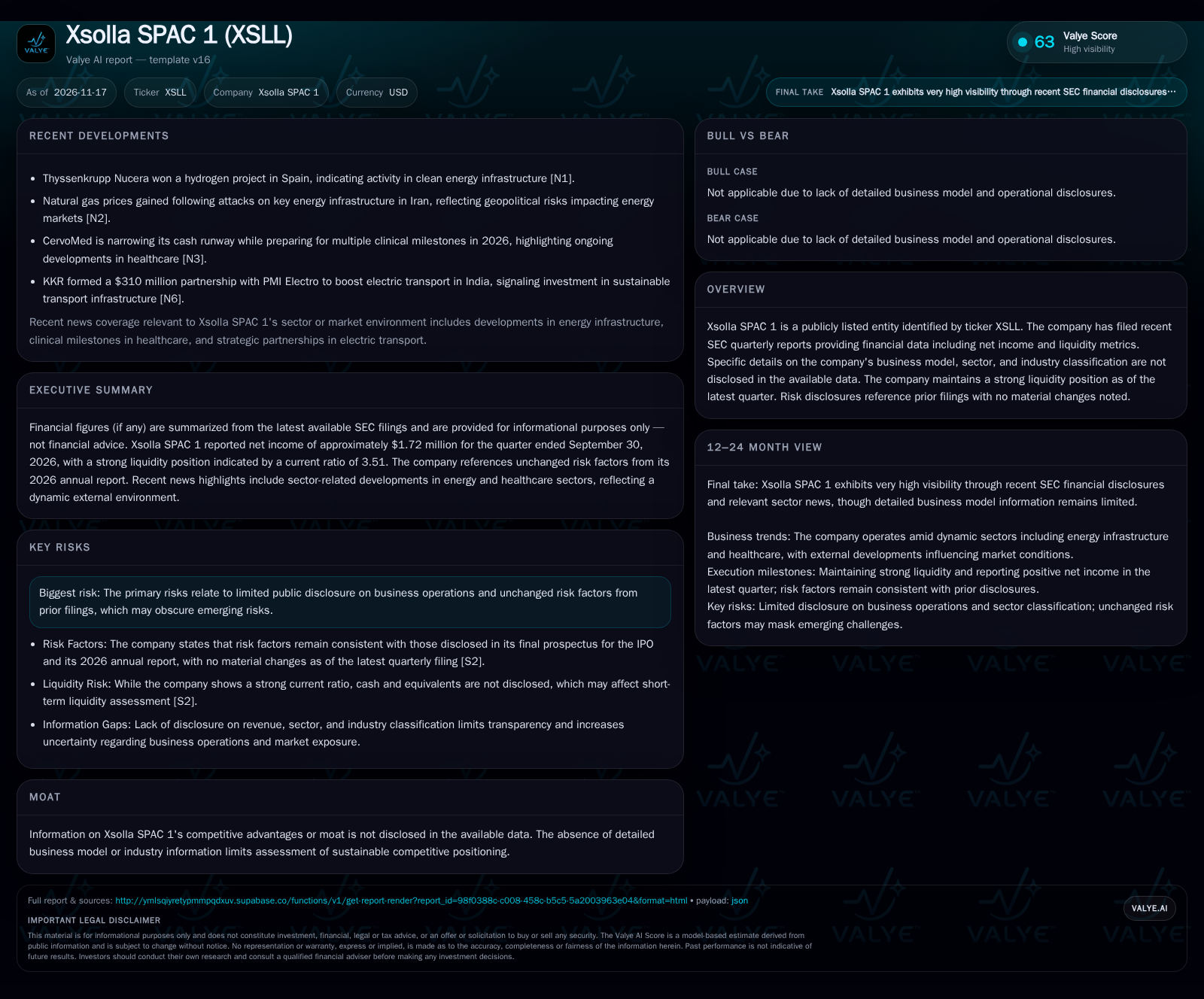
Xsolla SPAC 1 is a blank-check company with $1.72 million in net income and a current ratio of 3.51 as of September 2026 [S2]. Its sole mandate is to identify and merge with a target business within a set timeframe. No operating business or sector focus has been disclosed, so future value depends on deal execution rather than current operations.
Xsolla SPAC 1 sits at the classic SPAC crossroads: it has no current operating business and exists solely as a vehicle to identify and merge with a private company. The clock is ticking—if it cannot close a deal within its allotted window, it must return capital to shareholders. With no target identified or sector focus disclosed, the thesis for Xsolla SPAC 1 will be determined not by present performance, but by its ability to execute a value-creating transaction before its deadline.
Current Financial Position and the Absence of an Operating Business
The company reported cash and liquidity metrics for the period; these figures do not by themselves establish operating runway, investment capacity, financial flexibility, or financing capacity. [S2] However, the company provides no details on revenue streams, cash and equivalents, or sector focus. The company is a blank-check entity, meaning these financials reflect investment income and low operating expenses rather than commercial activity. Risk factors are unchanged from the last annual report, and no business combination target has been announced [S1] [S2]. These facts underscore that Xsolla SPAC 1’s value proposition is not about present operations, but about its ability to complete a successful merger within its mandated timeline.
Given the absence of operating revenues or disclosed business activities, an important analytical focus is the sustainability of the SPAC’s capital base through its trust account. The trust account typically holds investor funds in low-risk, interest-bearing instruments, which generate modest returns that can offset administrative costs.
SPAC Economics: Structure, Incentives, and Potential Value Creation
As a special purpose acquisition company (SPAC), Xsolla SPAC 1 does not generate revenue from operations. Instead, its economic model is built around raising capital from investors, holding it in trust (typically earning interest), and using these funds to acquire or merge with a private company. The SPAC’s sponsors and management typically receive a promote (often 20% of post-combination equity) as compensation, contingent on a successful deal. The economics for public shareholders hinge on three primary levers: the trust account value (minus redemptions), the quality and valuation of the target business, and the dilution from sponsor and PIPE investor terms. Operating leverage is not relevant until a target is acquired, at which point the economics of the combined entity—margins, capital needs, sector dynamics—become central. Until then, capital needs are minimal and fixed costs are low, but the risk of value destruction from an unfavorable or rushed deal is ever-present.
The alignment of incentives between sponsors and public shareholders is a pivotal element in SPAC economics. While sponsors typically receive a fixed equity promote, their returns depend heavily on closing a deal that enhances post-merger equity value above the implicit dilution threshold. This dynamic can create tension between the urgency to complete a transaction and the discipline to maintain valuation standards. Additionally, the presence and terms of PIPE investors can materially influence capital structure and dilution, affecting the net value accretion for existing shareholders. The timing of deal announcements relative to the SPAC’s deadline can also impact negotiation leverage and sponsor incentives, potentially leading to compromises in deal quality or structure.
Crowded SPAC Market and the Challenge of Differentiation
The competitive landscape for SPACs has become increasingly challenging. Hundreds of SPACs are typically searching for targets at any given time, often with overlapping sector preferences and similar capital structures. Without a disclosed sector or management narrative, Xsolla SPAC 1’s ability to attract a high-quality target depends largely on sponsor reputation, deal terms, and speed to execution. The main competitors are other blank-check companies seeking similar targets, as well as traditional IPO routes and direct listings. If Xsolla SPAC 1’s sponsors have deep sector relationships or a compelling value-creation plan, they may be able to differentiate—but absent public disclosure, this remains speculative. The risk is heightened by the sheer volume of SPAC capital chasing a limited pool of attractive targets, which can inflate valuations and erode post-merger returns.
In a saturated SPAC market, differentiation extends beyond sector focus to encompass deal execution capabilities and sponsor reputation. Sponsors with established networks and operational expertise may secure proprietary deal flow or negotiate favorable terms that are inaccessible to less connected SPACs. Moreover, the ability to structure innovative deal terms—such as earnouts, warrants, or contingent value rights—can mitigate valuation risk and align post-merger incentives. Conversely, SPACs lacking clear differentiation may face protracted deal timelines or resort to suboptimal targets, increasing the risk of shareholder redemptions and value dilution. The interplay between market sentiment toward SPACs broadly and investor appetite for specific sectors also shapes competitive dynamics.
A High-Quality Target and Shareholder Alignment Could Unlock Substantial Value
The most favorable scenario for Xsolla SPAC 1 is that it sources and announces a merger with an attractive, fast-growing private company at a reasonable valuation, with limited shareholder redemptions and strong post-merger performance. Evidence supporting this would include the announcement of a well-regarded target in a growth sector (such as technology, healthcare, or energy infrastructure), transparent deal terms with minimal dilution, and clear communication from management on strategy and integration. Early signals could be above-market PIPE commitments or positive investor reaction at deal announcement. Falsifying this scenario would be a lack of deal progress, a target with questionable fundamentals, or high redemption rates that drain trust account value.
Deal Execution under Pressure: Typical Outcomes for Late-Stage SPACs
The most plausible outcome for Xsolla SPAC 1, absent further disclosure, is a race against the clock to secure a business combination before its deadline. Many late-stage SPACs either strike deals with second-tier targets or seek multiple extensions, sometimes resulting in significant redemptions that reduce available capital. Confirmation of this scenario would be a deal announcement close to the deadline, with mixed investor reception and moderate-to-high redemptions. Alternatively, the SPAC could fail to close a deal and proceed to liquidation, returning funds to public shareholders (minus permitted dissolution expenses). Evidence against this scenario would be a high-quality, early-stage deal with strong shareholder support and capital retention.
Deal Failure, High Redemptions, or Value-Destroying Merger
The principal risk is that Xsolla SPAC 1 either fails to identify a viable target and is forced to liquidate, or consummates a merger with a business of poor quality, excessive valuation, or operational risk. In the event of liquidation, public shareholders would receive the trust account value per share, but sponsors and PIPE investors could lose their investment. If a deal is struck but faces high redemptions, the post-merger company may be undercapitalized and struggle to execute its strategy. The worst-case outcome is a value-destructive merger followed by poor trading performance, litigation, or delisting. Signs of this scenario include repeated deadline extensions, vague or defensive management communication, or a last-minute deal with limited disclosure.
Milestones That Will Determine Whether Xsolla SPAC 1 Creates or Returns Value
Announcement of a definitive agreement for a business combination, including sector, target fundamentals, and valuation if disclosed.
Level of shareholder redemptions at the time of deal vote—a high redemption rate typically signals limited confidence and reduces deal proceeds.
PIPE (private investment in public equity) participation and terms, if disclosed, as a gauge of external investor confidence and post-merger capitalization.
Any extensions to the original business combination deadline, which could indicate difficulty in sourcing or closing a deal.
Quality and credibility of disclosed target management and strategy, which would help test the thesis of value creation.
Post-announcement investor reaction and trading volume, as an early signal of market perception regarding the deal.
Updates to risk disclosures or material changes in financial reporting that could indicate shifting risks or emerging issues.
If disclosed, details on sponsor capital at risk, alignment mechanisms, and any changes in the structure of the promote or incentive pool.
Disclaimer: This is research-only, informational analysis and not investment advice. It may include AI-generated interpretation and general industry context. Always verify important details using primary sources.

Comments