
BHAV Acquisition Corp: SPAC Structure, Dilution Dynamics, and the Nemi Physical AI Transaction
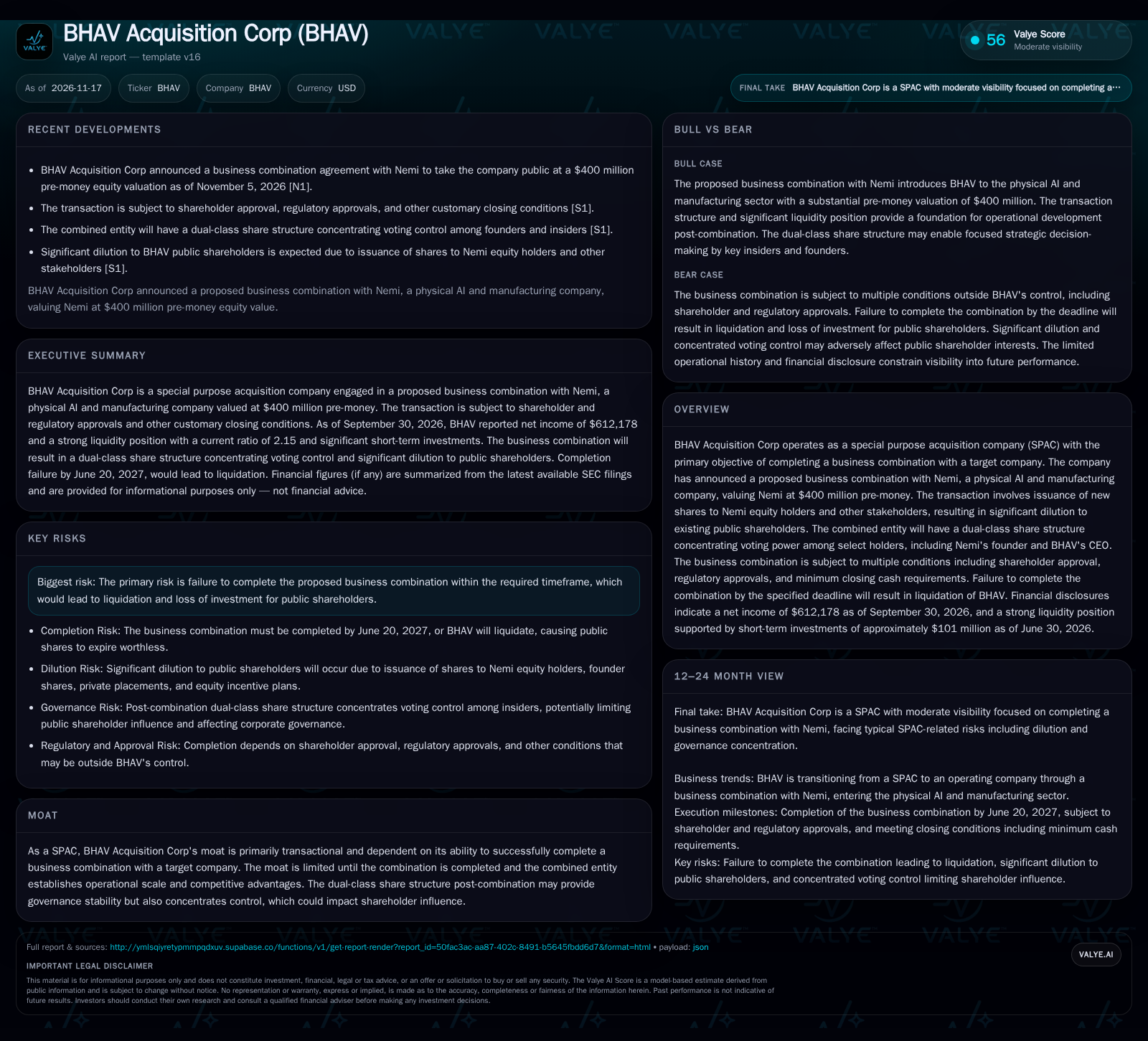
BHAV Acquisition Corp is set to merge with Nemi in a $400 million pre-money deal, but public shareholders face significant dilution and concentrated governance. The transaction’s outcome will define whether BHAV pivots from blank-check status to a stake in the emerging physical AI and manufacturing sector—or simply liquidates.
BHAV Acquisition Corp’s proposed business combination with Nemi, a physical AI and manufacturing firm, is valued at $400 million pre-money and would introduce the company to a high-growth sector. However, the deal brings substantial dilution for public shareholders, a dual-class structure concentrating control, and a hard deadline for completion. Success hinges on approvals, post-close execution, and the ability to translate liquidity into operational value.
BHAV Acquisition Corp’s proposed merger with Nemi, a physical AI and manufacturing company, represents a classic SPAC inflection point: the chance to pivot from a cash shell to an operating entity in a potentially high-growth sector, or to dissolve if the deal fails. The transaction’s $400 million pre-money valuation, dual-class governance structure, and significant dilution for public shareholders foreground the unique risks and rewards of SPAC investing. With a hard deadline to close by June 2027, the fate of BHAV—and its investors—depends on execution, approvals, and the ability to transform financial resources into sustainable business momentum.
Deal Structure, Timeline, and Shareholder Impact: The Facts Defining BHAV’s Next Chapter
BHAV Acquisition Corp has announced a proposed business combination with Nemi, a company in the physical AI and manufacturing arena, assigning Nemi a $400 million pre-money equity value as of November 5, 2026. The deal is structured to issue new shares to Nemi’s equity holders and other stakeholders, resulting in significant dilution to existing BHAV public shareholders. Post-transaction, a dual-class share structure will concentrate voting control among Nemi’s founder and BHAV’s CEO. The transaction is contingent on shareholder and regulatory approvals, with a minimum closing cash condition of $30 million. If the deal is not completed by June 20, 2027, BHAV will be required to liquidate and redeem public shares. Operationally, as of September 30, 2026, BHAV reported net income of $612,178 and current assets of $639,231, with short-term investments of approximately $101 million as of June 30, 2026. [S1] [N1] [N2]
The timing of the transaction introduces additional complexity, as the hard deadline compresses the window for securing necessary approvals and completing integration planning. This constraint may influence negotiation dynamics with stakeholders and could pressure management to prioritize speed over thorough due diligence or strategic alignment. Furthermore, the requirement to maintain a minimum cash balance post-closing underscores the importance of liquidity management, especially given the capital-intensive nature of physical AI and manufacturing sectors. Public shareholders must weigh the risk that the transaction’s financial and operational assumptions hold true within this limited timeframe, as failure to meet these conditions triggers liquidation, effectively capping upside potential.
From Cash Shell to Operating Entity: Economics of the Proposed Combination
As a SPAC, BHAV currently generates no recurring operating income and functions as a cash shell with the sole aim of completing a business combination. The business model pivots entirely once the Nemi deal closes: at that point, the economics hinge on Nemi’s physical AI and manufacturing operations. While specifics on Nemi’s revenue streams, margins, or cost structure are not disclosed, the typical economics for physical AI and advanced manufacturing companies involve a mix of hardware sales, integration/services, and potentially software or AI-driven recurring revenue. Fixed costs in such sectors can be significant due to R&D, manufacturing facilities, and technical staff, but gross margins may be enhanced if proprietary technology or automation drives differentiation.
For SPAC investors, the key economic levers are: (1) the value of the combined entity relative to the dilution imposed by new share issuance; (2) the ability of the post-combination company to deploy cash efficiently; and (3) the translation of pre-transaction liquidity (notably the $101 million in short-term investments) into growth or cash flow. The dual-class structure means public shareholders will have limited influence over post-merger capital allocation, which could affect the realization of synergies or operational efficiencies.
The economics of the combined entity will also depend heavily on the scalability of Nemi’s manufacturing processes and the degree to which physical AI solutions can be standardized or customized. If the business model leans towards bespoke manufacturing, margins may be constrained by higher variable costs and longer sales cycles, whereas standardized products could enable economies of scale and recurring revenue streams. The company reported cash and liquidity metrics for the period; these figures do not by themselves establish operating runway, investment capacity, financial flexibility, or financing capacity. Given the dual-class governance structure, the alignment of incentives between controlling insiders and public shareholders will be a key factor in capital efficiency and operational discipline.
Strategic Positioning and Post-Combination Governance: Opportunities and Trade-Offs
The potential combination positions BHAV (via Nemi) within the rapidly evolving physical AI and manufacturing sector—a field characterized by high barriers to entry, rapid innovation cycles, and increasing competition from established automation, robotics, and industrial technology players. The dual-class share structure, while offering governance stability and potentially enabling long-term strategic bets, also entrenches insider control and could discourage some institutional investors post-merger.
Competitive advantage for the combined company would likely depend on Nemi’s proprietary technology, integration capabilities, and ability to scale manufacturing efficiently. However, the absence of detailed disclosure on Nemi’s customer base, commercial traction, or technology differentiation means that the competitive moat is, at this stage, speculative. The ability to attract and retain talent, establish commercial partnerships, and adapt to evolving industry standards will be critical for sustainable positioning.
The dual-class structure's influence on governance may have nuanced effects on strategic agility. While concentrated control can facilitate decisive actions and long-term investments without short-term market pressures, it also raises concerns about accountability and minority shareholder protections. In a sector marked by rapid technological evolution, the ability to pivot or adjust strategy swiftly is paramount. If governance concentration leads to insular decision-making or resistance to external input, the combined company may struggle to adapt to competitive threats or technological shifts. Conversely, if the controlling parties leverage their expertise and networks effectively, this could translate into sustained innovation and competitive differentiation over time.
If Execution Aligns: How the Nemi Transaction Could Create Shareholder Value
If Nemi can demonstrate rapid revenue growth, margin expansion, and successful deployment of proprietary AI-driven manufacturing solutions, the market could reward the combined entity with a premium multiple—potentially offsetting initial dilution for public shareholders. The dual-class structure, if used judiciously, could enable bold, long-horizon investments that entrenched governance sometimes facilitates.
Confirmation of this scenario would require evidence of strong post-close operating results, announcements of major customer wins or contracts, and disclosure of sustainable gross margins. Additional positive signals would include retention of key technical talent, successful integration of SPAC resources, and clear communication of strategic milestones.
Most Likely Outcome: Incremental Progress, Execution Risk, and Shareholder Dilution
Public shareholders experience substantial dilution and limited governance influence due to the dual-class structure. The company invests in product development and commercialization, but revenue growth and margin expansion are gradual and subject to execution risk.
Confirmation would come from timely deal closure, initial filings disclosing detailed pro forma financials, and moderate operational progress in the first few quarters post-close. Falsification would be indicated by delays in closing, failure to meet minimum cash conditions, or lack of operational traction from Nemi’s business lines.
When Approval or Execution Falters: Liquidation or Value Erosion
The principal risk is that the business combination fails to secure shareholder or regulatory approval, or that closing conditions (such as the minimum $30 million cash requirement) are not met. In this case, BHAV would liquidate, returning trust proceeds to public shareholders—often at or near the original SPAC IPO price, but with no participation in potential upside. Alternatively, if the deal closes but Nemi underperforms, the combination could result in value destruction for public shareholders, exacerbated by dilution and limited governance rights.
Falsification of the downside scenario would involve the successful closing of the deal with robust post-close operating performance. Confirmation would be found in missed deadlines, failed votes, regulatory hurdles, or early signs of operating underperformance and cash burn post-merger.
Milestones and Disclosures That Will Shape BHAV’s Post-Deal Trajectory
Progress on shareholder and regulatory approvals for the Nemi business combination; any delays or setbacks would materially affect deal certainty.
Disclosure of pro forma financials for the combined entity, including Nemi’s revenue, margin profile, and growth rates—if disclosed.
Clarity on the final ownership and dilution structure post-close, including the impact of founder shares, private placements, and any additional financing rounds.
Evidence of initial customer traction, signed contracts, or commercial partnerships in the physical AI and manufacturing segment.
Retention and incentives for key technical and operational personnel from both BHAV and Nemi.
Updates on regulatory classification as a 'controlled company' and any implications for corporate governance or shareholder rights.
A useful metric would be post-close cash burn and runway, especially if initial operating losses are expected during scaling.
Disclaimer: This is research-only, informational analysis and not investment advice. It may include AI-generated interpretation and general industry context. Always verify important details using primary sources.

Comments