
Southern Cross Acquisition I Corp.: SPAC Structure, Financial Position, and the Clock on Business Combination Execution
Southern Cross Acquisition I Corp. is a newly public SPAC facing the typical race against time to identify and close a business combination, as reflected by its recent IPO, lack of operating revenue, and going-concern uncertainty. Its financial disclosures highlight both the transient nature of SPAC resources and the criticality of deploying capital before the mandated liquidation deadline.
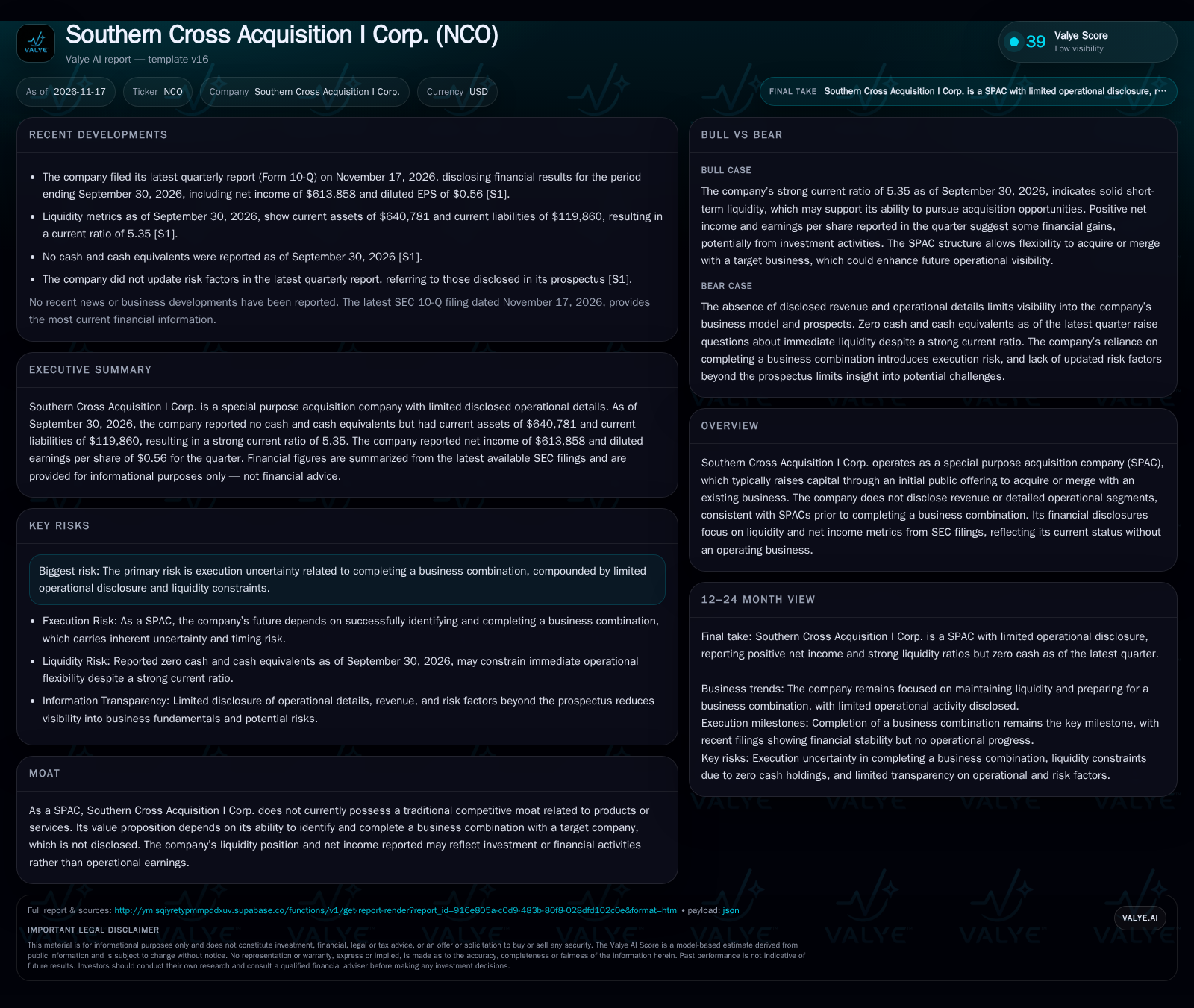
Southern Cross Acquisition I Corp. (NCO) is a blank-check company that completed its IPO in July 2026, raising gross proceeds of $115 million. As of September 30, 2026, it reported no cash and cash equivalents, current assets of $640,781, and current liabilities of $119,860. The company has not identified a merger target and faces a July 2027 deadline to complete a business combination or return funds to shareholders. Its reported net income reflects SPAC accounting and not operating results. Execution risk and capital deployment remain the central variables.
Southern Cross Acquisition I Corp. stands at an early and critical juncture in its SPAC lifecycle. The next several quarters will test management’s ability to deploy capital, negotiate a deal, and create value within a narrowing window.
IPO Proceeds, Liquidity Status, and the Race to Find a Target
Southern Cross Acquisition I Corp. completed its IPO on July 22, 2026, raising $115 million in gross proceeds through the sale of 11,500,000 units at $10.00 per unit. Each unit comprised one ordinary share, one right (convertible into a quarter share upon business combination), and one warrant. As of September 30, 2026, the company reported current assets of $640,781 against current liabilities of $119,860, with a current ratio of 5.35. However, it reported zero cash and cash equivalents, and management disclosed substantial doubt regarding its ability to continue as a going concern absent a successful business combination within the 12-month window post-IPO (ending July 22, 2027) [S1]. No target business has been identified, and there have been no substantive discussions with acquisition prospects to date [S1].
SPAC Economics: How Value Is Created or Lost Before a Merger
Southern Cross Acquisition I Corp., like all SPACs, generates no operating revenue prior to a business combination. Its only material inflows are IPO proceeds—most of which are typically held in a trust account—and any interest income earned on those funds. The reported net income for the quarter ($613,858) and diluted EPS ($0.56) likely reflect interest income or mark-to-market adjustments on trust assets, not business operations [S1]. Until a merger is closed, ongoing expenses are primarily legal, regulatory, and diligence costs, funded by a small pool of working capital outside the trust account.
The capital structure is designed to minimize pre-merger risk for investors: funds are held in trust and can be redeemed if no deal is completed. However, the sponsor bears the cost of unsuccessful SPAC formation and faces dilution if the merger is not value-accretive. Operating leverage is absent prior to a deal, and the critical variable is the quality and speed of target identification. Should a merger be consummated, the economics shift rapidly—SPACs often pay a premium for targets, and the merged entity must quickly justify its valuation through revenue growth and synergies.
SPAC Competition: The Challenge of Differentiation in a Crowded Field
Southern Cross Acquisition I Corp. is one of many blank-check companies competing for a finite pool of viable acquisition targets. The SPAC market has grown increasingly crowded, with sponsors ranging from private equity firms to industry specialists. The primary competitive factors are sponsor reputation, speed of execution, ability to raise PIPE (private investment in public equity) financing or secure anchor investors, and the attractiveness of deal terms to potential targets.
Without an identified target or disclosed sector focus, Southern Cross must differentiate itself primarily through sponsor networks and the ability to close a deal efficiently. However, the lack of a sector tilt may broaden its search universe but also dilutes its pitch to founders seeking domain expertise. Competing SPACs may already have advanced discussions or exclusive letters of intent with high-quality targets, raising the risk that Southern Cross will face either less attractive targets or be forced to pay a higher premium to win a deal.
Value Creation if a High-Quality Business Combination Is Secured
The most favorable outcome for Southern Cross Acquisition I Corp. is the identification and successful merger with a high-growth, scalable business that can thrive as a public company. In this scenario, the trust account funds are deployed into a target with strong fundamentals, and the sponsor’s due diligence and negotiation create a combination that offers public investors exposure to a differentiated growth story. The merged entity benefits from public currency, enhanced access to capital, and a credible path to operational profitability.
Evidence that would confirm this scenario includes the announcement of a definitive agreement with a private company in an attractive sector (e.g., technology, healthcare, or sustainability), the securing of additional PIPE financing at or above trust value, and positive market reception upon deal announcement. Early indications of strong target management retention, clear integration plans, and visibility into future revenue growth would further support the upside thesis.
Most Likely Trajectory: Deal Uncertainty and the Timeline Squeeze
The most plausible path for Southern Cross Acquisition I Corp. is a protracted search for a suitable merger target, with deal negotiations potentially extending close to the mid-2027 deadline. The SPAC may announce a letter of intent or enter into a definitive agreement, but there is a material risk that the target will be a smaller or less differentiated business, reflecting the competitive and time-constrained nature of the current SPAC market.
Confirmation of this trajectory would include incremental disclosures of target sector focus, engagement of financial advisors, or non-binding LOIs. Conversely, continued silence or delays in announcing a target would suggest growing execution risk and increase the probability of forced liquidation. Market reaction to any announced deal—especially redemption rates and PIPE participation—would provide a real-time test of sponsor credibility and target quality.
What If No Deal Emerges? Liquidation and Sponsor Write-Offs
If Southern Cross Acquisition I Corp. fails to identify and close a business combination by July 22, 2027, it will be required to liquidate and redeem public shares, returning the trust account funds (less expenses) to investors. In this scenario, public shareholders are generally protected, but the sponsor’s investment in founder shares and at-risk capital is forfeited. The company may also face reputational damage, and the opportunity cost of time and resources spent pursuing unsuccessful targets is realized.
Evidence confirming this downside would be the absence of meaningful deal progress by the first half of 2027, lack of PIPE or deal-related financing announcements, and SEC filings indicating preparations for dissolution. High redemption rates even if a deal is announced, or failure to meet minimum cash conditions, would also point to a failed SPAC outcome.
Milestones and Metrics That Will Define Southern Cross’s Outcome
Any disclosure of a letter of intent (LOI) or definitive agreement with an acquisition target would significantly alter the investment case.
Details on the sector focus, size, and financial profile of any prospective target, if disclosed, would clarify the scope for value creation.
Announcements of PIPE financing or anchor investor participation would indicate market confidence in the proposed merger.
Quarterly updates on remaining time to deadline, trust account balances, and any extension votes would help gauge execution risk.
Redemption rates at the time of deal announcement or completion, if disclosed, would signal public shareholder support or skepticism.
Changes in sponsor structure, additional capital injections, or working capital loans would provide clues to ongoing sponsor commitment.
SEC filings or press releases regarding the extension of the combination period or preparations for liquidation would indicate increased downside risk.
Disclaimer: This is research-only, informational analysis and not investment advice. It may include AI-generated interpretation and general industry context. Always verify important details using primary sources.

Comments