
ESG Inc.: Mushroom Product Specialist Confronts Liquidity Strain and Strategic Uncertainty
ESG Inc. operates across mushroom product segments with international subsidiaries but now contends with a working capital deficit, significant net losses, and a flagged going concern risk. Its ability to reshape its cost structure, access external funding, or pivot its commercial model will likely determine whether it can sustain operations or must restructure.
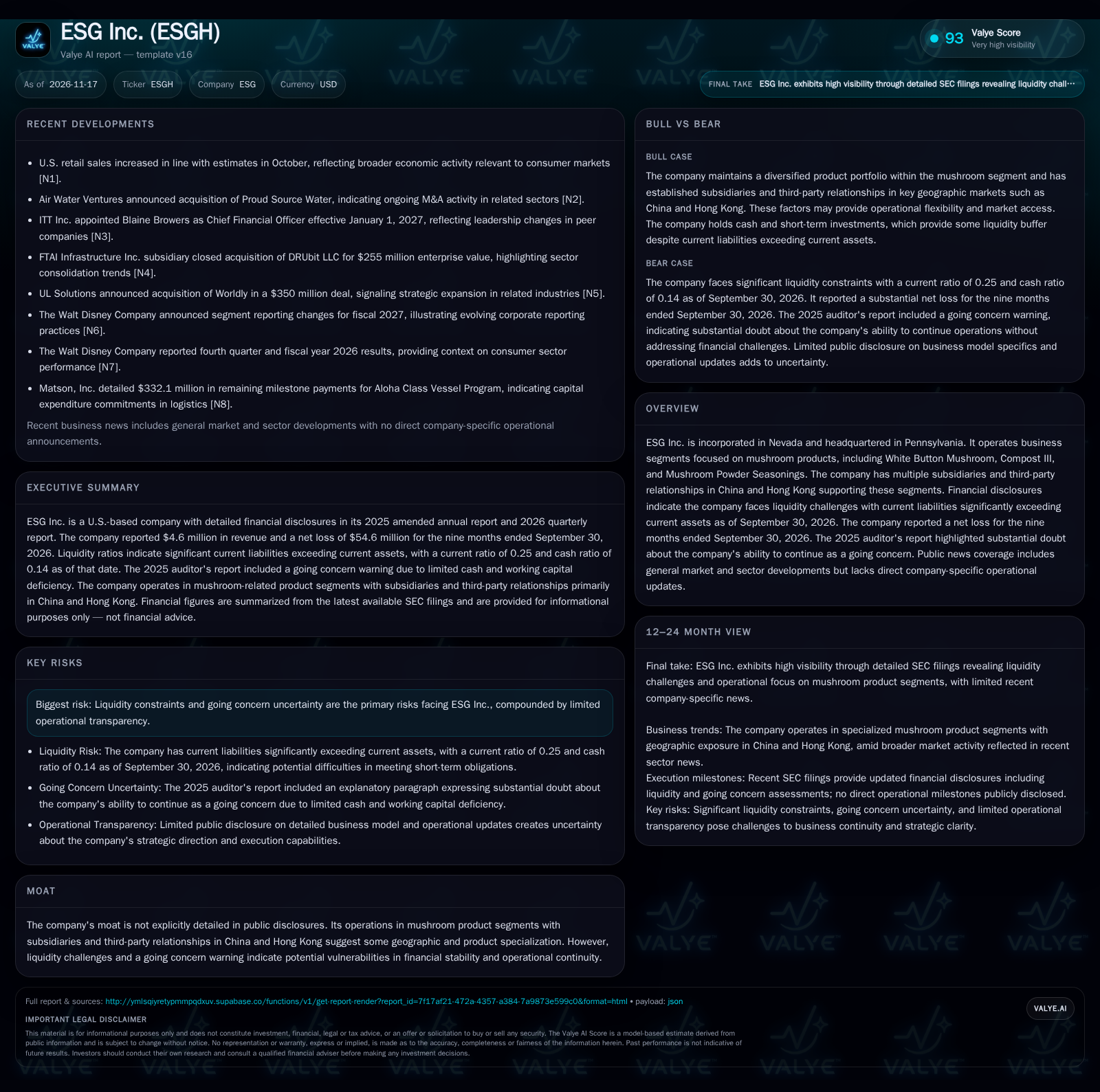
ESG Inc. reported $4.6 million in revenue and a $54.6 million net loss for the first nine months of 2026, with current liabilities far exceeding current assets and a going concern warning from auditors. The company's future hinges on resolving acute liquidity issues and clarifying its business execution in mushroom product markets spanning the U.S., China, and Hong Kong. Without new funding or a material shift in operations, ongoing viability remains in doubt. [S1] [S2]
ESG Inc. is a U.S.-based mushroom product company with operations in China and Hong Kong, but its latest filings reveal a business under acute financial stress. As of late 2026, current liabilities dwarf current assets, the company is running substantial net losses, and auditors have raised doubts about its ability to continue as a going concern. While the company maintains international relationships and a diversified mushroom portfolio, its liquidity crunch and lack of recent operational disclosures create deep uncertainty over its future direction and survival prospects. [S1] [S2]
Liquidity Challenges and Going Concern Risks Shape ESG Inc.'s Current Outlook
ESG Inc. reported $4.6 million in revenue alongside a net loss of $54.6 million for the nine months ending September 30, 2026. As of that date, the company held current assets of $145.6 million against current liabilities of $574.3 million, resulting in a current ratio of just 0.25 and a cash ratio of 0.14. This pronounced working capital deficit has triggered an auditor's going concern warning in the 2025 report, citing limited cash and doubts about the company’s ability to meet short-term obligations. Despite maintaining $42.978 million in cash at year-end 2025, this reserve has proven insufficient to stabilize operations amid ongoing losses and mounting liabilities. These financial realities now overshadow the company's operational footprint in mushroom products and its international subsidiary network. [S1] [S2]
Analyzing Mushroom Product Economics: Scale, Margins, and Cash Flow Pressures
ESG Inc.'s business spans segments such as White Button Mushroom, Compost III, and Mushroom Powder Seasonings. In principle, mushroom cultivation and processing can offer moderate gross margins when operations achieve adequate scale and cost control, particularly through vertical integration or proprietary product development. However, the company’s current economics are heavily negative: a net loss more than ten times revenue for the first nine months of 2026 indicates either grossly insufficient scale, structurally high costs, or both. Fixed costs in agriculture (land, facilities, labor) and in food processing (equipment, compliance, logistics) typically require high capacity utilization to break even. International subsidiaries and third-party arrangements could, in theory, help optimize sourcing or market access, but they might also add overhead and complexity without guaranteed margin benefits. The acute liquidity shortfall and negative operating leverage suggest that ESG Inc. has not yet established a sustainable economic model or achieved the scale needed to cover its fixed costs.
A critical factor influencing ESG Inc.'s economic viability is its ability to manage the supply chain and production cycle inherent to mushroom cultivation, which typically involves time-sensitive biological processes and inventory perishability. If the company faces inefficiencies or delays in any stage—from substrate preparation to harvesting and processing—these can exacerbate cash flow pressures by increasing holding costs or causing product spoilage. Additionally, fluctuations in raw material costs or labor availability, particularly across international operations, may introduce volatility that challenges fixed-cost absorption and margin stability. Understanding how ESG Inc. navigates these operational complexities would help clarify whether its losses stem from transient scale-up issues or deeper structural inefficiencies.
ESG Inc.'s Position Within the Global Mushroom Value Chain and Its Competitive Landscape
The mushroom products market is characterized by commodity-like bulk fresh mushrooms, value-added processed goods, and specialty ingredients. Entry barriers are moderate: large competitors can leverage scale, while niche producers may survive on differentiated products or local distribution. ESG Inc. operates with subsidiaries and relationships in China and Hong Kong, potentially tapping both low-cost production and access to Asian markets. However, without evidence of proprietary strains, exclusive supply contracts, or unique processing know-how, the company may struggle to differentiate itself against both multinational agribusinesses and regional producers. Moreover, liquidity distress can erode bargaining power with suppliers and customers, undermining any operational advantage. In the absence of recent operational disclosures or evidence of brand or technology moat, ESG Inc.'s competitive position appears vulnerable—especially if larger, better-funded peers can absorb cost shocks or undercut prices.
The competitive dynamics in ESG Inc.'s markets also depend on regulatory environments and consumer trends, which can vary significantly between the U.S., China, and Hong Kong. For instance, food safety standards, import-export restrictions, and certification requirements may influence cost structures and market access. If ESG Inc. can leverage compliance expertise or certifications as barriers to entry, it might carve out defensible niches despite financial strain. Conversely, failure to meet evolving regulatory demands could increase operational risks and costs. Moreover, shifting consumer preferences towards organic, sustainable, or functional mushroom products could offer differentiation opportunities if the company aligns its product development accordingly. Without clear evidence of strategic positioning along these dimensions, competitive vulnerability remains elevated.
Survival Strategies: Restructuring Efforts and Strategic Partnerships Under Consideration
A favorable outcome for ESG Inc. would require decisive restructuring—either via external funding, cost rationalization, or a strategic transaction. If the company can secure bridge financing or a capital infusion, it could stabilize its liquidity and buy time to right-size its cost base. Strategic partnerships, particularly with established food companies or agribusinesses in China or the U.S., might also unlock supply chain synergies or access to new distribution channels. Confirmation would come from announcements of new funding, asset sales, cost-cutting initiatives, or joint ventures that materially improve liquidity or gross margins. A reversal of auditor going concern warnings and narrowing of net losses in future filings would further validate a turnaround. However, this scenario depends on the company’s ability to credibly present a plan to investors or partners despite its current financial distress.
For example, collaborations with entities possessing established distribution networks or advanced processing capabilities may reduce capital expenditures and accelerate market penetration. Additionally, joint ventures might facilitate risk sharing and provide access to specialized expertise in agronomy, quality control, or regulatory affairs. However, the success of such partnerships depends on ESG Inc.'s ability to negotiate terms that preserve sufficient control and value capture. If partnerships are structured primarily as outsourcing arrangements without long-term strategic alignment, they may offer limited relief and could dilute the company's core competencies or brand identity.
Projected Operational Challenges: Continued Losses Without External Support
The most plausible near-term trajectory is that ESG Inc. continues to operate under severe liquidity strain, with ongoing net losses and limited ability to meet obligations. Unless management can rapidly reduce costs or monetize assets, working capital constraints may force delays in supplier payments, curtailment of production, or asset sales at distressed prices. Confirmation would come from continued negative operating cash flow, persistent going concern warnings, and a lack of new funding announcements. If the company is unable to clarify its business model or demonstrate improved execution, it risks further erosion of stakeholder confidence and potential insolvency proceedings. This base case is reinforced by the absence of recent operational updates or visible progress on restructuring as of the latest filings.
Potential Downside Outcomes Including Insolvency and Operational Disruptions
In the adverse scenario, ESG Inc. is unable to secure new funding or restructure its obligations, leading to insolvency or forced liquidation. Working capital deficits could trigger defaults on supplier or payroll commitments, resulting in loss of key personnel, regulatory intervention, or asset seizures. International subsidiaries and third-party relationships could be disrupted by inability to honor contracts or maintain compliance. Evidence of this scenario would include legal filings for bankruptcy protection, announcements of business cessation, or abrupt resignations of management and directors. The lack of operational transparency and acute liquidity constraints make this scenario increasingly plausible if no corrective actions are taken in the short term.
Factors Influencing ESG Inc.'s Future Trajectory and Potential Turning Points
Announcements of new debt or equity financing, or evidence of bridge loans that materially improve liquidity.
Disclosure of restructuring initiatives—such as headcount reductions, facility closures, or divestitures of non-core assets.
Changes in auditor opinion, specifically the removal or persistence of the going concern warning in future filings.
Trends in net loss and operating cash flow—narrowing losses or positive cash flow would suggest improving economics.
Updates on major customer wins, long-term supply contracts, or strategic partnerships that could enhance revenue visibility.
If disclosed, segment-level gross margins and capacity utilization rates, to assess whether any business line is approaching break-even scale.
News of regulatory actions, legal proceedings, or asset seizures related to nonpayment or insolvency.
Changes in the composition or governance of the board and executive team, signaling a shift in strategy or control.
Disclaimer: This is research-only, informational analysis and not investment advice. It may include AI-generated interpretation and general industry context. Always verify important details using primary sources.

Comments