
Bayview Acquisition Corp: SPAC Viability Hinges on Oabay Merger Execution and Liquidity Recovery After Nasdaq Delisting
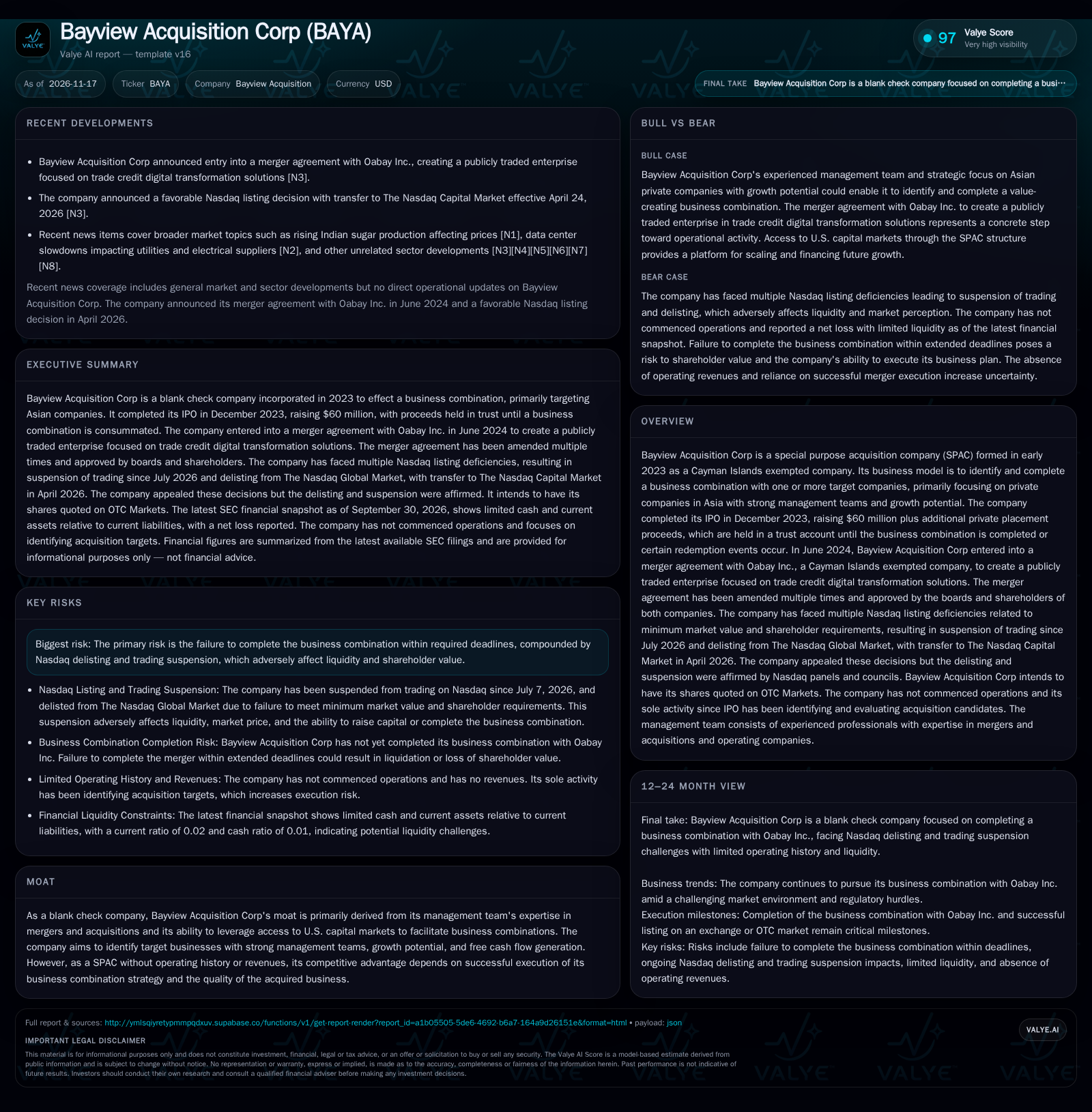
Bayview Acquisition Corp faces a defining crossroads: with its Nasdaq delisting now affirmed and trading suspended, its future pivots on completing the Oabay Inc. merger and establishing operational credibility in the trade credit digital transformation sector.
The company has yet to generate revenue, and its ability to deliver shareholder value depends on executing a credible business combination and overcoming the reputational and capital-raising challenges of operating off-exchange. [S2]
Bayview Acquisition Corp embodies the high-stakes nature of the SPAC model at a moment of acute vulnerability. The outcome of its business combination will determine whether Bayview can pivot from a capital-raising vehicle in search of a business to a sustainable enterprise in trade credit digital transformation—or whether it will be forced to liquidate, leaving little for public shareholders. The SPAC’s journey from IPO optimism to regulatory setback offers a revealing lens on the risks and rewards of blank-check companies operating in a tightening capital and regulatory environment. [S2]
Nasdaq Delisting, Liquidity Crisis, and the Oabay Merger: The Present Reality
Bayview Acquisition Corp’s defining near-term facts are stark: as of September 30, 2026, it reported $38,342 in cash and equivalents against $5,122,987 in current liabilities, producing a current ratio of just 0.02 and a cash ratio of 0.01. The company recorded a net loss of $132,925 for the period. [S2] Trading in Bayview’s securities has been suspended since July 2026, and the Nasdaq delisting was affirmed despite appeals. The company now plans for its shares and rights to be quoted on OTC Markets. [S2] Meanwhile, its only operational step since IPO has been the pursuit of a merger, culminating in a repeatedly amended agreement with Oabay Inc. to form a public enterprise focused on trade credit digital transformation. [S2] These developments create a binary outlook: the company must complete the Oabay merger and pivot to operations or risk liquidation in a context of sharply diminished liquidity and investor confidence.
SPAC Economics: Capital Structure, Redemption Dynamics, and Post-Merger Uncertainty
Bayview’s business model to date is typical of SPACs: raise capital via IPO, hold proceeds in trust, and pursue a business combination. Until a merger closes, no operating revenues are generated, and cash outside the trust is minimal—often insufficient to cover extended overhead or deal costs. [S2] The economics for shareholders hinge on the ability to close a value-creating deal before redemptions and expenses erode the capital base.
SPACs face acute funding pressure as deadlines approach, especially when regulatory setbacks (such as delisting) threaten to accelerate redemptions or reduce post-merger investor interest. Once delisted, Bayview’s ability to attract institutional capital or deliver liquidity for existing holders is sharply curtailed. The move to OTC Markets typically means thinner trading, wider spreads, and less analyst coverage, raising the bar for the merged entity’s operational credibility.
If the Oabay merger closes, the new entity’s economic prospects would depend on its ability to generate revenue in the trade credit digital transformation sector—a space that, while growing, is competitive and demands significant upfront investment in technology, customer acquisition, and compliance. The post-merger capital structure could be under severe strain if redemptions are high or if PIPE (private investment in public equity) financing is unavailable or dilutive. The absence of free cash flow at the SPAC level and the risk of negative working capital post-merger amplify the importance of a seamless operational ramp-up.
Market Perception, Listing Status, and the Search for a Defensible Post-Merger Niche
At present, Bayview’s competitive position is defined less by its own operations and more by its ability to serve as a capital conduit for Oabay Inc. The delisting and move to OTC Markets undermine the typical SPAC advantage of U.S. exchange visibility and liquidity, making it harder to attract high-quality acquisition targets or command premium valuations.
In the trade credit digital transformation sector, success typically relies on proprietary technology, integration with financial institutions, and the ability to win trust from traditionally conservative B2B customers. Established fintechs, regional banks, and specialist SaaS vendors already compete for market share in Asia and globally, and a newly public entity with limited operational history faces a steep credibility gap.
Bayview’s management team brings relevant M&A and operating experience, which could help in structuring the transaction and guiding the post-merger entity. However, the loss of Nasdaq status means the new company will need to work harder to build trust with both customers and capital providers, particularly if early results are uneven.
If the Oabay Merger Delivers Operational Traction and Restores Investor Confidence
The best-case scenario for Bayview is a swift, successful closing of the Oabay merger, with the combined entity launching a credible, differentiated platform in trade credit digital transformation. If Oabay demonstrates early customer wins, rapid revenue growth, and operational discipline, this could attract renewed investor interest—even on the OTC Markets—and potentially set the stage for relisting on a major exchange if listing standards are met.
A favorable outcome would be confirmed by public disclosure of meaningful contracts, positive cash flow within the first year post-merger, and evidence that the merged entity can secure non-dilutive growth capital or strategic partnerships. Conversely, failure to meet these milestones, continued cash burn, or high redemption rates would undermine the bull case.
Transitioning to OTC: A Survival Story Dependent on Operational Execution
The most plausible near-term outcome is that Bayview completes the Oabay transaction and begins trading on the OTC Markets, but faces sustained challenges in attracting liquidity and investor attention. The merged entity may struggle to scale quickly due to limited cash, a smaller-than-expected float after redemptions, and reputational headwinds from its delisting history.
Operational progress—such as modest customer adoption or pilot deployments—may be achieved, but funding constraints could limit the pace of innovation and marketing. Confirmation of this scenario would be visible in incremental revenue disclosures, low trading volumes, and ongoing working capital tightness. A falsification would be a secondary capital raise at attractive terms or a rapid return to exchange listing.
Merger Collapse or Persistent Illiquidity Triggers Liquidation Risk
The adverse scenario is that the Oabay merger fails to close—due to regulatory, shareholder, or financial hurdles—or that the combined entity cannot achieve operational viability. In this case, Bayview may be forced to liquidate, returning remaining trust assets to shareholders, which could be minimal after redemptions and expenses.
Alternatively, if the merger closes but the new company is unable to generate revenue, raise additional capital, or stem cash burn, it could face insolvency or be forced into a distressed sale. Confirmation of this path would be a termination of the merger agreement, lack of OTC trading, or a public announcement of liquidation proceedings.
Milestones That Will Determine Whether Bayview’s SPAC Strategy Succeeds or Fails
Completion of the Oabay Inc. merger and the public disclosure of the final transaction structure.
Redemption rates at the time of merger closing—high redemptions would shrink the capital base and undermine post-merger flexibility.
Initial revenue, customer, and contract disclosures from the combined entity—if disclosed, these would evidence operational traction.
Cash flow and working capital trends in the first two quarters post-merger—would help test the sustainability of operations.
Ability to obtain non-dilutive growth capital or PIPE financing at reasonable terms.
Resumption of trading liquidity and volume on the OTC Markets, and any progress toward relisting on a major exchange.
Management turnover or loss of key personnel, which could indicate internal instability.
Disclaimer: This is research-only, informational analysis and not investment advice. It may include AI-generated interpretation and general industry context. Always verify important details using primary sources.

Comments