
JENA ACQUISITION Corp II: SPAC Execution Window Tightens Amid NYSE Compliance Uncertainty
With its business combination deadline approaching and NYSE listing at risk due to a thin shareholder base, JENA ACQUISITION Corp II faces a narrowing opportunity to leverage its experienced management and trust capital to secure a value-creating deal.
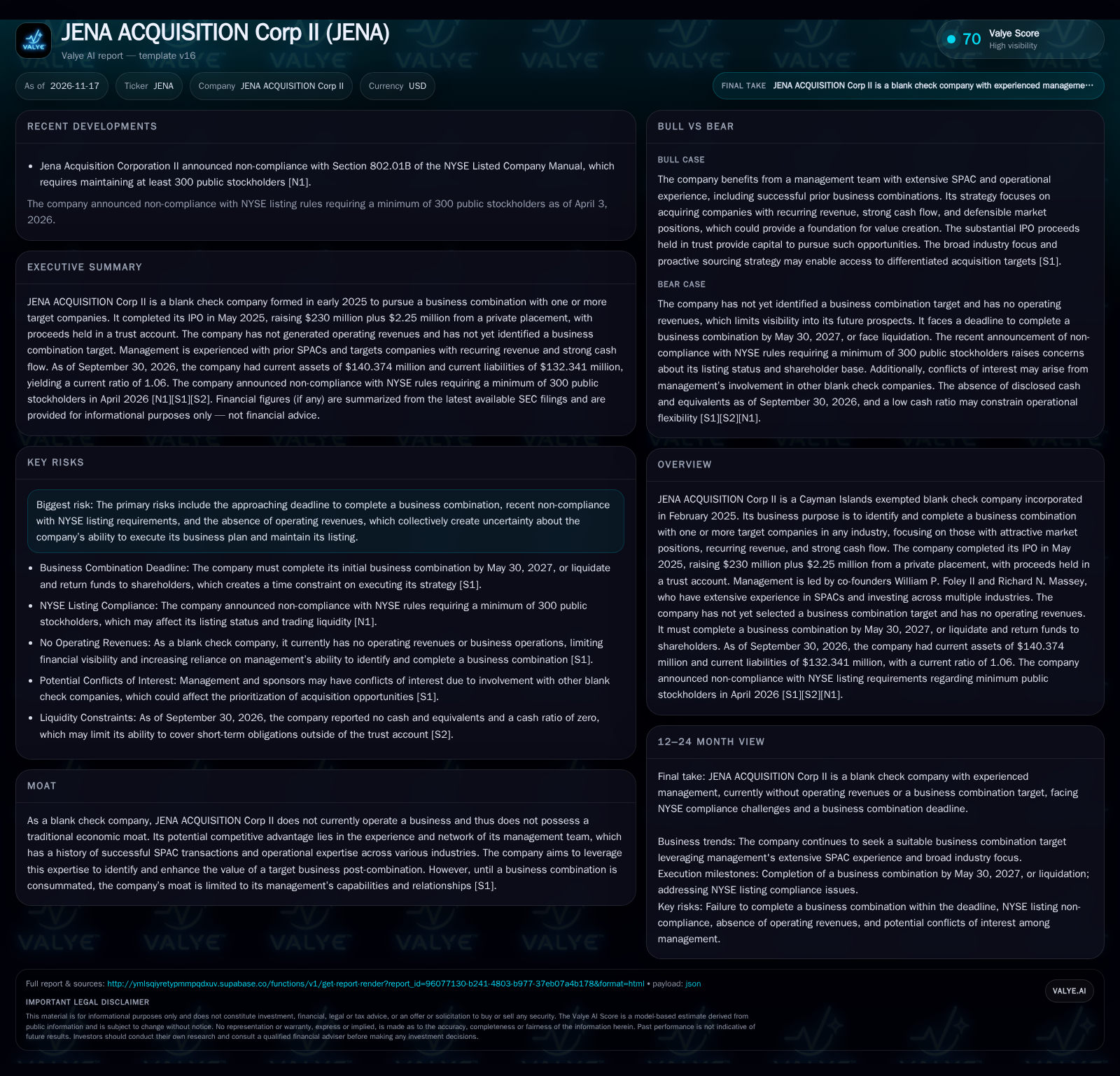
JENA ACQUISITION Corp II must complete a business combination by May 2027 or liquidate, but faces NYSE listing non-compliance due to insufficient public shareholders. [S1] [S2] [N1]
JENA ACQUISITION Corp II stands at a critical juncture typical of late-stage SPACs: flush with uncommitted capital but facing both a hard deadline for a deal and mounting structural pressure from exchange compliance issues. Despite a high-profile team with a record of completed SPAC transactions, the absence of a merger target and a recent NYSE non-compliance notice underscore the narrowing margin for successful execution. The company’s ability to convert trust capital and management expertise into a durable business combination will determine not just investor returns, but the SPAC’s continued existence as a public entity.
Deadline Pressure, Listing Risk, and No Target: The Present State of JENA ACQUISITION Corp II
JENA ACQUISITION Corp II, incorporated in February 2025, has not yet identified a target for its business combination, despite having completed its $230 million IPO and raising an additional $2.25 million from a private placement. The proceeds remain held in trust, as is standard for SPACs at this stage. However, as of September 30, 2026, the company reports current assets of $140.374 million against current liabilities of $132.341 million, resulting in a slim current ratio of 1.06 and a cash ratio of zero—indicating that any operational liquidity outside the trust is extremely limited. Most urgently, the company received an NYSE non-compliance notice in April 2026 for failing to maintain at least 300 public stockholders, raising the prospect of delisting. The SPAC faces a hard deadline: it must consummate a qualifying transaction by May 30, 2027, or liquidate and return remaining trust funds to shareholders. [S1] [S2] [N1]
SPAC Mechanics: Trust Capital, Fee Structures, and the Economics of a Blank Check
JENA ACQUISITION Corp II’s economics are defined by the SPAC structure: capital raised in trust is earmarked for a business combination, with sponsor compensation—typically through founder shares and warrants—tied to successful deal completion. No operating revenue is generated pre-merger, and the only short-term income is from interest on trust assets, if any. The company’s current asset/liability structure suggests that most resources remain sequestered in the trust, unavailable for general operations except for allowable working capital withdrawals. The economics for public shareholders depend on the quality and value of the eventual target, as well as the terms of the merger—particularly the enterprise value, dilution from sponsor incentives, and the ability to retain or attract new capital post-combination. If a deal is not completed, the SPAC liquidates, and investors receive pro rata trust proceeds minus limited expenses, often resulting in minimal to no return above the IPO price.
From a cost perspective, sponsor advances, legal, and due diligence fees can erode the net trust value over time, especially as the deadline approaches and negotiation leverage may shift to targets. The absence of disclosed cash and equivalents (zero cash ratio) implies that any ongoing expenses must be tightly managed or funded by sponsors, as working capital outside the trust is scarce. The economics of the eventual business combination will dictate whether the SPAC structure creates value or merely returns capital to investors.
SPAC Competition: Sponsor Track Record Versus a Crowded Field and Diminishing Targets
JENA’s principal competitive lever is its management pedigree: William P. Foley II and Richard N. Massey bring a record of completed SPACs and operational turnarounds across sectors such as fintech, insurance, and business services. In theory, this experience and network could yield proprietary deal flow or improve post-merger execution. However, the current SPAC market is saturated, with many blank check companies chasing a finite pool of attractive targets—especially those with the recurring revenue, cash flow, and defensible positions JENA seeks.
Potential competitors include other late-stage SPACs, private equity funds, and strategics, all of whom may offer more certainty or better terms to targets. Recent years have also seen increased regulatory scrutiny of SPAC structures and target disclosures, raising the bar for execution. The company’s NYSE non-compliance and thin public float may further erode its appeal to potential targets, who may prefer a SPAC with stable listing and a broader base of public shareholders. If JENA cannot differentiate itself through speed, sponsor capital, or transaction creativity, it risks being outbid or overlooked by desirable targets.
How a Swift, High-Quality Deal Could Unlock Value
The most favorable outcome for JENA would be the rapid identification and successful merger with a private company that fits its stated criteria—recurring revenue, existing cash flow, and a defensible market position. If the management team leverages its network to secure an exclusive or proprietary deal, particularly in sectors where their expertise is strong, the merged entity could command a premium and attract institutional capital post-combination. A successful transaction could also resolve NYSE compliance by broadening the shareholder base, restoring trading stability, and potentially re-rating the shares.
Evidence of this scenario would include a definitive agreement with a credible, growth-oriented target well in advance of the May 2027 deadline, clear communication of transaction rationale and synergy, and a successful shareholder vote. Additional confirmation would come from increased public float and improved compliance with NYSE listing requirements. Conversely, delays, leaks of failed negotiations, or the announcement of a low-quality or highly dilutive target would falsify this scenario.
Most Likely Outcome: Protracted Search, Heightened Pressure, and the Risk of Liquidation
The most plausible trajectory is that JENA continues to seek a target under increasing time and market pressure. As the deadline approaches, the company may face a shrinking pool of attractive targets, rising sponsor and legal costs, and persistent NYSE compliance challenges. The risk is that, without a clear path to restoring its shareholder base, the company’s negotiating leverage with potential targets weakens—leading either to a suboptimal deal or, if no transaction is reached, liquidation and return of trust capital to shareholders.
Confirmation of this scenario would be ongoing announcements about target searches or preliminary talks, but no definitive agreement or resolution of listing status. Signs of erosion in trust value, such as increased expense accruals or sponsor advances, would further support this base case. A reversal would require either a credible deal announcement or regulatory relief on the listing front.
Delisting and Liquidation: How Execution Failure Could Destroy Value
The adverse scenario is a failure to identify a credible business combination within the allotted window, coupled with persistent NYSE non-compliance. If the company is delisted due to insufficient public shareholders before a deal is announced, it could lose the ability to attract a quality target entirely, as most merger candidates value public-listing continuity. In this case, the SPAC would proceed to liquidation, returning trust proceeds to shareholders—potentially diminished by ongoing expenses, legal fees, and any penalties associated with delisting or regulatory non-compliance.
Evidence confirming this scenario would be a continued lack of target announcements, no progress on increasing public float, and formal NYSE delisting proceedings. A sudden acceleration of liquidation preparations or sponsor statements about winding up would further corroborate the downside trajectory. Any sign of regulatory relief, or a last-minute merger with a viable target, would challenge this negative outlook.
Milestones and Metrics That Will Determine JENA’s SPAC Outcome
Announcement of a definitive business combination agreement, particularly one that addresses both quality of target and public float requirements.
Evidence of restored or improved compliance with NYSE listing standards, specifically the minimum 300 public stockholder threshold.
Disclosure of any material change in trust account value—such as significant withdrawals for permitted expenses or sponsor loans.
Updates on cash and equivalents outside of the trust account, which would clarify short-term liquidity and operational runway.
Communications from management regarding the status and progress of target searches, negotiations, or exclusivity agreements.
Any regulatory or NYSE updates on the company’s listing status, extension requests, or potential for delisting proceedings.
If disclosed, details about potential dilution from sponsor shares, warrants, or PIPE (private investment in public equity) financing structures in connection with a proposed deal.
Shareholder vote outcomes and redemption rates, if and when a business combination is proposed.
Disclaimer: This is research-only, informational analysis and not investment advice. It may include AI-generated interpretation and general industry context. Always verify important details using primary sources.

Comments