
Averin Capital Acquisition Corp.: Information Gaps, Financial Snapshots, and the Limits of SPAC Transparency
Averin Capital Acquisition Corp. offers only a sparse financial snapshot—highlighting a positive net income and a current ratio near 2—but omits revenue, cash, and operational details. This leaves investors navigating a landscape defined more by disclosure gaps than by business fundamentals, underscoring the risks and ambiguities inherent in some SPAC structures.
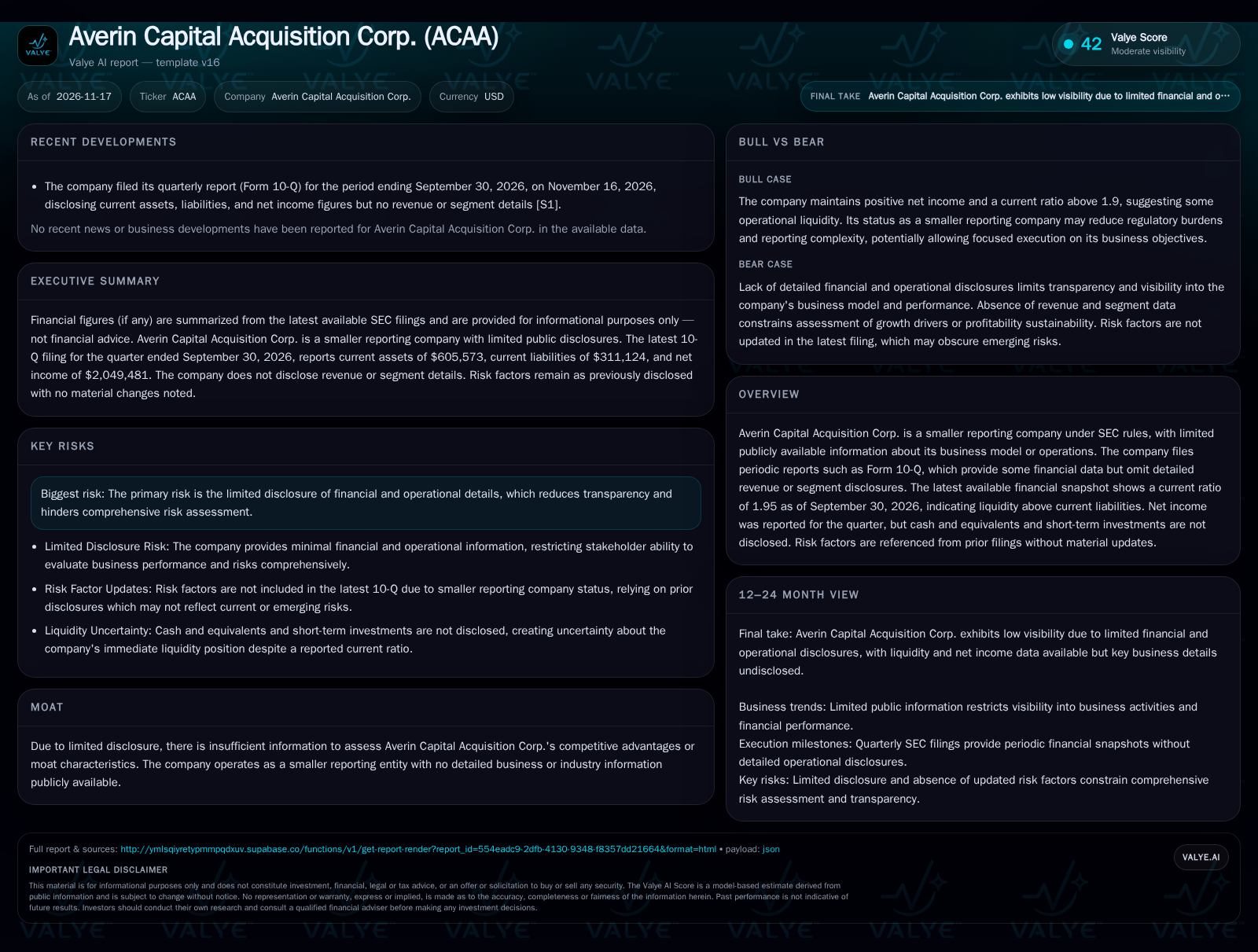
Averin Capital Acquisition Corp. reported net income and a current ratio of 1.95 in its latest 10-Q, but omits revenue, cash, and operational data, providing little insight into its business model, capital structure, or sustainability. This limited disclosure is typical of some SPACs pre-business combination and raises questions about risk transparency and value creation potential. [S1]
Averin Capital Acquisition Corp. sits at a familiar crossroads for smaller reporting companies and SPACs—where regulatory minimums are met, but true business visibility is elusive. The company’s latest 10-Q provides a snapshot of positive net income and a current ratio of 1.95, yet omits any information on revenue, cash, or operational activities. For investors, this raises more questions than answers: What drives the bottom line? How sustainable is the reported profitability? And what, if any, underlying business is being managed? In a market that increasingly prizes transparency and operational clarity, Averin’s sparse filings highlight the analytical challenges and risks associated with investing in disclosure-light entities.
Sparse Financials and Disclosure Gaps Define the Current State
As of September 30, 2026, Averin Capital Acquisition Corp. reported current assets of $605,573 and current liabilities of $311,124, yielding a current ratio of 1.95. The company booked net income of $2,049,481 for the quarter. However, critical details—including revenue, cash and equivalents, and segment information—are not disclosed in the latest 10-Q. Risk factors remain unchanged from earlier filings, with no new or updated disclosures on emerging risks. This bare-bones reporting structure is typical for some SPACs and smaller reporting companies, especially pre-business combination, but it leaves stakeholders with minimal insight into the company’s underlying activities, capital structure, or risk exposures. [S1]
The omission of revenue and cash details complicates traditional financial ratio analysis, such as return on assets or cash conversion cycles, which are critical for evaluating operational efficiency and liquidity sustainability. Without segment disclosures, investors cannot assess geographic or product-line diversification, which typically informs risk assessment and growth potential. The static risk factor disclosures, while providing some baseline understanding, do not capture dynamic market or regulatory shifts that could materially affect the company's prospects. This lack of evolving risk narrative further limits the ability to anticipate or price potential downside scenarios effectively.
How Value Could Be Created (or Destroyed) in a Disclosure-Light Shell
Without revenue or segment disclosures, the mechanics of Averin’s business model are opaque. For SPACs and acquisition shells, typical economics are defined by sponsor capital contributions, trust interest, and expense management—rather than operating revenue. Net income can sometimes result from interest earned on trust assets or accounting entries rather than core operations. The absence of cash and equivalents data further clouds analysis of capital needs and runway.
If Averin were to execute a business combination, future economics would hinge on the acquired target’s revenue mix, gross margins, and operating leverage. Until then, fixed costs are likely dominated by legal, advisory, and administrative expenses, with variable costs minimal. The lack of transparency on actual cash flows or burn rate makes it difficult to estimate how long current resources will last or how sensitive the entity is to delays in deal consummation.
Any future value creation will depend on successfully identifying and merging with a viable operating business, negotiating favorable terms, and managing post-deal integration. The current reporting offers no evidence of progress or imminent transaction.
From a capital structure perspective, the absence of cash and equivalents data restricts the evaluation of the company’s ability to fund ongoing expenses or pursue strategic opportunities without external financing. If the reported net income primarily derives from non-operational sources such as interest income on trust funds, it may not be a reliable indicator of future profitability post-business combination. The cost structure likely remains fixed and administrative in nature, but any variability in these expenses could disproportionately impact net income due to the lack of operational revenue to absorb fluctuations. This makes the entity’s financial sustainability highly sensitive to timing and cost management until a viable operating business is acquired.
SPACs in a Crowded Field: Limited Differentiation, High Uncertainty
Averin Capital Acquisition Corp. operates in a saturated environment of SPACs and blank-check companies, all seeking to identify and merge with promising private businesses. In this context, competition is less about product or market share and more about access to attractive targets, sponsor reputation, and deal execution speed.
Given the absence of disclosed business activities, Averin’s competitive position cannot be evaluated on operational or strategic grounds. If and when a target is announced, sector-specific competitors and market structure will become relevant. For now, the company’s differentiation may hinge on sponsor experience, alignment of incentives, and ability to source proprietary deals—none of which are described in the current filings.
The main counterforces are the abundance of alternative SPACs, tightening regulatory scrutiny, and growing skepticism from both investors and potential targets toward blank-check vehicles with minimal transparency.
In a market crowded with SPACs, the ability to differentiate often depends on sponsor networks and access to proprietary deal flow rather than traditional competitive moats. Without transparency into sponsor credentials or strategic focus areas, it is difficult to assess Averin’s competitive advantages or vulnerabilities. Moreover, the increasing regulatory scrutiny on SPAC disclosures and deal structures could impose additional compliance costs or constraints, potentially affecting the relative attractiveness of the vehicle to targets and investors alike. This evolving regulatory environment adds a layer of uncertainty that compounds the inherent competition for high-quality acquisition opportunities.
A Successful Deal Could Unlock Value—If Execution and Disclosure Improve
The most favorable scenario is one in which Averin identifies a high-quality private business, negotiates a compelling merger, and provides robust post-deal disclosures. This could catalyze a re-rating of the shares based on the fundamentals and growth prospects of the acquired entity.
Evidence that would confirm this scenario includes: a definitive merger agreement with a credible target, detailed investor presentations and pro forma financials, and improved transparency around cash, revenue, and operational plans. A successful de-SPAC transaction—especially in a sector with secular growth tailwinds—could drive both liquidity and valuation.
Conversely, absence of deal progress, continued lack of disclosure, or failure to attract a compelling target would falsify this upside pathway.
Continued Disclosure Minimalism and Prolonged Uncertainty Likely Persist
The most plausible near-term scenario is that Averin continues to provide only the minimum required financial updates—reporting net income or loss, current assets and liabilities, but omitting operational details and business development progress. This pattern is common among SPACs that have yet to announce a business combination.
Confirmation would come from future quarterly filings that maintain this level of disclosure, with no material changes to risk factors or evidence of deal activity. The company may incur ongoing administrative and advisory expenses, with net income subject to fluctuations in trust interest or accounting adjustments rather than operational performance.
This scenario would be falsified if the company meaningfully updates its risk disclosures, provides target or sector information, or announces a business combination.
Deal Failure, Sponsor Fatigue, and Dissolution Risk
On the downside, Averin could fail to secure a business combination within its designated timeframe, triggering a return of capital to public shareholders and a wind-down of the entity. This risk is heightened if market conditions for SPAC deals deteriorate, sponsor incentives wane, or regulatory scrutiny intensifies.
Potential confirming evidence would include: repeated extensions of the SPAC’s deadline, increases in administrative expenses relative to assets, or explicit warnings in future filings about challenges in sourcing a deal.
Dissolution would likely result in limited or no premium to trust value for shareholders, and sponsors could lose their at-risk capital. This scenario becomes more probable if no deal is announced as the expiration date approaches and if the company continues to report only minimal financials without operational progress.
Testing the Averin Thesis: Disclosure, Deal Progress, and Capital Signals
Any announcement of a definitive agreement to acquire or merge with an operating business would be the single most important event to monitor.
Future filings that provide a breakdown of cash and equivalents or detailed trust account balances would help clarify the company’s true liquidity position.
Updates to risk factors—especially those addressing new regulatory, market, or target-specific risks—would signal improved transparency or new challenges.
Disclosure of sponsor capital contributions, redemptions, or extensions to the SPAC’s lifespan would illuminate capital structure dynamics.
Evidence of meaningful administrative or deal-related expenses (if disclosed) could indicate either progress toward a transaction or increasing sponsor burden.
Any investor presentations, roadshow materials, or pro forma financials associated with a proposed business combination would help test the upside scenario.
A useful metric would be the remaining time until mandatory dissolution or the deadline for a business combination, if disclosed in future filings.
Disclaimer: This is research-only, informational analysis and not investment advice. It may include AI-generated interpretation and general industry context. Always verify important details using primary sources.

Comments