
Southport Acquisition Corp. II: SPAC Structure, AI Sector Focus, and the Uncertainty of Business Combination Execution
Southport Acquisition Corp. II, an early-stage SPAC targeting the artificial intelligence sector, faces the typical challenges of blank-check companies: minimal operational disclosure, net losses, and a ticking clock to complete a business combination. Its substantial trust proceeds from the recent IPO offer potential deal capacity, but limited financial transparency and a recent investor exit highlight persistent execution and confidence risks.
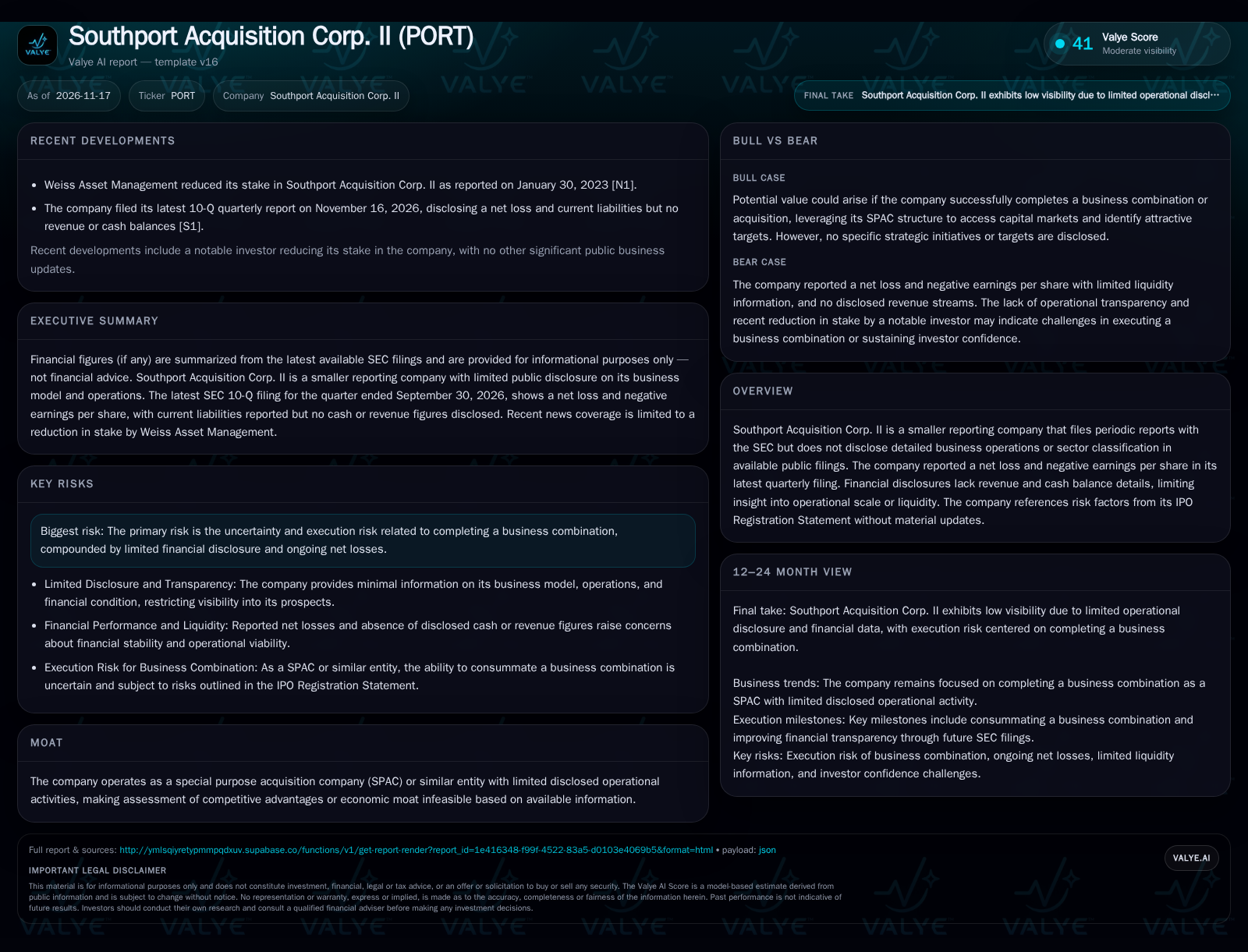
Southport Acquisition Corp. II is a newly public SPAC with a stated focus on the AI sector. Despite raising over $212 million in trust proceeds from its IPO and private placement, the company currently reports no revenue or cash balance, a net quarterly loss, and limited operational transparency. The primary challenge is executing a successful business combination before regulatory deadlines, amid investor skepticism and lack of disclosed deal progress. [S1] [N1]
Southport Acquisition Corp. II exemplifies the high-wire act of blank-check companies in today’s capital markets: flush with trust proceeds from a recent IPO, but with operational ambiguity and execution risk looming large. With over $212 million in trust and a stated intent to pursue deals in the artificial intelligence sector, Southport II must now identify and close a compelling transaction before its regulatory window closes. The lack of disclosed revenue, cash, or acquisition progress, combined with a recent reduction in a key investor’s stake, underscores the uncertainty and time pressure inherent in the SPAC model.
IPO Proceeds, Trust Structure, and the Absence of Disclosed Revenue
Southport Acquisition Corp. II completed its initial public offering on October 2, 2026, issuing 21,000,000 public units at $10.00 each, including 1,000,000 units from a partial over-allotment. This, combined with a private placement of 770,000 units, resulted in $212.1 million being deposited into a U.S. trust account. As of September 30, 2026, the company reported a net loss of $189,660 and did not disclose any revenue, cash, or cash equivalents. Current liabilities stood at $623,685. No business combination or acquisition target has been announced, and the company continues to reference risk factors from its IPO Registration Statement without material updates. [S1]
A recent reduction in stake by Weiss Asset Management, as reported in January 2023, signals at least some investor wariness or portfolio rebalancing. [N1] The combination of a large trust, minimal operational disclosure, and negative earnings per share typifies the early-stage phase for SPACs post-IPO, with execution risk now front and center.
How the SPAC Model Creates Optionality—and Where the Economics Can Break Down
Southport II’s economic model is predicated on successfully identifying and merging with a private company, ideally one in the artificial intelligence sector. The $212.1 million trust account represents both a war chest and a constraint: these funds are typically restricted to use for a qualifying acquisition, with redemptions by public shareholders possible if a suitable deal is not found or approved.
In the SPAC structure, sponsors typically invest via founder shares and private placement units, bearing the upfront costs of formation and deal sourcing. If a merger is consummated, sponsors can realize significant upside through equity conversion and potential warrant exercises. However, if no deal is completed within the regulatory window (often two to three years post-IPO), the SPAC must liquidate and return funds to investors, leaving sponsors with sunk costs and no upside.
The absence of disclosed revenue or operational cash flow means Southport II is entirely reliant on trust proceeds and sponsor support to fund ongoing expenses. Negative net income and lack of liquidity disclosure raise the risk that administrative and due diligence costs could erode the sponsor’s capital if a business combination takes longer than anticipated or fails to materialize.
SPACs Chasing AI: Crowded Field, Differentiation Challenges, and the Importance of Target Quality
The artificial intelligence sector has become a focal point for both public and private capital, with multiple SPACs and established strategics seeking to acquire or merge with promising AI companies. Southport II’s lack of a disclosed target puts it in direct competition with other blank-check entities, private equity, and corporate acquirers—all vying for a limited pool of top-quality targets.
SPACs often face adverse selection problems: the most attractive AI startups may prefer traditional venture funding or direct listings, while those seeking a quick public listing may carry higher risk or less mature business models. Southport II’s ability to secure a differentiated transaction could hinge on sponsor relationships, sector expertise, and willingness to offer favorable terms.
With no operational track record or disclosed pipeline, Southport II’s competitive position is currently defined by its capital base, sponsor credibility, and the speed and quality of its deal sourcing. The reduction in a notable investor’s stake may signal perceived limitations in differentiation or execution.
Transformative Acquisition Could Unlock Value—If a High-Quality AI Target Is Secured
The most favorable scenario for Southport II is the identification and completion of a merger with a high-growth, credible AI company. If such a target is found, the SPAC structure offers a fast track to public markets for the private company and potential for significant returns for both sponsors and public shareholders.
Confirmation of this scenario would require a public announcement of a definitive merger agreement with a recognized, scalable AI business, positive market reaction, and robust PIPE (private investment in public equity) participation to support the deal. Early signs could include rumors or disclosures of advanced negotiations, press releases outlining a letter of intent, or regulatory filings indicating a pending transaction.
Falsification would be indicated by continued silence on deal progress, failure to secure a target within the regulatory window, or shareholder redemptions that materially reduce the available trust proceeds.
Likely Outcome: Prolonged Target Search, Rising Costs, and Uncertain Deal Quality
The most plausible path is that Southport II continues its search for an AI sector target, incurring ongoing administrative and legal costs while facing increasing time pressure from NYSE listing rules and SPAC regulations. The eventual outcome could be a merger with a less competitive or more speculative company, as higher-quality targets are won by better-resourced or faster-moving competitors.
This scenario would be confirmed by periodic extensions of the SPAC’s deadline (subject to shareholder approval), incremental updates about deal sourcing activities, or announcements of non-binding letters of intent that fail to materialize into definitive agreements. Ongoing net losses and lack of revenue would persist, with sponsor capital at risk.
Falsification would require either a clear, high-quality deal announcement (moving the scenario toward the upside) or a decision to liquidate the trust and return funds to shareholders (moving toward the downside).
Failure to Secure a Suitable Target Leads to Liquidation and Sponsor Losses
The adverse outcome for Southport II is the inability to identify or close a business combination before regulatory deadlines, resulting in the forced liquidation of the trust account. In this case, public shareholders would receive their pro-rata share of the trust, but sponsors would lose their founder shares and private placement investment.
This scenario could be confirmed by the expiration of the SPAC’s business combination window without a transaction, regulatory filings indicating intent to liquidate, or a material increase in redemptions as the deadline approaches. Negative investor sentiment, as evidenced by further stake reductions or lack of PIPE interest, would also support this outcome.
Falsification would require either a last-minute deal announcement or a successful extension of the SPAC’s deadline with clear communication about target progress.
Milestones That Will Reveal Whether Southport II Can Deliver on Its AI SPAC Ambitions
Disclosure of a definitive business combination agreement with a credible AI-sector target would be the most material catalyst.
Any regulatory filings or press releases indicating deadline extensions, shareholder meetings to approve extensions, or changes to the SPAC’s trust structure.
Updates to the company’s financials, especially any disclosure of cash burn, remaining trust proceeds, or PIPE commitments, if disclosed.
Announcements of PIPE (private investment in public equity) participation or other co-investment alongside the SPAC deal, as a signal of external validation.
Material changes in sponsor or insider shareholdings, which could reflect shifting confidence or risk appetite.
Further reductions in institutional or anchor investor stakes, or increased redemptions by public shareholders as deadlines approach.
Any public disclosure of negotiations, letters of intent, or regulatory filings related to potential targets, even if non-binding.
A useful metric would be the percentage of trust proceeds that remain unredeemed at the time of any business combination announcement.
Disclaimer: This is research-only, informational analysis and not investment advice. It may include AI-generated interpretation and general industry context. Always verify important details using primary sources.

Comments