
CannapharmaRx’s Paradox: Positive Net Income Amid Liquidity Strain and Strategic Obscurity
CannapharmaRx, Inc. delivered positive net income on minimal revenue in Q3 2026, but a severe liquidity shortfall and lack of disclosed sector focus raise profound questions about business sustainability and strategic direction.
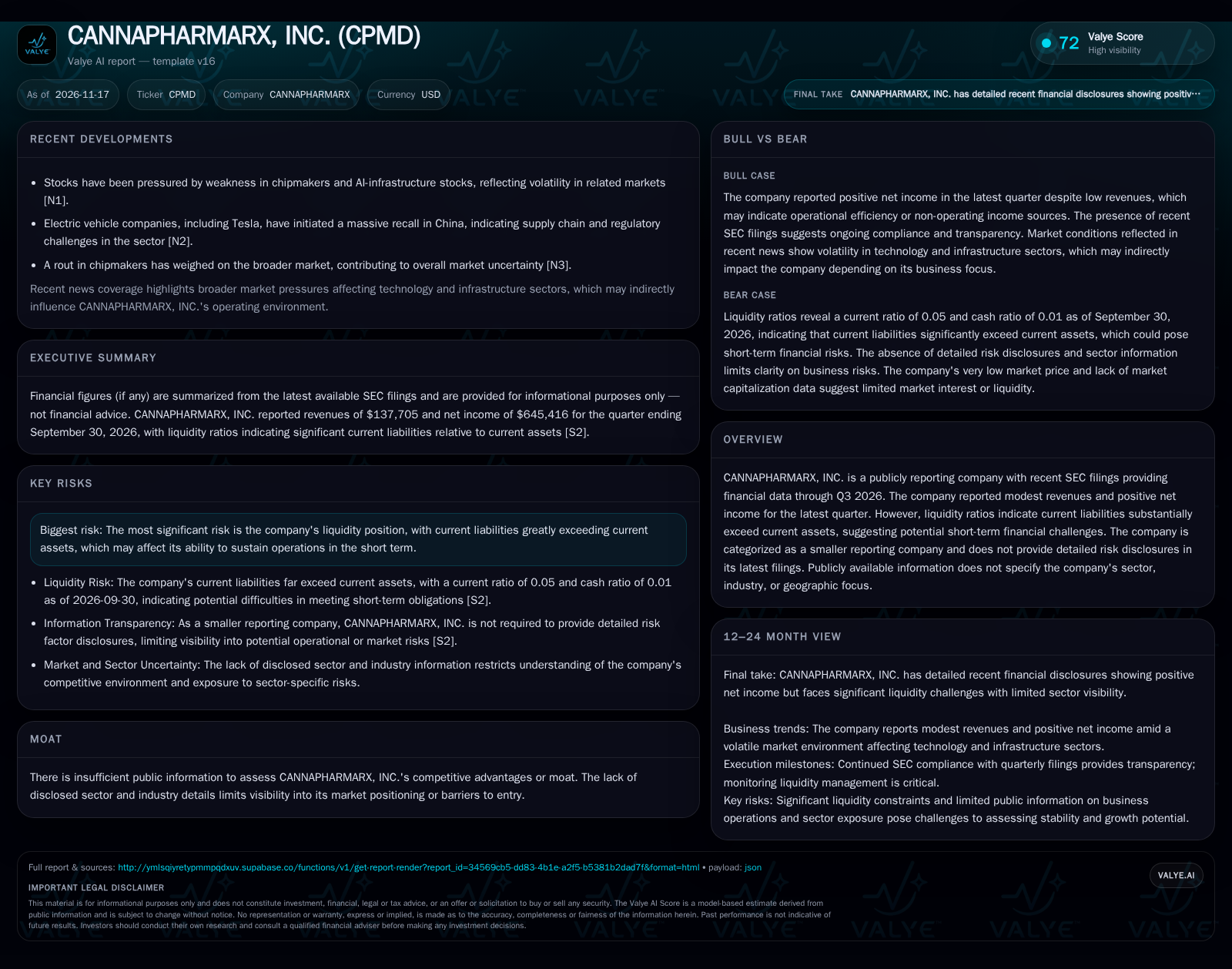
CannapharmaRx’s latest quarter shows $137,705 in revenue and unexpectedly strong net income of $645,416. The company’s sector and operational model remain undisclosed, complicating any assessment of core business health or future prospects. Without visibility into business drivers or risk factors, the company’s ability to sustain or scale operations is highly uncertain. [S2]
CannapharmaRx, Inc. presents a confounding financial profile: positive net income in the latest quarter despite modest revenues, but with a balance sheet signaling acute short-term financial risk. The company’s lack of disclosed sector or business model detail makes it difficult to assess whether recent profitability reflects operational strength, non-recurring income, or accounting effects. [S2]
Q3 2026 Snapshot: Net Income Surplus Masks Acute Liquidity Deficit
CannapharmaRx, Inc. reported revenues of $137,705 and net income of $645,416 for the quarter ending September 30, 2026. These results present a striking juxtaposition: generating positive net income on minimal sales. However, the company’s liquidity metrics are deeply concerning, with current liabilities at $32.7 million and current assets at just $1.74 million, including a mere $633 in cash as of March 2026. The company reported cash and liquidity metrics for the period; these figures do not by themselves establish operating runway, investment capacity, financial flexibility, or financing capacity. The absence of detailed sector, industry, or operational disclosures further complicates interpretation, leaving the source of profitability and future prospects unclear. [S2]
The juxtaposition of positive net income against a backdrop of minimal revenue and severe liquidity constraints invites a closer examination of the accounting treatments and cash flow dynamics at play. For instance, non-cash accounting gains such as revaluation of assets, recognition of deferred tax assets, or adjustments to reserves could inflate net income without corresponding cash inflows. Moreover, the timing of revenue recognition versus cash receipts may cause discrepancies between reported profitability and actual liquidity. Understanding whether net income translates into positive operating cash flow would be critical; if operating cash flow is negative or negligible, it would reinforce concerns about the sustainability of reported profits and the company's ability to meet short-term obligations.
Evaluating Financial Mechanics: Profitability Versus Liquidity Trap
The company’s ability to report positive net income on low revenue suggests either extremely lean operations, the realization of non-operating income (such as asset sales, settlements, or accounting reversals), or a one-off event rather than sustainable core profitability. Without segment or operational disclosure, it is impossible to assess whether the core business generates positive gross margins, or whether net income is driven by items not repeatable in future quarters. The acute liquidity shortfall—current assets covering only a fraction of current liabilities—implies that, absent a near-term cash infusion or liability restructuring, the company could struggle to fund ongoing operations. If the business model is asset-light or relies on high-margin licensing, positive net income could theoretically persist, but persistent liquidity deficits usually signal unsustainable economics, regardless of accounting profit.
The interplay between profitability and liquidity often hinges on the company’s working capital management and capital structure. If CannapharmaRx operates with extended payment terms to suppliers or relies heavily on trade credit, it might temporarily report profits while accumulating payables that strain liquidity. Conversely, if receivables collection is weak or inventory turnover is slow (if applicable), cash conversion cycles could exacerbate cash shortages despite accounting profits. Additionally, the capital structure—specifically the maturity profile and covenants of debt—may impose constraints that limit potential financial flexibility. Without clarity on financing arrangements or asset liquidity, the company may face a classic liquidity trap where accounting profitability masks an underlying cash crunch.
Strategic Positioning: The Blind Spot of Undisclosed Sector Exposure
With no sector, industry, or peer set disclosed, CannapharmaRx’s competitive positioning is impossible to benchmark. Conversely, if it is a holding company or IP aggregator, lumpy income and low recurring cash flows might be expected. The absence of transparency also means that barriers to entry, customer stickiness, and pricing power cannot be evaluated. In such an information vacuum, the company may face significant disadvantages in capital markets and customer acquisition, as counterparties and investors typically demand clarity on core operations and competitive edge.
Potential for Turnaround: Asset Monetization or Strategic Capital Injection?
A plausible upside would require the company to either monetize latent assets (such as IP, real estate, or non-core investments) or secure a strategic capital infusion that addresses the liquidity crisis. If the positive net income reflects a durable high-margin business line or recurring licensing revenue, and if management can negotiate liability extensions or raise equity/debt without punitive dilution, CannapharmaRx could stabilize and eventually scale. Evidence supporting this scenario would include new disclosures of recurring customer contracts, meaningful asset sales at book or premium value, or a successful capital raise that significantly improves liquidity ratios. Falsification would come from continued non-operating income as the main profit source, or inability to improve the balance sheet despite positive accounting results.
Sustained Uncertainty: Minimal Operations and Ongoing Financial Stress
The most plausible trajectory is that CannapharmaRx continues to operate at a minimal level, eking out occasional profits through non-core activities or cost containment, but with persistent and possibly worsening liquidity stress. Without new capital or a sharp improvement in working capital management, the company may fall behind on obligations, risking default or forced asset sales at distressed prices. Confirmation of this scenario would be repeated quarters of low revenue, sporadic net income, and no material improvement in current or cash ratios. Falsification would require a clear operational pivot, sector disclosure, or evidence of sustainable recurring revenue.
Liquidity Crisis Escalates: Asset Fire Sales or Operational Cessation
In the adverse scenario, CannapharmaRx’s acute liquidity deficit could force the company into distressed asset sales, creditor negotiations, or even cessation of operations. If current liabilities cannot be rolled over or settled through non-cash means, and if revenue generation remains anemic, the company may enter a downward spiral of eroding stakeholder confidence and rising financing costs. Evidence for this scenario would be a further decline in current assets, missed payments, or disclosures of default risk and going-concern warnings. If the company’s next quarterly filings show deepening negative working capital and no new financing, the risk of insolvency becomes acute.
Essential Developments That Could Redefine CannapharmaRx’s Outlook
Disclosure of business segment, sector, or primary revenue drivers—any clarity here would be foundational for assessing future prospects.
Evidence of recurring revenue: New or existing long-term customer contracts, if disclosed, would help test whether profits are sustainable.
Material asset sales or settlements: Confirmation that non-operating items are driving results, or that one-time events are being monetized.
Quarterly changes in current and cash ratios: Sustained improvement would be a positive indicator; further deterioration would confirm distress.
Full-year net income and cash flow statements: These would help disentangle operational versus non-operating income.
Management commentary or risk disclosures: Any forward-looking statements, if provided, would offer critical insight into strategy and risk.
Disclaimer: This is research-only, informational analysis and not investment advice. It may include AI-generated interpretation and general industry context. Always verify important details using primary sources.

Comments