
Vision Marine’s Strategic Pivot: U.S. Focus, Restructuring, and the Unmanned Systems Gambit
Vision Marine Technologies is navigating a period of profound transition—compressing its capital structure, exiting the Canadian exchange, and pursuing a reverse takeover that could fundamentally change its business mix. The company’s near-term financials remain pressured, but the proposed combination with an unmanned systems firm signals a high-stakes attempt to reset its trajectory.
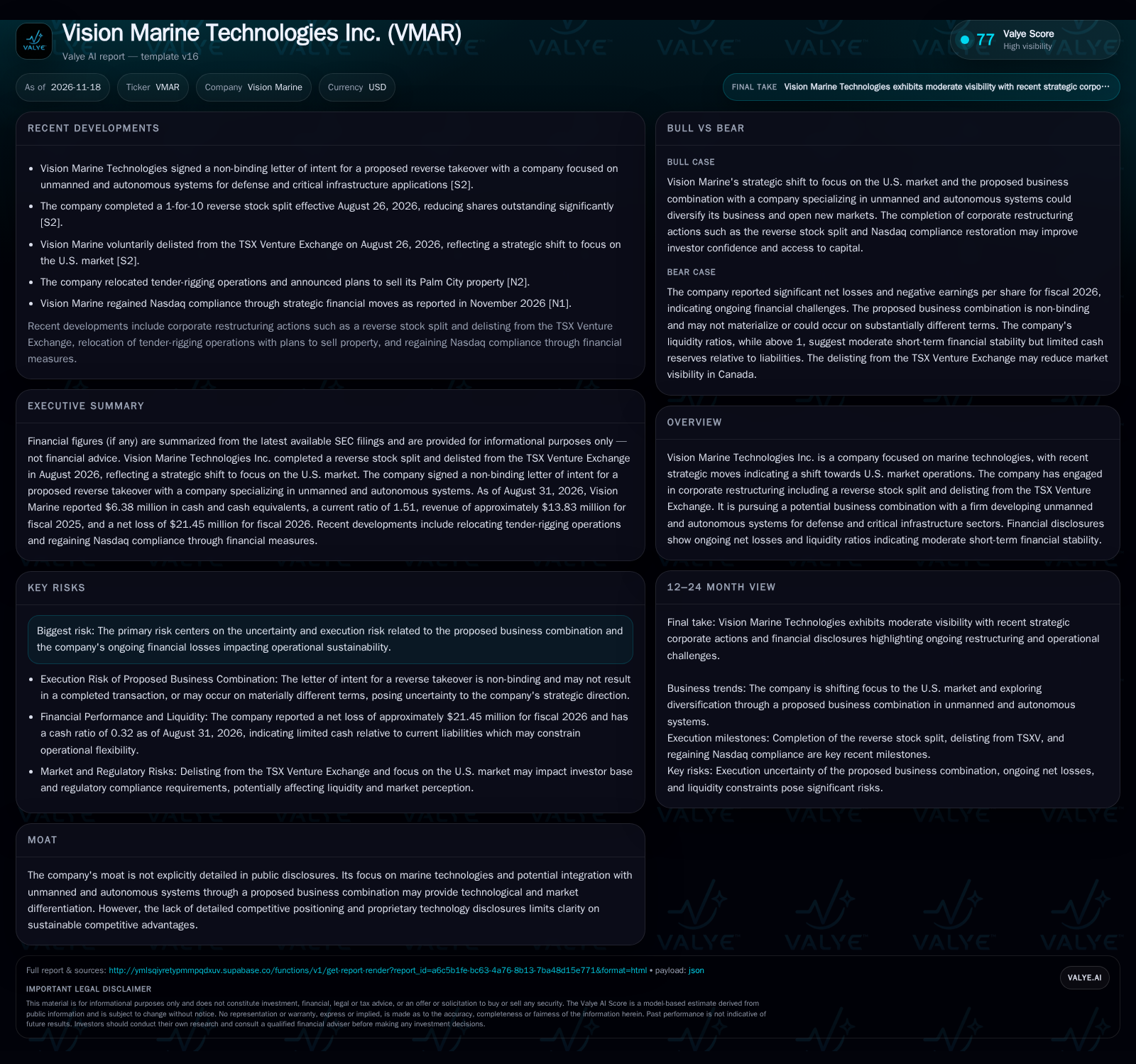
Vision Marine Technologies has executed a 1-for-10 reverse stock split, delisted from the TSX Venture Exchange, and reported a substantial net loss for fiscal 2026. The company is now pursuing a reverse takeover with a defense- and infrastructure-focused unmanned systems firm, which would leave current shareholders with only a small stake in the combined entity. This marks a strategic pivot toward the U.S. market and high-tech sectors, but the outcome and its economic implications remain highly contingent on execution and transaction terms. [S1] [S2]
Vision Marine Technologies is at a strategic crossroads. After years of focusing on electric marine propulsion, the company has compressed its share count, exited the Canadian exchange, and reported continued net losses. Now, Vision Marine is positioning itself for a transformative reverse takeover with a company in the unmanned and autonomous systems sector, targeting defense and infrastructure markets. This pivot—if executed—could fundamentally reshape its business mix, risk profile, and long-term prospects, but execution risks and dilution for existing shareholders loom large. The coming quarters will test whether Vision Marine can convert its restructuring into a viable platform for growth or if financial pressures will continue to dominate the story.
Major Restructuring and a Potential Sector Leap: Where Vision Marine Stands
Vision Marine Technologies has undergone a series of material changes in the past year. Most notably, it completed a 1-for-10 reverse stock split on August 26, 2026, reducing its outstanding shares from approximately 6.53 million to 653,046. Concurrently, the company voluntarily delisted from the TSX Venture Exchange, underscoring its shift toward U.S.-centric operations, as nearly all sales and revenue are now generated in the United States. [S2]
The company reported a net loss of $21.45 million for the fiscal year ended August 31, 2026, on $13.83 million in revenue for fiscal 2025. As of the same date, Vision Marine held $6.38 million in cash and cash equivalents, current assets of $30.43 million, and current liabilities of $20.16 million, resulting in a current ratio of 1.51 and a cash ratio of 0.32. [S1]
In a bid to reset its strategic direction, Vision Marine signed a non-binding letter of intent for a reverse takeover with a private firm specializing in unmanned and autonomous systems for defense and critical infrastructure. If completed as proposed, existing Vision Marine shareholders would retain only about 2.9% of the combined entity before any additional financing or contingent consideration. [S2]
From Electric Marine to Defense Tech: Economic Shifts and Structural Realities
Vision Marine’s historical business model centered on electric propulsion systems for boats—a hardware-intensive segment with lumpy order cycles, moderate gross margins, and significant capital requirements for R&D, manufacturing, and inventory management. The economics of this sector are typically characterized by high fixed costs and limited pricing power, with customer adoption dependent on regulatory incentives, fuel price dynamics, and the pace of electrification in recreational and commercial marine markets.
The company’s fiscal 2025 revenue of $13.83 million against a net loss of $21.45 million in fiscal 2026 highlights operating leverage that has not been favorable—costs have far outpaced revenue, suggesting insufficient scale or margin to absorb overhead. If the business combination with the unmanned systems firm proceeds, the economic model could shift dramatically: the target company focuses on autonomous and unmanned systems for defense and infrastructure, sectors that often feature longer sales cycles, higher barriers to entry, and the potential for larger, more stable contracts but also significant upfront investment and long procurement processes.
The reverse takeover, if consummated, would likely dilute current Vision Marine shareholders substantially while shifting the capital structure to support a business reliant on defense/government contracts, which may alter the risk-reward profile. Cash management, working capital intensity, and capital expenditure needs could change materially depending on the new entity’s product mix and go-to-market strategy.
Competitive Landscape: From Niche Marine Player to Entrant in Autonomous Systems
Vision Marine’s legacy marine propulsion business operates in a fragmented market with established competitors in both legacy combustion and emerging electric propulsion segments. Barriers to entry are moderate, with brand, distribution, and regulatory certifications as key differentiators—but no evidence suggests Vision Marine has established a defensible moat through proprietary technology or lasting customer lock-in.
Should the reverse takeover close, the competitive set would pivot dramatically. The unmanned and autonomous systems sector is populated by defense contractors, specialized robotics firms, and technology integrators, many of which possess significant resources, established government relationships, and entrenched R&D capabilities. Entry into this space would require Vision Marine (or the combined entity) to demonstrate technical reliability, meet stringent regulatory and security standards, and compete for limited procurement slots against much larger players.
The question is whether the combined company can carve out a technological or market niche—such as unique IP, integration capability, or cost advantage—to offset the scale and relationship advantages of incumbent defense and automation providers.
Transformational Deal Unlocks New Markets and Margin Leverage
If Vision Marine successfully completes the reverse takeover and the new entity executes on contracts in the unmanned and autonomous systems arena, the company could access higher-margin, longer-duration revenue streams from defense and critical infrastructure customers. This would diversify away from the cyclical, lower-margin marine propulsion market and could position the company for sustained growth if it captures share in a rapidly expanding sector.
Confirmation of this scenario would require evidence of: (1) completion of the business combination on favorable terms; (2) disclosure of meaningful contract wins or customer pilots in the defense/autonomous space; (3) a shift in revenue mix toward higher-margin, recurring, or multi-year projects; and (4) improved gross margins and a path to operating breakeven or profitability.
Falsification would occur if the deal falls through, if the target company lacks commercial traction, or if the combined entity fails to win significant contracts or demonstrate technical differentiation.
Incremental Restructuring with Ongoing Losses and Uncertain Deal Closure
The most plausible near-term path is continued operational restructuring and cost management while Vision Marine attempts to close the proposed business combination.
Indicators that would confirm this scenario include slow progress on the business combination, additional restructuring announcements (such as asset sales), and persistent negative operating margins. Lack of material contract wins or revenue diversification would reinforce the view that the transition remains incomplete.
A deviation from this scenario would be signaled by either a collapse of the proposed deal (reverting Vision Marine to a standalone, capital-constrained marine tech company) or a rapid acceleration in new business wins post-combination.
Deal Fails, Core Business Remains Subscale, and Liquidity Erodes
In the adverse scenario, the non-binding business combination either falls apart or closes on unfavorable terms, leaving Vision Marine with a subscale marine technology business, ongoing net losses, and a shrinking reported cash balance. Without a successful pivot, the company could face mounting pressure to divest additional assets, cut costs further, or seek dilutive emergency financing.
Falsification would require either stabilization in the core business (e.g., new contracts in marine propulsion) or a completed combination that brings in new capital, capabilities, and revenue sources.
Milestones that Will Shape Vision Marine’s Next Chapter
Formal completion, amendment, or cancellation of the proposed reverse takeover—including definitive agreement terms, deal structure, and resulting ownership split.
Disclosure of new contract wins, pilots, or partnerships in the unmanned and autonomous systems sector if the combination closes.
Changes in revenue mix or margin profile—especially evidence of higher margin, longer-duration contracts versus historical marine propulsion sales.
Trends in cash flow from operations and quarterly net loss—whether losses are narrowing, and if cash burn is being controlled.
Nasdaq compliance status and any risk of relisting or delisting due to ongoing financial performance or market cap thresholds.
If disclosed, backlog or pipeline metrics in either the marine or unmanned/autonomous segments to gauge forward revenue visibility.
Disclaimer: This is research-only, informational analysis and not investment advice. It may include AI-generated interpretation and general industry context. Always verify important details using primary sources.

Comments