
Spectrum Brands: Strategic Shifts and Margin Progress in a Volatile Consumer Staples Market
Amid margin improvements and a transformative joint venture in Home and Personal Care, Spectrum Brands faces a complex landscape of competitive pressures, supply chain risk, and strategic execution challenges. The company's diversified portfolio and recent operational gains offer resilience, but persistent headwinds test its ability to deliver sustained value.
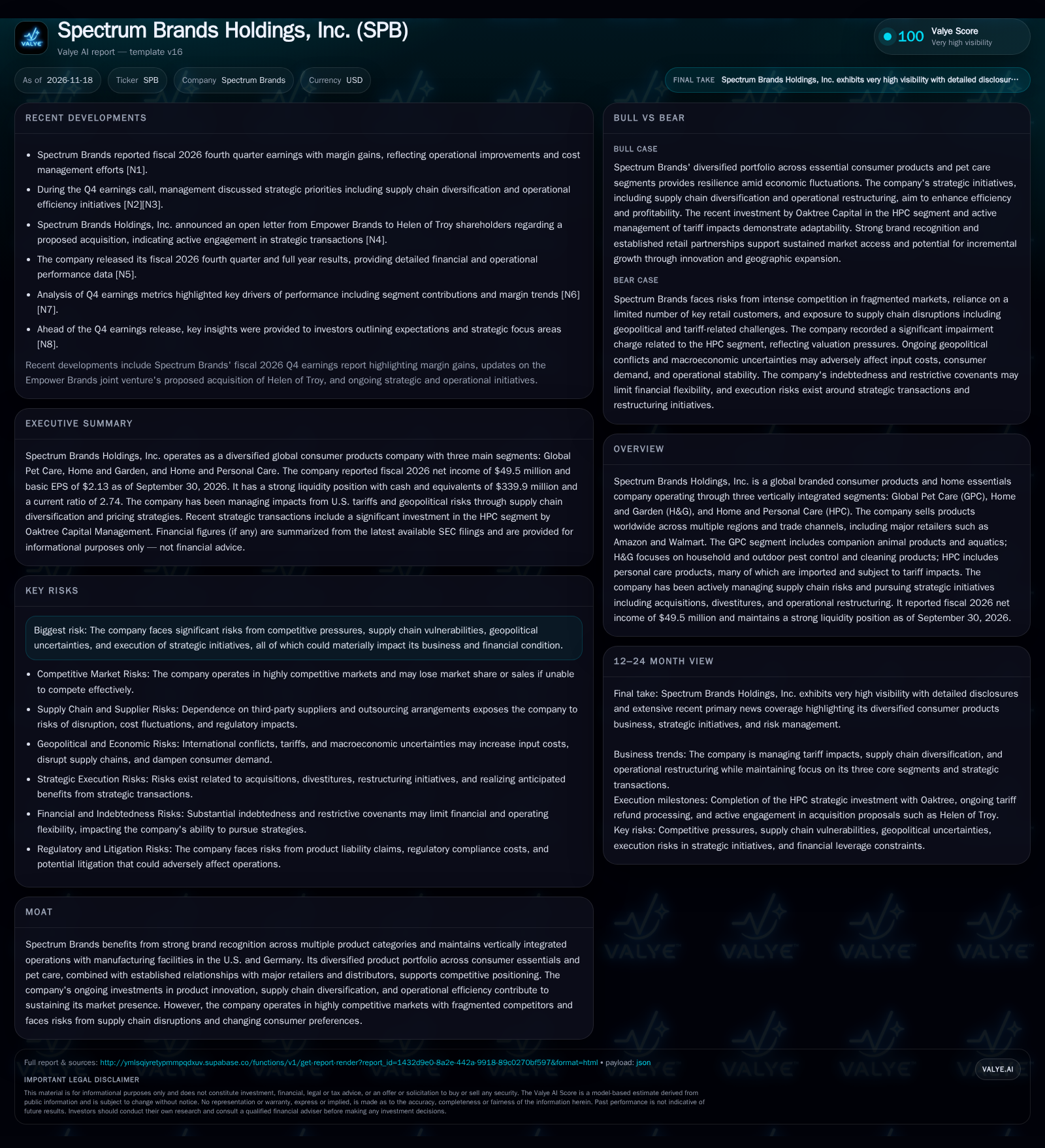
Spectrum Brands reported FY2026 net income of $49.5 million with margin gains and a current ratio of 2.74. The company completed a strategic investment in its Home and Personal Care (HPC) segment with Oaktree Capital, recognized a $104 million HPC impairment, and recouped $60.6 million in tariff refunds. These developments signal both operational progress and the ongoing challenge of navigating supply chain, competitive, and macroeconomic risks. [S1] [N1] [N5]
Spectrum Brands Holdings enters the end of 2026 at a strategic crossroads: margin improvements and operational progress are evident, but the company’s path forward is defined by a complex mix of competitive intensity, supply chain uncertainty, and the imperative to extract value from recent strategic transactions. The Oaktree Capital partnership in the Home and Personal Care segment, a $104 million impairment, and ongoing tariff management each signal both opportunity and risk. For investors, the question is whether Spectrum’s diversified consumer staples portfolio and recent restructuring efforts can consistently offset the volatility inherent to a fragmented, globally sourced business.
Margin Improvements and Portfolio Changes Shape 2026 Outcomes
Spectrum Brands reported fiscal 2026 net income of $49.5 million, with basic EPS of $2.13, a cash balance of $339.9 million, and a current ratio of 2.74 as of September 30, 2026 [S1] [N5]. These numbers reflect the company’s focus on operational discipline, with Q4 margin gains attributed to cost management and supply chain actions [N1] [N5].
A transformative event in 2026 was the strategic investment by Oaktree Capital in the Home and Personal Care (HPC) segment. Oaktree acquired approximately 27.3% equity ownership in HPC through a preferred equity instrument with an 8% cumulative dividend, now classified as redeemable noncontrolling interest [S1].
The company recognized a $104 million impairment charge in HPC, highlighting ongoing valuation and performance challenges in that segment [S1].
Additionally, Spectrum Brands recouped $60.6 million in tariff refunds after paying $66.4 million under U.S. IEEPA tariffs, impacting cash flows and segment economics during the year [S1].
Revenue Drivers: Diversified Products, Channel Strategy, and Margin Focus
Spectrum Brands’ business model is anchored in its three vertically integrated segments: Global Pet Care (GPC), Home and Garden (H&G), and Home and Personal Care (HPC). Each segment targets essential consumer needs, with GPC (including pet food and aquatics) and H&G (household and outdoor controls) benefiting from relatively steady demand and broad retail distribution. The company’s reliance on major retailers (with Amazon and Walmart representing a substantial share of GPC sales) drives volume but can compress margins due to negotiating leverage and promotional pressures.
Pricing, volume, and mix are central to the company’s economics. Margin improvements reported in FY2026 reflect a combination of pricing actions to offset input costs, supply chain diversification to mitigate tariff and geopolitical risk, and cost management initiatives [N1] [N5]. However, the $104 million impairment in HPC underscores the vulnerability of imported, lower-margin categories—particularly those subject to tariffs and global supply chain disruptions.
Operating leverage is present but not extreme: while fixed costs in manufacturing and distribution create some scalability, much of the portfolio is exposed to variable costs tied to commodities, logistics, and labor. The company reported cash and liquidity metrics for the period; these figures do not by themselves establish operating runway, investment capacity, financial flexibility, or financing capacity.
Market Dynamics: Brand Equity Confronts Fragmentation and Private Labels
Spectrum Brands’ main advantage lies in its broad portfolio of recognized brands and its ability to reach consumers through multiple retail channels. The vertically integrated model supports some cost and supply chain control, but most product categories—pet care consumables, cleaning and repellents, and personal care appliances—are highly competitive, fragmented, and subject to substitution by private labels or new entrants.
Large retail partners wield considerable negotiating power, often demanding lower prices or higher promotional support. The risk is twofold: customer concentration increases exposure to shifts in retailer strategies, while the rise of e-commerce, direct-to-consumer channels, and private label brands can erode category margins and loyalty.
Competitor categories range from multinational consumer staples conglomerates to niche private label and regional players. The company’s exposure to tariffs and supply chain disruptions also limits its ability to maintain pricing power in the face of cost inflation, especially in HPC where much of the product is imported.
Potential for Margin Growth Through Supply Chain and Portfolio Optimization
The most favorable scenario for Spectrum Brands hinges on successful execution of its supply chain diversification, pricing discipline, and operational restructuring. If the company continues to realize margin gains through cost controls and passes on input costs to customers without significant volume loss, adjusted EBITDA margins could structurally improve.
A further upside catalyst would be the successful deployment of Oaktree’s capital and expertise to accelerate innovation or efficiency in the HPC segment, reversing impairment trends and restoring growth. Strategic M&A or divestitures—such as the proposed Helen of Troy acquisition by the Empower Brands JV—could add scale or focus the portfolio on higher-margin, defensible categories [N4].
Confirmation of this scenario would require sustained improvement in adjusted EBITDA margin, positive organic net sales growth (if disclosed), and evidence of market share gains or expanded distribution with leading retail partners.
Core Business Stability Faces Execution and Market Volatility Challenges
The most plausible outcome is that Spectrum Brands’ diversified portfolio provides a buffer against severe downturns, but persistent headwinds limit the pace of value creation. The GPC and H&G segments—anchored in pet care consumables and household essentials—offer stable cash flow and some pricing flexibility, offsetting more volatile or lower-margin categories in HPC.
Operational improvements and supply chain actions may continue to support mid-teens adjusted EBITDA margins, but major margin expansion is likely constrained by retailer power, lingering input cost inflation, and the fixed cost of the Oaktree preferred equity outflows. The impairment in HPC may signal a re-basing of expectations rather than a one-time reset.
Evidence supporting this scenario would include continued positive net income, stable or improving adjusted EBITDA margins, and no further major impairments or restructuring charges. Falsification would come from renewed supply chain disruptions, significant customer losses, or further deterioration in HPC.
Risks from Macroeconomic Disruptions and Operational Setbacks
The adverse scenario for Spectrum Brands is driven by a combination of renewed supply chain shocks, sustained input cost inflation, and execution missteps in strategic transactions or operational restructuring. If supply chain diversification fails to deliver, or if tariffs and geopolitical disruptions escalate, the company could face margin compression, loss of shelf space with key retailers, or further impairments—particularly in HPC.
Another risk is that the Oaktree preferred equity structure could become a drag on HPC cash flow, especially if consumer demand weakens or cost inflation cannot be passed through. In this scenario, the company’s ability to service its obligations and invest in growth could be compromised, potentially forcing asset sales or further restructuring.
Confirmation of this scenario would include declining adjusted EBITDA margins, additional impairment charges, negative earnings, or liquidity stress as evidenced by rising leverage or deteriorating current ratios.
Factors Influencing the Success of Spectrum Brands’ Restructuring Efforts
Sustained improvement or deterioration in adjusted EBITDA margin, especially as supply chain actions and pricing strategies take effect.
Organic net sales growth or volume trends by segment, if disclosed, to gauge underlying demand and pricing power.
Progress on supply chain diversification—such as reduced reliance on Southeast Asian imports in HPC—and management commentary on cost inflation.
Evidence of increased shelf space, expanded distribution, or new product launches with major retail partners.
Updates on the performance and profitability of the HPC segment post-Oaktree transaction, including the impact of the preferred equity dividend.
Further impairment charges, restructuring costs, or asset sales—especially in HPC or other underperforming segments.
Material changes in customer concentration or loss of major retail partners.
Additional tariff or regulatory developments affecting input costs, supply chain stability, or international operations.
Disclaimer: This is research-only, informational analysis and not investment advice. It may include AI-generated interpretation and general industry context. Always verify important details using primary sources.

Comments