
SUNRISE REAL ESTATE GROUP: Niche Alliances and Financial Diversification in a Fragmented Chinese Market
Sunrise Real Estate Group’s complex web of subsidiaries and its focus on mid-sized Chinese developers shape both its opportunity set and its operational challenges. While recent financials show modest scale, the company’s expansion into financial services and its niche market approach could offer resilience if execution aligns with market shifts.
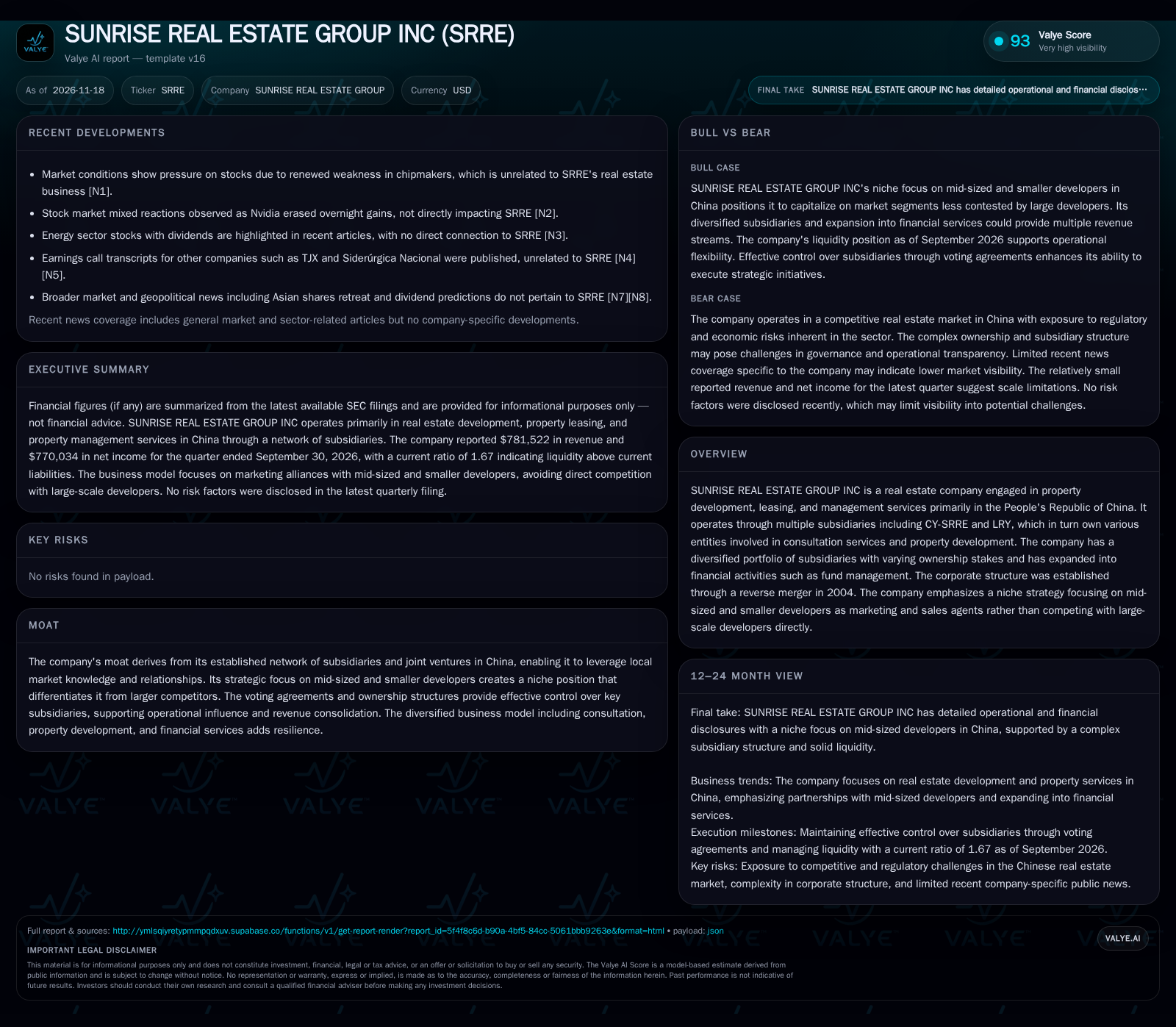
Sunrise Real Estate Group (SRRE) operates a network of subsidiaries focused on property development, leasing, and management in China, with a niche strategy targeting mid-sized and smaller developers. As of September 2026, its financials show modest revenue and net income, with a current ratio of 1.67 and cash plus short-term investments totaling $24.9 million. The company’s expansion into financial services and reliance on a few key revenue contributors highlight both diversification ambitions and concentration risks. Its future depends on execution within a complex structure and navigating the competitive, regulatory, and economic landscape of Chinese real estate. [S2]
Sunrise Real Estate Group stands at the intersection of China’s evolving property sector and the growing demand for specialized, outsourced services among mid-sized developers. Its intricate network of subsidiaries—and recent foray into financial services—reflects both its ambition to diversify and the inherent challenges of operating in a fragmented, heavily regulated market.
Recent Financials and Structural Highlights Define Near-Term Reality
For the quarter ended September 30, 2026, Sunrise Real Estate Group reported revenue of $781,522 and net income of $770,034, translating to basic and diluted EPS of $0.01 per share. As of the same date, the company held $8.7 million in cash and equivalents and $16.2 million in short-term investments, resulting in a current ratio of 1.67 and a cash ratio of 0.45. These figures indicate a balance sheet with liquidity above current liabilities, though the scale of operations remains modest. Critically, over 80% of 2025 revenue came from Huai'an Tianxi Real Estate Development Co., Ltd, highlighting the company’s revenue concentration and dependency on key subsidiaries. [S2] The company’s structure—spanning multiple subsidiaries and joint ventures primarily in China—remains a defining operational feature.
How Sunrise Monetizes: Niche Segmentation, Fee Models, and Asset Cycles
SRRE’s core business spans real estate development, property leasing, and management—sectors typically defined by capital intensity, cyclical demand, and long asset turnover cycles. By focusing on alliances with mid-sized and smaller developers, SRRE positions itself as a marketing and sales outsourcing partner, likely earning fee-based income or profit-sharing from project sales and leasing, rather than shouldering the full risk and capital requirements of large-scale development. This model could provide more stable cash flows and lower capital needs per project, but may also cap upside if partners retain most project economics.
The company’s expansion into financial services, such as fund management and entity investment, suggests a move to diversify revenue streams and potentially capture higher-margin, recurring income. However, the economics of these activities in China are highly sensitive to regulatory shifts, fundraising success, and asset performance. Fixed costs are likely moderate due to the consulting and management nature of many subsidiaries, but asset-heavy development arms could still expose SRRE to significant balance sheet risk if projects underperform or market liquidity tightens.
Operating leverage is likely mixed: consulting and management services could scale efficiently with volume, while development profits may remain lumpy and tied to project completions. The company reported cash and liquidity metrics for the period; these figures do not by themselves establish operating runway, investment capacity, financial flexibility, or financing capacity. [S2]
Competing as a Niche Partner in a Crowded, Regulated Market
SRRE’s main differentiator is its strategic focus on mid-sized and smaller developers, positioning itself as a marketing and sales agent rather than a direct rival to China’s dominant, large-scale real estate companies. This approach may limit direct head-to-head competition with the largest property developers, but it also means SRRE operates in a fragmented segment where relationships, execution, and reputation are key.
The company’s web of subsidiaries and joint ventures could enable local market knowledge and flexibility, but also increases governance complexity and potential for inefficiency. In the Chinese property sector, regulatory risk is high—particularly for financial activities and cross-border capital flows—so SRRE’s expansion into fund management must be carefully managed. Substitute offerings include in-house sales teams, larger agencies, or direct digital platforms, which could erode SRRE’s value proposition if they offer superior reach or cost efficiency.
Peers would include other property service firms, real estate consultancies, and specialized sales and marketing agencies operating in China’s second- and third-tier cities. The extent of SRRE’s competitive edge likely depends on the strength of its developer relationships, execution on project delivery, and ability to adapt to evolving market and regulatory trends.
If Niche Alliances Scale and Financial Services Gain Traction
SRRE could unlock material upside if it succeeds in deepening its partnerships with mid-sized developers, broadening its fee-based project pipeline, and scaling its financial services platform. In this scenario, the company leverages its local market expertise and subsidiary network to win repeat mandates, driving higher, more stable consulting and management revenues. If its fund management and investment activities attract outside capital and generate returns, SRRE could build a recurring income stream with higher margins and lower direct capital risk.
Upside would be confirmed by sustained, diversified revenue growth (reducing reliance on Huai'an Tianxi), a rising share of income from financial services, and evidence of successful new project launches or fund closes. Improved operating margins, greater geographic reach, and increased partnership announcements with credible developers would further validate this scenario. Conversely, failure to grow non-core revenues, continued concentration, or regulatory setbacks in financial services would falsify the upside thesis.
Maintaining Operations Amid Concentration and Modest Growth
The most plausible trajectory is that SRRE continues to operate with a modest scale, maintaining its core client relationships and subsidiary structure while facing ongoing revenue concentration. Incremental growth may come from additional developer partnerships or small-scale property management contracts, but the company’s limited scale and competitive market likely constrain rapid expansion. Financial services may provide some diversification, but regulatory risk and execution hurdles could limit the pace and profitability of this segment.
Confirmation of this scenario would include quarterly revenue and net income figures remaining in the current range, continued dominance of Huai'an Tianxi in the revenue mix, and muted expansion in financial services. Falsification would require either a sharp drop in revenue concentration (e.g., multiple new contributors) or a meaningful jump in consulting or fund management income.
Revenue Concentration and Regulatory Shocks as the Primary Threats
SRRE’s heavy reliance on a single subsidiary for the majority of its revenue exposes it to significant downside risk if that entity underperforms, faces local regulatory issues, or loses key contracts. Further, the company’s complex structure and expansion into financial activities could increase scrutiny from regulators, particularly as Chinese authorities continue to intervene in real estate and financial markets to maintain stability.
A downside scenario would be triggered by a sharp decline in revenue from Huai'an Tianxi, project delays or failures, or adverse regulatory changes affecting SRRE’s financial services operations. Confirmation would come via quarterly reports showing declining revenues, negative net income, or increased legal and compliance costs. A failure to diversify revenue streams or maintain liquidity could also precipitate more severe financial stress.
Milestones That Could Shift the Course for Sunrise Real Estate Group
Quarterly revenue and net income trends, especially any changes in the contribution mix by subsidiary, would help test the company’s ability to diversify its business.
Updates or disclosures around new partnerships, mandates, or project wins with mid-sized and smaller developers would indicate traction in SRRE’s core niche.
The company reported profitability for the period.
If disclosed, churn or retention rates among developer partners would help measure SRRE’s market position and client satisfaction.
Changes in regulatory environment for real estate and financial services in China, and any management discussion of compliance or operational impacts, would be critical external factors.
Board or management changes, especially in subsidiaries driving the majority of revenue, could signal shifts in strategy or risk profile.
Any move to simplify the corporate structure or enhance transparency in inter-subsidiary relationships would be a positive signal for governance and risk management.
Disclaimer: This is research-only, informational analysis and not investment advice. It may include AI-generated interpretation and general industry context. Always verify important details using primary sources.

Comments