
BellRing Brands: Sales Momentum and Leadership Change Shape Earnings Outlook
Despite a mixed earnings landscape and operational risks, BellRing Brands shows resilience through Q4 sales improvement and a refreshed executive team. The company’s ability to convert top-line momentum into sustainable profitability faces critical tests in a fiercely competitive consumer products environment.
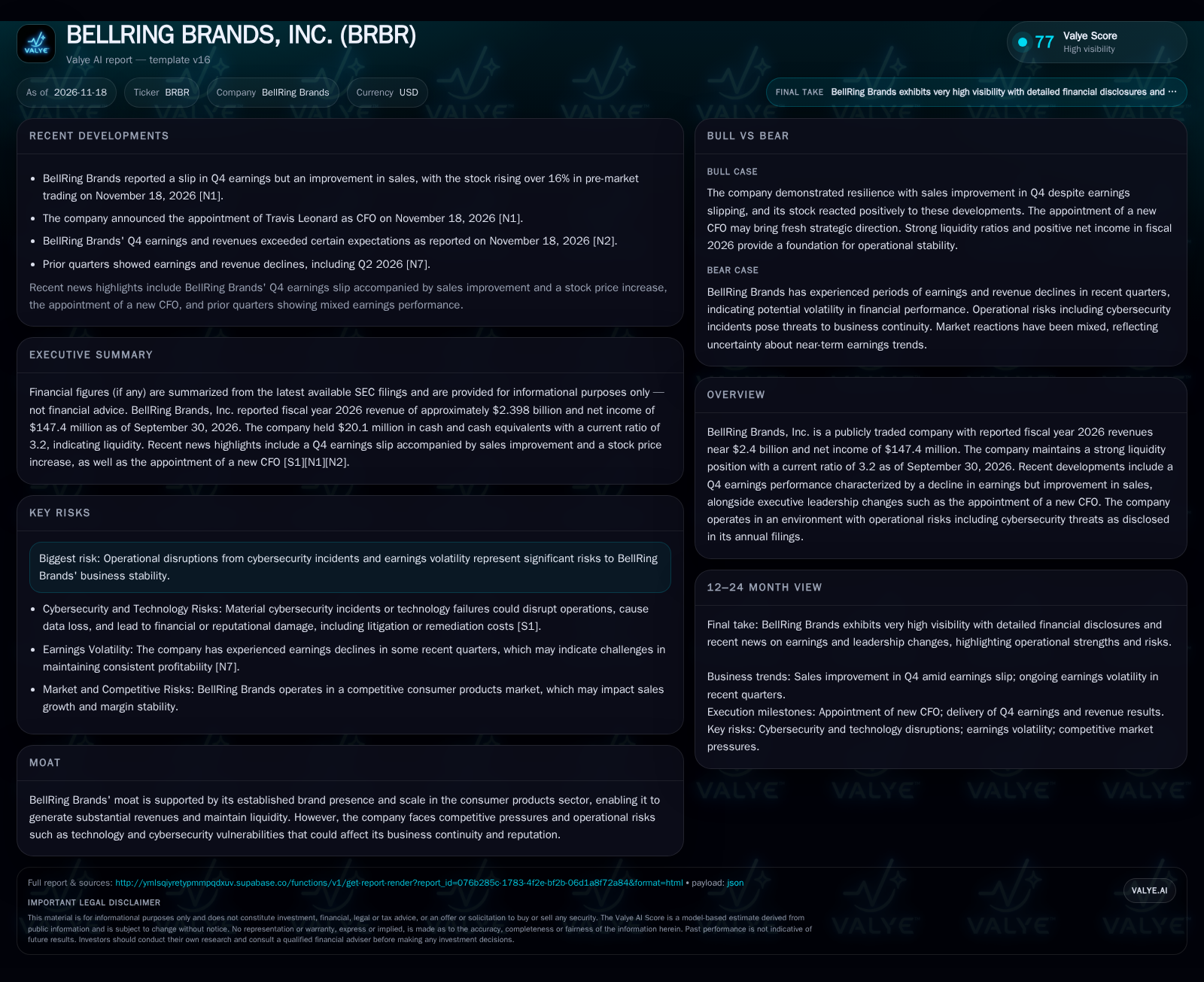
BellRing Brands reported fiscal 2026 revenue of $2.398 billion and net income of $147.4 million, with a current ratio of 3.2 as of September 30, 2026. Q4 saw improved sales despite an earnings slip, and the stock rose over 16% in pre-market trading following the results. The appointment of a new CFO and ongoing earnings volatility highlight both potential for renewed strategic focus and persistent financial uncertainty. Operational risks, especially in cybersecurity, remain material concerns for the business. [S1] [N1] [N2] [N7]
BellRing Brands enters fiscal 2027 balancing renewed sales momentum against persistent earnings volatility and operational risk. The company’s Q4 performance—sales improvement despite a dip in earnings—sparked a significant stock rally, suggesting that investors may see green shoots for recovery or operational leverage. The recent appointment of a new CFO adds another variable to the strategic equation, raising questions about whether BellRing can translate top-line gains into more consistent profitability amid competitive and technological headwinds.
Sales Gains, Earnings Fluctuations, and Leadership Shift Define Current Landscape
BellRing Brands reported fiscal year 2026 revenue of approximately $2.398 billion and net income of $147.4 million, with basic EPS of $1.26. The company’s Q4 results were mixed: earnings slipped, but sales improved, and the stock price responded with a 16%+ jump in pre-market trading on the announcement. This reaction suggests investors may be prioritizing top-line momentum or interpreting the sales improvement as an early sign of a turnaround. The appointment of Travis Leonard as CFO introduces a new leadership dynamic at a time when the company has faced several quarters of earnings and revenue pressure. The company reported cash and liquidity metrics for the period; these figures do not by themselves establish operating runway, investment capacity, financial flexibility, or financing capacity. Importantly, the company continues to highlight cybersecurity and technology risks as material threats to ongoing operations. [S1] [N1] [N2] [N7]
Revenue Composition, Margin Dynamics, and Profitability Challenges
BellRing Brands’ business model in the consumer products sector typically depends on branded, high-volume packaged goods—often focused on nutrition and wellness segments. Revenue is driven by product sales through retail, e-commerce, and potentially specialty channels. Given the scale reflected in its nearly $2.4 billion in annual revenue, fixed operating costs (such as manufacturing, warehousing, and SG&A) are likely substantial, but the company should benefit from operating leverage if volume growth can be sustained.
Gross margins in consumer packaged goods are sensitive to raw material costs, promotional intensity, and channel mix. If BellRing’s Q4 sales improvement resulted from higher volume rather than discount-driven promotions, there may be latent margin expansion potential—though this is not established by the current report. The slip in earnings despite stronger sales suggests either elevated input costs, persistent overhead, or margin-dilutive growth tactics.
Going forward, the company’s ability to expand margins will likely depend on product mix (premium vs. value offerings), pricing power in the face of inflation, and the effectiveness of cost management initiatives—potentially under new CFO leadership.
Competitive Pressures from Consumer Brands and Digital Risks
BellRing Brands operates in a fiercely competitive consumer products environment, facing rivalry from large multinational food and nutrition brands, private-label entrants, and new direct-to-consumer players. Differentiation can be achieved through brand strength, product innovation, distribution reach, and shelf presence, but these advantages tend to erode quickly without continual investment.
Switching costs for consumers in this category are generally low, making brand equity and perceived product efficacy crucial. E-commerce and digital marketing have increased both the speed of competitive response and the risk of reputational damage from supply chain or cybersecurity failures. The company’s explicit disclosure of technology and cybersecurity risks underlines its vulnerability to digital disruptions, which could impact operations, erode trust, or result in costly remediation.
While BellRing’s scale provides some purchasing power and a platform for innovation, competitors with deeper pockets or more agile digital strategies could pressure margins and market share. The appointment of a new CFO may signal an intent to adapt more rapidly, but the durability of any competitive edge will depend on execution and brand investment.
Sustained Sales Growth Combined with Operational Focus May Restore Margins
The most favorable scenario for BellRing Brands involves converting recent sales momentum into durable revenue growth, while simultaneously reining in costs and improving margin structure. If the Q4 sales improvement reflects underlying demand rather than temporary promotions or channel fill, it could mark the beginning of a new growth cycle, especially if paired with new product launches or expanded retail partnerships.
The fresh perspective brought by a new CFO could catalyze cost discipline, more effective working capital management, or smarter capital allocation—unlocking operating leverage as volumes rise. Evidence confirming this scenario would include: sequential margin expansion, sustained double-digit revenue growth, improved cash conversion cycles, and evidence of successful product innovation or distribution gains. Falsification would come from continued margin compression, inventory build-up without corresponding sales, or a reversion to negative earnings trends.
Sales Stabilization Accompanied by Ongoing Margin Challenges
The most plausible path forward is one where BellRing Brands achieves modest top-line growth but continues to experience margin and earnings volatility. Sales may benefit from category tailwinds (e.g., demand for nutrition/wellness), but promotional activity, input cost inflation, and competitive pricing pressure could limit profitability gains. The company’s working capital structure may remain stretched, with cash conversion lagging sales growth.
Confirmation of this scenario would come from stable or slightly rising revenues alongside flat or fluctuating operating margins and continued variability in quarterly earnings. Evidence that would falsify this scenario includes a clear trend of either sustained margin improvement (signaling a move toward the upside case) or a sharp and persistent reversal into negative earnings territory (signaling the downside).
Accelerating Earnings Decline Fueled by Competition and Cyber Threats
A more adverse scenario materializes if BellRing Brands’ sales growth stalls or reverses, while costs remain inflexible or rise further. Competitive pressures—from both established brands and digital-first challengers—could erode pricing and shelf space, forcing the company into margin-dilutive promotions or product rationalizations. Operational disruptions, especially from cybersecurity incidents, could impose direct financial costs as well as reputational damage, compounding the pressure on margins and potentially leading to customer attrition.
This scenario would be confirmed by sequential revenue declines, sustained negative earnings, margin compression, significant one-time charges related to technology incidents, or a deterioration in liquidity metrics. Falsification would require evidence of stabilization in both revenue and earnings, with successful mitigation of operational risks.
Factors Influencing BellRing’s Prospects for Stable Value Generation
Quarterly gross and operating margin trends—if disclosed—would help determine whether sales growth is translating into sustainable profitability.
Sequential revenue growth versus category benchmarks would signal whether BellRing is gaining or losing share in its core segments.
Cash conversion cycle and changes in working capital balances would clarify the company’s ability to translate reported sales into actual cash flow.
New product launches, retail distribution wins, or channel expansion announcements would be concrete signals of organic growth momentum.
Disclosure of cybersecurity incidents, remediation costs, or technology investments would help assess operational risk management.
Retention and repeat purchase rates—if disclosed—would provide insight into brand loyalty and customer switching dynamics.
Impact of CFO-led strategic initiatives (e.g., cost cuts, capital allocation changes) should be monitored for evidence of improved execution.
Quarterly updates on advertising and promotional spend versus sales growth would clarify the quality of revenue gains.
Disclaimer: This is research-only, informational analysis and not investment advice. It may include AI-generated interpretation and general industry context. Always verify important details using primary sources.

Comments