
Red Robin’s Strategic Reset: Navigating Losses, Liquidity Strain, and the Stakes of Operational Overhaul
Red Robin faces mounting operational and financial pressures, underscored by Q3 2026 losses and constrained liquidity. The company’s First Choice strategy aims to restore traffic and margins via operational efficiency, refranchising, and menu innovation—but execution risk and competitive intensity remain high.
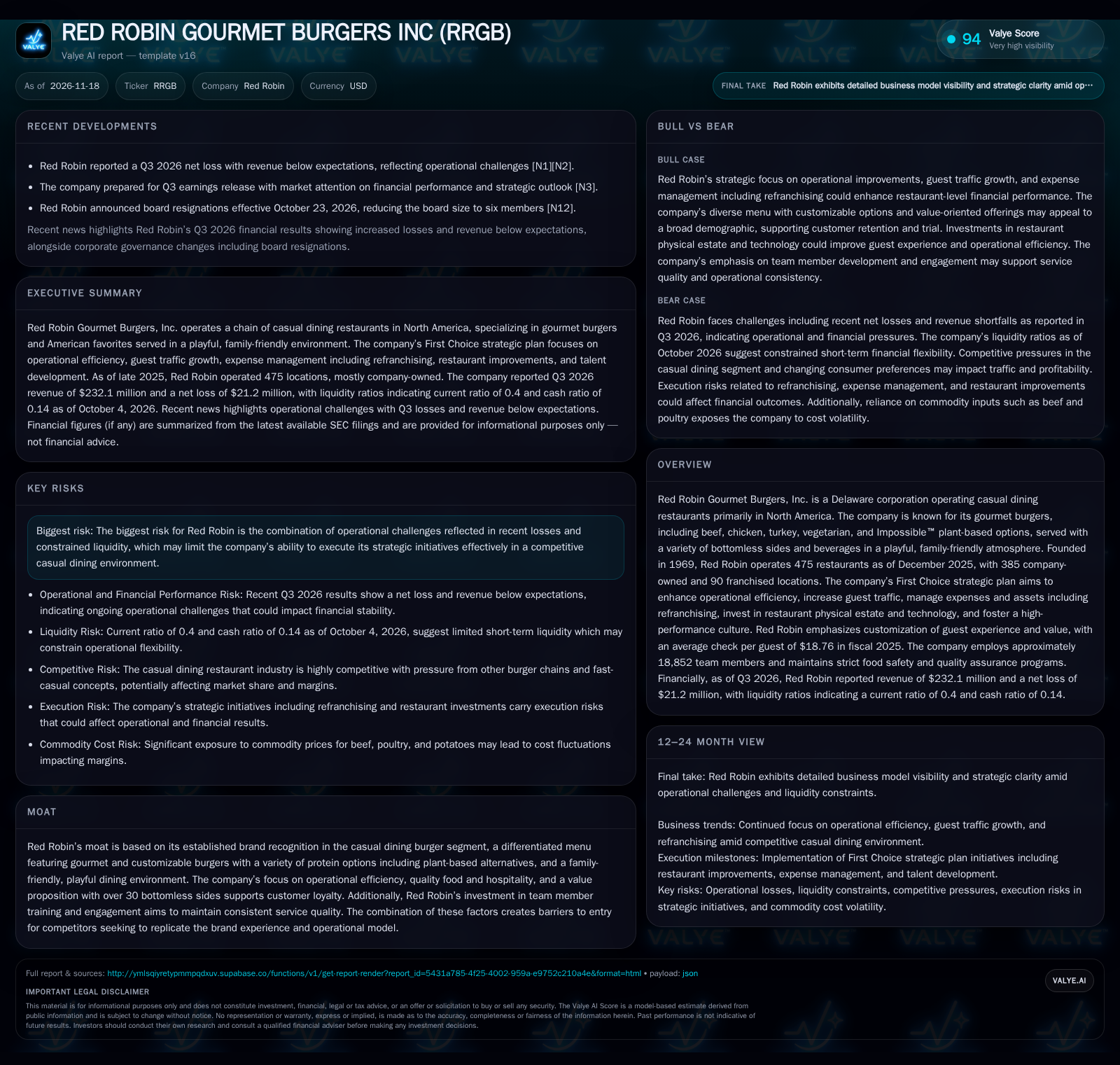
Red Robin reported a Q3 2026 net loss of $21.2 million on revenue of $232.1 million, missing expectations and highlighting ongoing operational challenges. Liquidity ratios are weak, with a current ratio of 0.4 and cash ratio of 0.14 as of October 4, 2026. The First Choice strategy targets efficiency, guest traffic, and refranchising, but execution risk is heightened by a shrinking board and competitive threats. Sustained losses and limited flexibility put pressure on swift, effective strategic action. [S2] [N1] [N2]
Red Robin Gourmet Burgers, once a staple of the casual dining landscape, is at a crossroads. The company’s Q3 2026 results—marked by a $21.2 million net loss and revenue shortfall—underscore the urgency behind its ongoing First Choice turnaround strategy. With liquidity ratios flagging and leadership in flux after board resignations, Red Robin must execute on operational and menu innovation in a fiercely competitive environment. The next chapter hinges on whether efficiency gains, refranchising, and customer experience upgrades can overcome deep-seated industry challenges and internal headwinds.
Recent Losses, Liquidity Strain, and Board Turbulence Shape the Near-Term Outlook
Red Robin reported a net loss of $21.2 million on revenue of $232.1 million for Q3 2026, falling short of expectations and highlighting persistent operational challenges [S2] [N1] [N2]. [S2] Compounding these pressures, the company recently saw board resignations that reduced its board size to six, potentially impacting strategic oversight and continuity. These developments collectively amplify execution risk and raise the stakes for the First Choice strategy in the months ahead.
How Red Robin’s Revenue Model and Cost Structure Amplify Operating Leverage
Red Robin’s economics are driven by a combination of check size, guest traffic, and menu mix, with an average check per guest of $18.76 in fiscal 2025—a 5.3% year-over-year increase [S1]. Company-owned restaurants, which make up the majority of locations, expose Red Robin to both the upside of operational improvements and the downside of fixed-cost absorption when traffic lags. Labor, occupancy, and food costs represent the largest variable and semi-fixed expenses, with commodity price fluctuations (notably beef and poultry) directly impacting gross margins.
The First Choice strategy attempts to mitigate cost pressure through operational efficiency and asset management, including refranchising company-owned stores. If successful, refranchising could shift some fixed-cost risk off Red Robin’s balance sheet and provide upfront cash, but it may also reduce ongoing revenue and operational control. Investments in technology and physical upgrades are intended to support guest experience and potentially drive higher average checks, but require capital outlays at a time when liquidity is already stretched. The company’s scale allows for some purchasing power, but not to the extent of the largest quick-service chains, so margin expansion is likely to depend on both cost discipline and traffic recovery.
Differentiation, Menu Innovation, and the Pressures of a Crowded Casual Dining Field
Red Robin’s competitive positioning centers on its brand recognition in the family-friendly, gourmet burger space, with menu breadth—hand-pressed burgers, plant-based options, and over 30 bottomless sides—intended to drive both trial and repeat visits [S1]. Customization and value are emphasized to differentiate from both fast-casual and traditional burger competitors.
However, the casual dining segment is intensely competitive, facing encroachment from fast-casual chains (which offer faster service and comparable quality at lower price points) and digital-native delivery platforms. Red Robin’s ability to defend share will likely rest on its ability to deliver a consistently superior in-restaurant experience, innovate on menu and value, and maintain cost competitiveness. The company’s investments in team member training and engagement may support service quality, but high labor turnover and rising wage costs remain sector-wide headwinds. Without clear evidence of superior retention, pricing power, or customer frequency, Red Robin’s differentiation could be vulnerable to both shifting consumer preferences and aggressive discounting by peers.
If Operational Reforms Spur Traffic and Margin Recovery, a Turnaround Could Take Hold
A favorable scenario for Red Robin would see the First Choice strategy translate into meaningful traffic gains, higher average checks, and improved cost discipline. If investments in restaurant upgrades and technology lead to a measurable lift in guest satisfaction and frequency, the company could recapture lost traffic and leverage its fixed-cost base for margin expansion. Successful refranchising could inject needed cash and reduce operational risk, while menu innovation (including plant-based and customization options) could attract new customer segments.
Confirmation of this scenario would come from sequential improvements in same-store sales, higher guest counts, and a return to operating profitability. Evidence of declining labor and food costs as a percentage of sales, as well as positive net cash flow, would further validate the turnaround. Alternatively, a failure to achieve sustained traffic or margin gains would falsify this bull case.
Stabilization Hinges on Incremental Traffic Gains and Tight Cost Control
The most plausible near-term outlook is a period of continued volatility, with modest improvements in operational efficiency offset by ongoing competitive and cost pressures. Red Robin may achieve incremental traffic and check gains through menu tweaks and guest experience investments, but labor and commodity cost inflation could limit margin recovery. The company is likely to remain reliant on tight working capital management, and further refranchising may be needed to shore up liquidity.
This scenario would be confirmed by stabilization or slow improvement in same-store sales, a narrowing of operating losses, and maintenance of liquidity levels without additional distress signals. Conversely, a continued decline in guest counts, widening losses, or further deterioration in liquidity would suggest even this middle path is under threat.
Liquidity Crunch and Execution Missteps Could Trigger Deeper Strategic and Financial Stress
The adverse scenario is defined by a failure to stem losses or restore traffic, leading to further erosion of cash and working capital. If operational reforms stall or competitive pressures intensify, Red Robin could face a liquidity crunch that forces asset sales, accelerated refranchising at unattractive terms, or even restructuring negotiations. Board instability and governance gaps could further impede timely, decisive action.
Key confirming evidence would include a rapid decline in available cash, inability to meet near-term obligations, negative trends in same-store sales, or public signals of covenant breaches or emergency financings. Persistent negative operating cash flow with no clear path to stabilization would also validate the downside case.
Milestones That Will Reveal Whether Red Robin’s Turnaround Is Gaining Traction—or Running Out of Time
Same-store sales growth and guest traffic trends, if disclosed, will be crucial for assessing whether menu and service enhancements are driving recovery.
Gross margin and labor cost as a percentage of sales would help test the impact of operational efficiency and commodity cost management.
Progress and terms on refranchising initiatives—including proceeds and impact on ongoing revenue—will illuminate the balance between liquidity needs and operational control.
Board composition stability and evidence of strengthened governance will indicate whether recent resignations are a transitory issue or a sign of deeper oversight instability.
Capital expenditure levels, particularly on restaurant and technology upgrades, should be tracked for alignment with strategic aims and liquidity realities.
Employee turnover and guest satisfaction metrics, if disclosed, would provide early signals of service quality and the effectiveness of training investments.
Disclosure of any new financing arrangements, asset sales, or restructuring actions would signal the severity of liquidity pressures and management’s response.
Disclaimer: This is research-only, informational analysis and not investment advice. It may include AI-generated interpretation and general industry context. Always verify important details using primary sources.

Comments