
WAFD INC: Scale Ambitions, Integration Stakes, and the Economics of Regional Banking Expansion
The company’s focus on commercial lending and active cybersecurity governance frame its strategic direction, yet limited disclosure and sectoral opacity complicate visibility into long-term value creation.
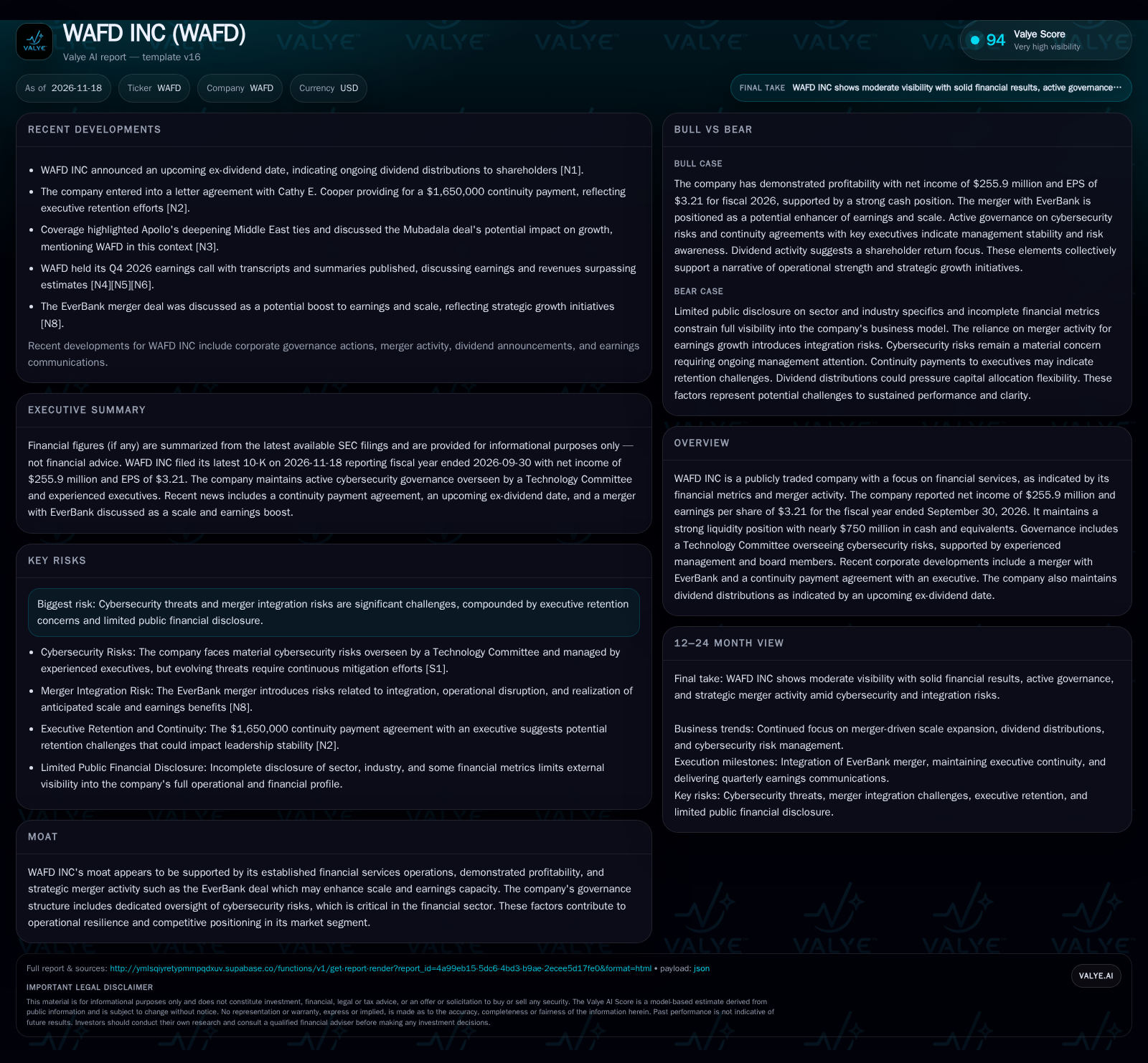
WAFD INC posted $255.9 million in net income and $3.21 in EPS for fiscal 2026, supported by $749.7 million in cash and equivalents [S1]. The company completed a merger with EverBank, aiming to boost scale and earnings [N8]. Executive retention is in focus, as seen in a $1.65 million continuity payment [N2]. Active governance on cybersecurity and regular dividends are additional priorities [S1] [N1]. Integration execution, merger benefits, and risk management are central to the company’s evolving thesis.
WAFD INC’s fiscal 2026 results present the portrait of a profitable, well-capitalized regional financial institution at a strategic crossroads. Recent merger activity with EverBank is positioned to elevate both scale and earnings power, yet the challenge of integration and the need for executive continuity are surfacing as critical watchpoints.
Recent Results and Strategic Actions Reshape the Risk-Reward Balance
WAFD INC reported net income of $255.9 million and earnings per share of $3.21 for the fiscal year ended September 30, 2026, underpinned by $749.7 million in cash and equivalents [S1]. The cited source reports dividend-related activity; that disclosure alone does not establish dividend-policy continuity, management confidence, or a material constraint on capital flexibility. [N1] The completion of the EverBank merger is presented as a catalyst for increased earnings and scale, though it also introduces the complexity of integration and post-merger alignment [N8]. Executive retention is a visible management priority, with a $1.65 million continuity payment to a key executive highlighting the importance of leadership stability during this transition [N2]. These developments collectively mark a phase of both financial strength and heightened execution risk for WAFD.
How WAFD’s Revenue Model and Capital Structure Could Evolve Post-Merger
WAFD’s business economics are fundamentally tied to traditional banking levers: net interest income from lending, fee-based services, and prudent capital management. The company reported cash and liquidity metrics for the period; these figures do not by themselves establish operating runway, investment capacity, financial flexibility, or financing capacity. [S1] The company’s commercial loan originations accounted for 95% of total originations in the nine months ended June 30, 2026 (bounded SEC context), underscoring a strategic focus on commercial lending over consumer [S2]. This mix suggests a higher-margin but potentially higher-risk lending portfolio, as commercial credits are typically more sensitive to economic cycles and require more sophisticated underwriting.
The EverBank merger could alter the revenue and expense structure significantly. If integration is successful, WAFD may benefit from operating leverage—spreading fixed costs over a larger asset base and capturing merger synergies. However, integration costs and potential loan book quality differences could pressure short-term margins. Dividend distributions also compete with internal capital needs, potentially constraining flexibility if merger synergies are delayed. The company’s ongoing investment in cybersecurity governance, while operationally prudent, further adds to fixed overhead.
Beyond the immediate revenue and cost implications, the post-merger capital structure will be pivotal in shaping WAFD’s strategic flexibility. If the merger results in increased leverage, the company may face tighter regulatory capital constraints, which could limit its ability to pursue aggressive loan growth or dividend increases. Conversely, maintaining a conservative capital buffer would support resilience against credit shocks but might temper return on equity metrics. The balance between capital adequacy and growth ambitions will likely influence management’s decisions on risk appetite and capital allocation priorities in the medium term.
Moreover, the composition of the loan portfolio post-merger warrants close attention. If the acquired assets differ materially in credit quality or sector concentration, this could alter the risk profile and provisioning requirements. For instance, a higher concentration in cyclical industries or geographies exposed to economic downturns would necessitate more rigorous risk management and potentially higher loan loss reserves. The effectiveness of underwriting standards harmonization and credit monitoring processes during integration will be critical in mitigating these risks and preserving asset quality.
Competitive Dynamics: Scale, Technology, and Regional Banking Pressures
WAFD operates in a highly competitive regional banking landscape, facing pressure from larger national banks, fintech entrants, and consolidating peers. The EverBank acquisition is a direct response to these structural forces—seeking to build scale and diversify the customer base. However, scale alone does not guarantee competitive advantage; integration success, cost discipline, and customer retention are equally critical.
Technology and cybersecurity are increasingly central to differentiation. WAFD’s board-level Technology Committee and seasoned CISO suggest awareness of escalating cyber risk, but it is unclear if these capabilities translate into superior digital offerings or customer experience [S1]. The bank’s heavy tilt toward commercial lending may offer higher yields, but also exposes it to competitive pricing pressures and credit risk, especially if larger banks or fintechs lower rates or innovate on credit underwriting. Regional concentration, as highlighted in SEC risk disclosures, can amplify the impact of local economic shocks.
In the competitive landscape, WAFD’s ability to leverage technology for operational efficiency and customer engagement will be a differentiator. While the presence of a Technology Committee and experienced cybersecurity leadership indicate governance awareness, the translation of these capabilities into scalable digital platforms or innovative product offerings remains uncertain. Competitors with more advanced digital infrastructures or partnerships with fintech firms may capture market share by offering faster, more personalized services, especially in commercial banking where client expectations are evolving rapidly. WAFD’s strategic investments in technology must therefore balance cybersecurity imperatives with agility and customer-centric innovation.
Additionally, regional economic dynamics and demographic shifts could influence WAFD’s competitive positioning. If the bank’s footprint remains concentrated in areas vulnerable to economic downturns or demographic decline, growth prospects may be constrained despite scale gains. Conversely, diversification into more dynamic markets through the merger could provide a buffer against localized shocks but also introduce unfamiliar competitive challenges. The bank’s capacity to adapt its product mix, pricing strategies, and risk appetite to heterogeneous regional conditions will be essential in sustaining profitability and customer loyalty amid evolving market pressures.
If Integration Delivers: Realizing Earnings Growth and Operational Synergies
The most favorable scenario for WAFD is one where the EverBank merger is smoothly integrated, leading to enhanced earnings power, cost synergies, and improved risk diversification. Successful cross-selling of products to a broader commercial client base could drive fee income and increase lending volumes. If merger integration costs are controlled and customer attrition is minimized, operating leverage could emerge as a key earnings driver—particularly if technology investments result in improved efficiency or digital adoption.
Confirmation of this scenario would come from consistent post-merger earnings growth, rising efficiency ratios, and evidence of expanded customer relationships.
Managing Through Transition: Incremental Growth and Cautious Capital Allocation
The most plausible path is one of gradual integration, with moderate earnings growth as cost synergies and commercial lending expansion are realized over several quarters. Dividend distributions may continue, but any upward revision would likely be deferred until merger synergies are more visible.
Confirmation of this scenario would include steady quarterly earnings, manageable credit losses, and regular updates on integration progress. Management continuity and retention of key commercial clients would help validate the thesis. Conversely, delays in integration milestones, unexpected spikes in non-interest expenses, or deterioration in loan performance would challenge this outlook.
Integration Missteps or Credit Deterioration Could Undermine Value Creation
The adverse scenario would be triggered by significant integration failures—such as technology platform incompatibilities, cultural clashes, or higher-than-expected customer attrition—leading to missed synergy targets and margin compression. An uptick in commercial loan defaults, especially if regional economies weaken, could further erode profitability and capital. Executive departures or ineffective retention efforts could amplify operational disruption.
This scenario would be confirmed by negative earnings surprises, rising non-performing asset ratios, or guidance cuts related to merger execution. Signs of capital strain—such as dividend reductions, capital raises, or regulatory scrutiny—would further validate downside risk. Increased cybersecurity incidents or regulatory penalties tied to data breaches would also escalate costs and reputational damage.
Testing the Post-Merger Thesis: Earnings, Integration, and Risk Markers to Track
Quarterly net income and EPS progression post-merger, as a test of synergy realization and core profitability.
Efficiency ratio trends, which would signal whether cost synergies and operating leverage are materializing.
Commercial loan growth and credit quality metrics, especially in newly acquired or expanded markets.
Non-interest expense levels and one-time integration costs, which could signal execution challenges.
Executive turnover or additional continuity agreements, as a measure of management stability.
Updates on cybersecurity incidents or board-level cyber risk discussions, if disclosed, to assess operational risk management.
Customer retention rates or new account growth following the EverBank integration, if disclosed, to track merger success.
Disclaimer: This is research-only, informational analysis and not investment advice. It may include AI-generated interpretation and general industry context. Always verify important details using primary sources.

Comments